

 A. J. Philip
.jpg)
Myanmar or Burma, as it was called earlier, has always fascinated me. There could be many reasons for it. One could be the fact that my father served in the Burmese sector during the Second World War. As he told me, he was recruited in Kerala, taken to Delhi for some basic training and was, thereafter, sent to Burma to fight in the jungles there.
Not many people know that Burma was at one time part of British India and it was ruled from Calcutta, now Kolkata. By the time the new recruits like my father reached Burma, the country had already been taken over by the Japanese. For once the Burmese realised that the Japanese were worse than the British, though both were Asian.
The British would not have been able to recapture Rangoon but for the support the Burmese forces, led by General Aung San, father of Aung San Suu Kyi, provided to the British. The Japanese invasion of Burma began soon after they bombed Pearl Harbour in the US on December 7, 1941. The attack was so swift that the British could not resist it, let alone prevent it.
Incidentally, General Aung San and his forces were supporting the Japanese in the mistaken belief that it was the only way to send the British packing. Later, realisation dawned on him that a known devil was better than an unknown one.
To cut the story short, my father returned to Kerala as the forces under Field Marshal William Slim reoccupied Rangoon and the highest-ranking Britisher was brought back to his palace in the Capital.
Thereafter, something cataclysmal happened in Rangoon. General Aung San and his comrades-in-arms were brutally killed as he was chairing a meeting of the Governor’s Executive Council. The killers were five men in fatigues who arrived in a jeep at the Governor’s office. Hardly three months had passed since his party won the elections to the Constituent Assembly enabling him to become the great leader, in fact, the father of the nation.
The world would not have known about the killing but for a journalist from India, M Sivaram, who happened to be in Rangoon that day. He was the Southeast Asia correspondent of the international news-agency, Reuters. By the time the military cut Burma off the international communication network, the news had reached the four corners of the world, thanks to his journalistic enterprise.
It was many years later that a similar incident happened in Bangladesh when the father of the nation, Sheikh Mujibur Rahman, and his family were killed in a successful coup attempt.
As providence would have it, it was a relatively unknown leader, U Nu, who succeeded the charismatic general. Soon, he became very popular in the country as he was considered a thorough gentleman with a cherubic face. He was also a deeply religious person. In a country where Buddhism is almost the state religion, U Nu approximated the ideal leader. He remained Prime Minister from January 1948 to 1962, though with some gaps.
U Nu could not continue in power as the military led by General Ne Win grabbed power in a coup. Killing the venerable leader would have been suicidal for the generals. They allowed him to accept Nehru’s hospitality on the condition that he would not influence politics in Burma in any manner while he remained in exile.
For many years, U Nu lived almost incognito in a bungalow allotted to him at Bhopal. One of the persons with whom he remained in touch during his exile was KP Narayanan, editor of the MP Chronicle. He helped me to interview U Nu in 1980 when he was allowed to return to Myanmar on the condition that he would not dabble in politics.
U Nu was extremely careful while talking to me. He refused to speak a word about Burma while he remained garrulous about Buddhism. He was also prolific in thanking the Indian government for making his life comfortable in the city of lakes. It was not a new practice to send an inconvenient Burmese leader to India. When the British defeated King Theebaw Min, the last Burmese King, and seized power, he and his queen Supalaya were sent to India.
Similarly, when the last Moghul ruler, Bahadur Shah Zafar, was dethroned, he was exiled to Burma where he lies buried. When my son visited Burma a few years ago, one request I made to him was to take a picture of his tomb and send it to me.
There was another famous person whom Gen Ne Win had sent to India. She was Ma Khim Kyi, mother of Aung San Suu Kyi, and wife of General Aung San. She was posted in New Delhi as Burma’s Ambassador. It was the first time Burma appointed a woman as Ambassador.
The General just wanted her to be away from Burma so that she did not become a threat to the military rule. Prime Minister Jawaharlal Nehru was only too happy to provide a helping hand to her. He had fond memories of meeting General Aung San in Delhi before he left for London for the talks that paved the way for transfer of power in Burma. She was accompanied by her daughter and one of her sons.
The bungalow at 24, Akbar Road, which today serves as the Congress office and residence of party chief Sonia Gandhi and son Rahul Gandhi was where the Burmese ambassador and family stayed. It was at that time known as the Burma House. Aung San Suu Kyi studied at Jesus and Mary School, near the Cathedral Church and, subsequently, at Lady Shri Ram College.
While I was a school student, one of the questions often asked in general knowledge tests was: Which country was the world’s largest producer of rice? The answer was Burma. It was one of the richest countries in the world, mainly because of timber, agricultural produce and natural resources.
As Gen Ne Win consolidated his position as the undisputed leader, Burma began to slide into poverty. At one time, the Burmese government made a lot of efforts to convince the United Nations that Burma was “one of the least developed nations” so that it could get some extra benefit.
The General was such a cruel person that when U Thant, the third Secretary-General of the United Nations, died and his body was brought to Rangoon for funeral, the government did everything possible to harass the family.
The police also registered a case against the family for bringing the body to Burma without seeking and obtaining the permission of the government. What antagonised the regime was a Press conference U Nu addressed at U Thant’s house condemning the military rule.
The Army never allowed democracy to flourish in the country. In the 1947 elections to the Constituent Assembly, General Aung San’s party won 248 out of 255 seats. I have already mentioned what happened to the General and six of his ministerial colleagues.
As U Nu failed to tame the military, Aung San Suu Kyi remained abroad and fell in love with a Britisher, Michael Aris, and they had two children. She had earlier spent time at the Institute of Advanced Studies at Shimla where her thesis was on how colonialism impacted India and Burma. She concluded that while India and Indians benefited from the British systems and practices, colonialism had no such beneficial influence on Burma.
The military junta considered her marriage to a foreigner and her stay in Britain as a Godsend. They would have been happier if she had remained there. Unfortunately for them, her mother had a stroke and was admitted to the same hospital where she, as a medical nurse, had met General Aug San and had fallen in love with him.
She decided to return to Burma to take care of her mother when she needed her service the most. She was always conscious of the fact that she was the daughter of General Aung San. Gradually, she got caught in the vortex of politics. The government characterised her as a western girl, a showpiece and a good-for-nothing person.
As she increasingly played a role in the country’s affairs, she was put under house arrest. Her long incarceration is often compared to the time Nelson Mandela spent in a jail on Robber Island. However, there was one fundamental difference between the two cases.
While Mandela had no freedom to come out of the jail, the military junta wanted her to leave the country so that she could attend to the needs of her family, especially when her husband suffered from an incurable disease. The regime made it clear that it would not allow her to return to Burma.
When elections were held in 1990, her party, the National League for Democracy (NLD) won 94 per cent of the seats. Yet, the junta refused to hand over power to the party. She remained in house arrest. When elections were held in 2010, her party was not allowed to contest. The Nobel Peace Prize she won was actually a slap in the face of the military regime. She became a prisoner of conscience. Writers and admirers of Aung San Suu Kyi began to compare her to Mahatma Gandhi.
Ultimately, under a new Constitution, elections were held five years later in which her party won a clear majority. Alas, under a law enacted specifically to deny the country’s leadership to her, anyone who had a foreigner as his or her spouse was not allowed to become the President.
Under the Army-drafted Constitution, one-quarter of seats in Parliament were reserved for the defence forces. Not only that, three key ministerial posts, including defence, were reserved for the military. Thus, the levers of power remained strongly in the hands of the Army. The Army also runs many companies and corporations in the country.
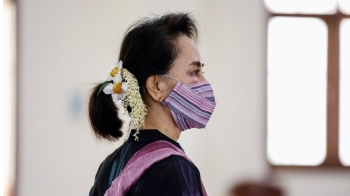
The NLD won 80 per cent of the seats in the elections held in November last. The military has been questioning the results on the specious ground that the election was not fair. Those who knew the ways of the military knew that a coup d’etat was in the making. And that is exactly what happened when Aung San Suu Kyi was put under house arrest and the military finished the facade of democracy.
While the whole democratic world has condemned the military takeover, Senior General Aung Hlaing has reason to be happy that China has extended support preventing the UN Security Council from condemning the coup. Alas, the image of Aung San Suu Kyi is no longer the same.
She stands condemned in the bar of public opinion for her role in the torture of the Rohingya Muslims. She was not ready to condemn the manner in which the majority community carried out a genocide against them. Tens of thousands of Rohingyas were forced to leave Myanmar to find themselves unwelcome in countries like Bangladesh and India.
The condition in which some of them live in India is so pathetic that words are insufficient to describe it. Anybody who comes forward to assist them will face the ire of the government. Instead of condemning the genocide, Aung San Suu Kyi went all the way to the International Court of Justice at the Hague in the Netherlands to claim that nothing wrong was done to the Rohingya Muslims.
In contrast, Mahatma Gandhi had sacrificed his life to support the demand that Pakistan be paid whatever was due to it under the terms of the Partition. Also, Nehru had gone out of the way to protect the Muslim refugees in Delhi from the anger of the Hindu refugees who had come to the city from what is today Pakistan.
Alas, Aung San Suu Kyi wanted the support of the majority community which she received in the November elections. In the process, she lost her shine. She is no longer the hope of the world. Therein lies the tragedy of Myanmar!
.jpg)
.png) Cedric Prakash
Cedric Prakash
 ICPA
ICPA
 ICPA
ICPA
 ICPA
ICPA
 ICPA
ICPA
 ICPA
ICPA
 ICPA
ICPA
.jpg) A. J. Philip
A. J. Philip
.jpg)
.png) Jacob Peenikaparambil
Jacob Peenikaparambil
.jpg)
.png) John Dayal
John Dayal