

 P. A. Chacko
Octogenarian Jesuit priest, Fr. Stan Swami, of Jamshedpur Jesuit Province, was picked up by NIA on 8th October from his office cum residence at Namkum in Ranchi ‘for questioning.’ He was told that a senior officer at the NIA office in Ranchi wanted to meet him. At the office he was arrested without any warrant. On 9th morning he was taken to Mumbai for further proceedings.
The allegation against Fr. Stan was that he had links with Maoists and banned organisations. Taking him to Mumbai points to the ongoing investigation into the 2018 Bhima Koregaon case in Maharashtra. It is pertinent to note that nationally reputed social activists and critics like poet Varvara Rao, advocate Sudha Bhradwaj, academic Vernon Gonsalves, and human rights activists Arun Ferreira and Gautam Navalka were arrested last year in connection with the Bhima Koregaon case. Denied bail, they are undergoing incarceration in Maharashtra
.
Father Swamy says the current NIA investigation of him “has nothing to do about Bhima-Koregaon case” where he has been booked as a “suspected-accused.” The agency raided his residence on August 28, 2018, and June 12, 2019, and took away his belongings, including his computer and internet modem. He was forced to give his email and FB passwords. They changed the passwords and seized the related accounts.Prior to his arrest on 8 October, he was summoned to go to Mumbai for questioning. He informed the Agency that he had already undergone a 15 hour questioning and that he could not travel to Mumbai because of his advanced age and the coronavirus pandemic ravaging India.
NIA is a central government agency created on Nov 26, 2008 to deal with terror related crimes all over the nation and is understood to function as the government’s ‘counter terrorism law enforcement agency.’
What is the mystery behind the octogenarian priest’s arrest?
Father Swamy is a suspect in the eyes of the Central government. It wants to implicate him with Bhima Koregaon violence case and accuse him of links with terror groups like Maoists. He has categorically denied any such involvement. According to him, NIA made him undergo a 15 hour investigation on July 27, 28, 29, 30 and August 6. The agency placed before him “several extracts allegedly taken from my computer implicating my connection to Maoist forces... I told them all these are fabrications stealthily put into my computer and I disowned them.” So, he sees something cynical in all this. Fabricate evidence and implicate falsely.
One thing is clear. Fr. Stan Swami is a nationally known figure. His stand for justice and advocacy of human rights and against rights violations have marked him as ground level social activist. As the Director of the Indian Social institute in Bangalore in nineteen eighties he had proved himself as a champion of human rights especially of the weaker sections like the Dalits and the Adivasis.
After his engagement in Bangalore, his moving on to Jharkhand was because he belongs to a Jesuit Province in Jharkhand. There he took to defending the rights of Adivasis and underprivileged groups. His involvement in Jharkhand is well described by Jharkhand Janadhikar Mahasabha, a rights group: ‘Stan works for the rights of Adivasis and other underprivileged groups in the state. Among other issues, he works on displacement, corporate loot of resources, the condition of under-trials and PESA. Stan has been a vocal critic of the government’s attempts to amend land laws and the land acquisition act in Jharkhand, and a strong advocate of the Forest Rights Act, PESA and related laws. He is an exceptionally gentle, honest and public-spirited person. Jharkhand Janadhikar Mahasabha has the highest regard for him and his work.’ (Statement issued on 12.06.2019)
Thus, in the process of his activities, Stan swami has incurred the wrath of the government and the capitalist forces who find Jharkhand a fertile ground for ‘corporate loot.’ His rights-related advocacy for Adivasi under-trials in Forest Act and PESA-related cases has not gone down well with the government. Responding to the harassment he was made to undergo, Stan was said to have quipped a sentence from Khalil Gibran “Life and death are one, even as the river and the sea are one.’ Brave words of a socially committed person!
Given the present situation in the country, anyone airing a critical opinion on the government or advocates rights and freedoms of the exploited masses is bound to be tagged as collaborator to terrorism.
The situation is getting more sinister like clamping terrorism- related cases on journalists who went to visit Hathras village recently in the rape-related incident.
No wonder, the European Parliament has taken serious note of the vicious environment in India. The Parliament’s Sub-committee on Human Rights urged the Narendra Modi government to meet its pledge to promote and protect human rights.
The Chief of the Panel, Maria Arena stated that journalists and peaceful critics were being arrested under “draconian counter-terrorism and sedition laws.” She condemned the targeting of human rights activists.Reacting to Stan swami’s arrest, John Dayal, nationally reputed journalist and rights activist, stated on Facebook, ‘In a way, every human rights activist is connected with Elgarr Parishad (Bhima Koregaon) case.Anger is building up in Jharkhand against the arrest of Fr. Stan Swami. Jharkhandi Adivasi, Francis Xavier Soren, has spelt out succinctly his people’s anger and revulsion: “Down with the govt’s witch- hunting and tyranny.’(FB)
The Forum for Justice and Peace, Jharkhand, condemned the NIA action. “We, the members of the Forum for Justice and Peace, strongly and unequivocally condemn the fact that Stan Swami, a Jesuit priest has been taken into custody by NIA. The inhuman treatment of an 83 year old frail and peace-loving citizen of India, who has given his life in the service of the Adivasis and other marginalised sections of society, speaks volumes of the deterioration of the democratic ethos in the country...We also demand the immediate and unconditional release of all human rights defenders and other dissenters who have been illegally detained and incarcerated for the last several months.”
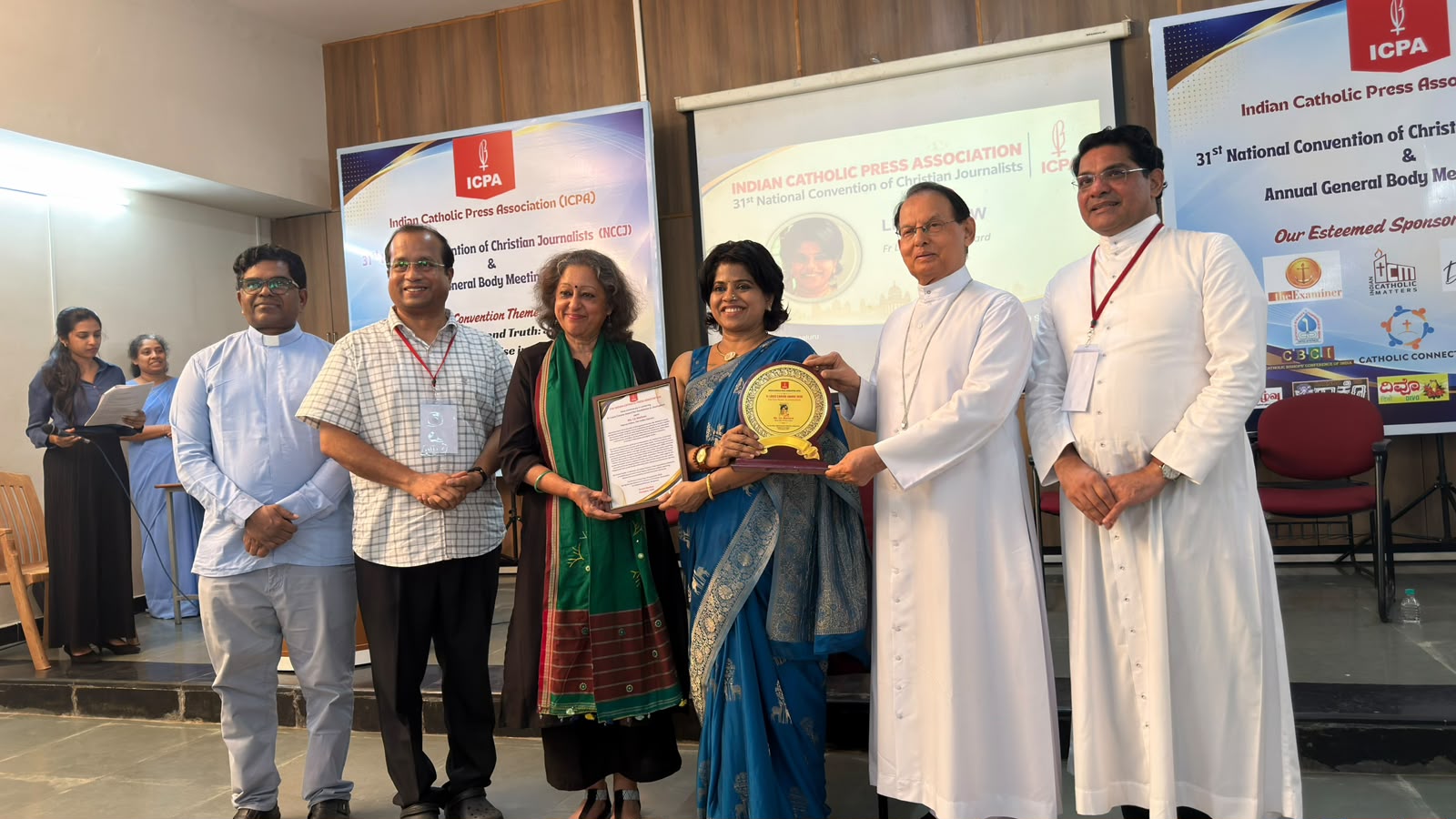
The Indian Catholic Press Association (ICPA) condemned the arrest of Fr. Stan Swamy in the following words: “Fr. Swamy’s arrest is nothing but a part of the strategy to throttle voices of dissent; it is outright infringement of civil liberties and yet another example of vindictiveness on the part of the investigating agencies.”
The PUCL (People’s Union for Civil Liberties) extending support to Fr Stan said, “The true reason for NIA arresting Fr. Stan Swamy today is because he had dared to expose the large scale abuse of anti-terror and sedition laws by the previous BJP-led Jharkhand government. Thousands of Adivasis were falsely implicated and arrested for exercising their fundamental right of protest in the Pathalgadi movement and kept in prison without hearing. Fr. Stan’s meticulous documentation of the untold suffering experienced by Adivasi youth, hundreds of whom were imprisoned for no offence at all, earned the ire of the police and the State which launched a witch hunt against Fr. Stan and some others in the human rights movement in Jharkhand. The data analysis of thousands of adivasis arbitrarily arrested by the police was also put in an affidavit in a PIL filed before the Jharkhand High Court which upset the Government.”
Meanwhile Fr George Pattery, the President of the Jesuit Conference of South Asia demanded the immediate release of Fr Stan Swamy. The wave of anger is on the rise not just because a priest is arrested, but because the nation is being dragged down to the trenches of state-sponsored terrorism on the poor, the marginalised, the Dalits and the Adivasis. The behest of the capitalist conglomerate and the majoritarian religious fundamentalism, coupled with skewed nationalism, are on the rise to counter any form of dissent.
.jpg)
.png) Cedric Prakash
Cedric Prakash
 ICPA
ICPA
 ICPA
ICPA
 ICPA
ICPA
 ICPA
ICPA
 ICPA
ICPA
 ICPA
ICPA
.jpg)
 A. J. Philip
.jpg)
.png) Jacob Peenikaparambil
Jacob Peenikaparambil
.jpg)
.png) John Dayal
John Dayal