

.jpg) Balvinder
Balvinder
Books, they say, are the best stress-relievers. And the books that talk about arts, perhaps, are the best bait in this regard.
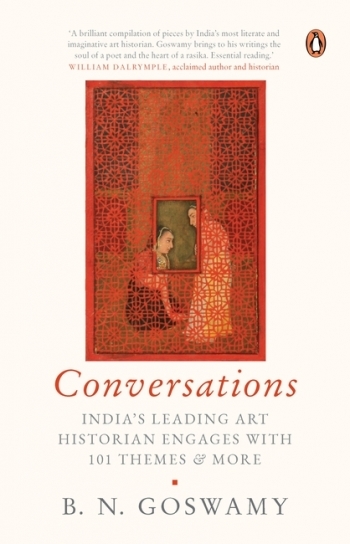
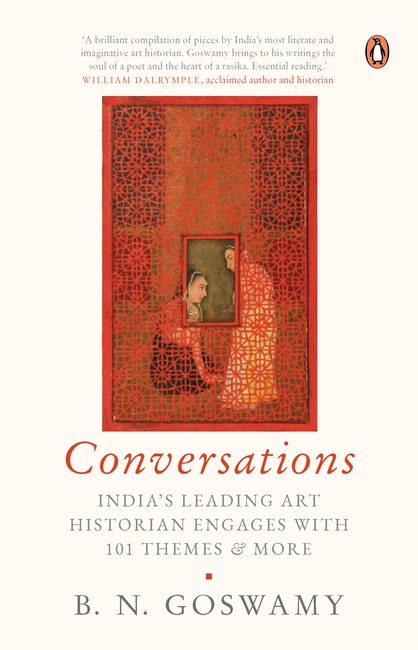
A recently published book by Dr B N Goswamy, an internationally acclaimed art historian, serves this purpose very well.
We know that the ancient India had the evil eye of foreign looters who have been invading India more than often. Due to the geographical location of Punjab, it had to face the brutal attacks of all those looters first. That is why the political history of Punjab has always been turbulent from the very beginning.
But it is to be commended that even during such an uncomfortable environment, the courageous and kind-hearted Punjabis not only preserved their creative and artistic skills, in every field of arts, but also kept adding new dimensions to them.
The contribution of many local and foreign historians in compiling the history of various artistic aspects of United Punjab has been invaluable.
Dr. B.N. Goswami's name, who specialises in visual art history, is prominent and unique in the list of all these historians.
To begin with, he daringly entered into the fold of a then dull-looking teaching profession by stepping down from a plum administrative post to examine and evaluate various aspects of the history of local visual arts with a keen eagle-like vision.
For the first time in this region, apart from establishing an exclusive Department of Art-History at the Panjab University, Dr Goswamy also set up an art museum here, exclusively housing contemporary art works.
So far, he has written some 25 books on various aspects of art, which are internationally recognised. Due to these achievements, he has received many national and international awards, including the most prestigious Padma Shri and Padma Bhushan.
In the early days of Dr. Goswamy’s long journey, he made valuable contributions as an art critic of The Tribune, an old and well-known in the Northern region daily, for many years. As a result, he not only enumerated local artistic events but also made several successful attempts to guide and encourage the emerging young artists.
In addition to his research papers and books on art history, Dr. Goswami started, in 1995, a bi-weekly column in The Tribune which continues to this day. In this column, he expanded the range of art to make the historical and social aspects of art more interesting and intuitive for the readers, covering varied artistic perspectives of whole of the South Asia.
Dr. Goswamy’s recently published book, titled "Conversation", is a collection of hundred-plus selected articles published in The Tribune. This 600-page illustrated book has been attractively published by Penguin, which Dr. Goswamy has fondly dedicated to his chief source of inspiration, his historian and loveable wife Karuna who breathed her last recently.
The unique articles in this group are private and informal -- philosophical but not planned. They have a loose unity that is both fascinating and interesting representation of varied aspects of art.
These engrossing articles not only shed light on the artistic knowledge in the minds of the readers but also provoke the readers to question, to raise their curiosity to know more.
.jpg) Stanislaus Alla
Stanislaus Alla
.jpg)
.png) Cedric Prakash
Cedric Prakash
.jpg) Elsa Lycias Joel
Elsa Lycias Joel
.jpg)
 A. J. Philip
.png) Jacob Peenikaparambil
Jacob Peenikaparambil
.jpg)
.png) John Dayal
John Dayal
.jpg)
.jpg)
.png) Joseph Maliakan
Joseph Maliakan
.png)
.png) Robert Clements
Robert Clements
.jpg) Cedric Prakash
Cedric Prakash