

.jpg) Dr. M. D. Thomas
Dr. M. D. Thomas
.jpg)
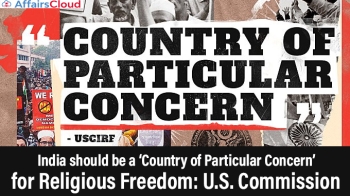
The United States Independent Commission on Religious Freedom (USICRF), in its report released on May 1, 2023, categorized India as ‘a country of particular concern’ for its ‘severe violations of religious freedom or belief’ in the year 2022.
The USICRF, a bipartisan government advisory body created by an Act of the Congress in 1998, in its latest annual report asked the US Congress to take up the issue of religious freedom in India through hearings, briefings, letters and Congressional delegations.
In response, India termed the comment as ‘biased and motivated’, a traditional response without any feeling. To quote, Arindam Bagchi, the spokesman of the federal external affairs ministry, “we reject such misrepresentation of facts, which only serves to discredit the USICRF itself”.
Further, the ministry advised the USICRF to develop a better understanding of India, its plurality, democratic ethos and constitutional mechanisms. This advice is over and above the complaints raised by India in the past as regards the so called attempts to tarnish the image of India.
It is not the first time India scores this merit of a ‘country of particular concern’. It has been doing so for the fourth consecutive years. The USICRF report in 2023 states, ‘conditions of religious freedom in India continue to worsen in 2022’. The worsening situation is a matter of grave concern, which India is either slow to realize or is refusing to admit.
A ‘country of particular concern’ is a designation for a nation engaged in severe violations of religious freedom under International Religious Freedom Alliance, which is a network of like-minded countries fully committed to the Declaration of Principles for advancing freedom of religion or belief around the world.
Imposing anti-conversion laws in 10 States, attacking Churches and Christians, mob-lynching of Muslims in the pretext of cow slaughter, targeting human rights defenders and media persons, and the like are proofs for the brutal attacks on religious freedom. India seems to conveniently close the eyes at these foul instances and thus play the fool, by habit so, in view of a false and goody-goody image.
The bone of contention here is the contradiction between theory and practice. The theory of India is the deafening ‘self-talk’ about becoming the ‘vishwa guru’, super power, saare jahaan se achha, and the like. The practice is its utter failing in some of the basic lessons of life, like waste management, along with aping the west in almost everything in the name of development. This discrepancy is a matter of ‘particular concern’, too.
It is true that India is a land of ‘diversity’, more so than perhaps the entire world. But, the breakdown in honouring and learning from differences, the time-to-time frictions and crack down between groups, the difficulties in knitting together as a nation, the majoritarian ‘hindutva’ politics, the change of history books, the blatant half truths and full lies in the public space, etc. pose a major question at the unity and integrity of the country. This is a point of particular concern, as well.
Yet again, India is the largest democracy in the world, considering the vote bank. But the undemocratic way of politicians easily jumping over to other parities, lack of democracy in the social and economic arenas, the chunk of the population being poor, like ‘bheedchaal’ (crowd-like following) and ‘bhedchaal’ (sheep-like following), and the autocratic way of capturing the autonomous institutions squarely stare at the real spirit of democracy. This is another matter of particular concern.
India has a Constitution that is one of the best in the world. Its Preamble contains an amalgam of human values of the supreme order, very much in a condensed form. But, the blatant violation of the Constitutional values in the system of governance as well as the failure in measuring out justice to the citizens and communities make a topsy-turvy of the values of the Constitution, shockingly so. This is yet another particular concern.
The discredit of ‘particular concern’ the country has earned is not only in the area of religious freedom, but also of caste, gender, ideology, food habits, dress patterns and other socio-cultural realities. Considerations of high and low in caste, familiar and strange, rich and poor, of this religion and that religion, and the like, challenge the very fabric of clicking together with fellowship as a nation.
In addition, India never tires shouting on the top of its voice that it is a ‘religious country’. But, in point of fact, the Himalayan heap of superstitions, ceremonial rituals, theological abstractions, myths and stories, pilgrimages and the like, hardly make any impact in life. The sheer lack of ethics in life, as against the time, energy and money spent in the name of religion, is a matter of ‘particular concern’ in India.
Well, ‘particular concern’ is symbolic of a pathological state of affairs. It is like being on the ‘ventilator’, supported by an artificial supply of oxygen. How long can a country survive as a ‘country of particular concern’, that too, a country restlessly aspiring for securing a permanent membership in the United States Security Council? How could India ever realize the dream or slogan ‘21st century is for India’?
It is high time India should look into the mirror, secure a correct self-understanding and do the necessary homework for improving its look, for oneself and for the entire world. I believe, G 20 is a great occasion for India to achieve an awareness of ‘who’s who’, while global leaders meet and international concerns come to the table, along with the required alterations in policy and practice.
‘Religious freedom’ is granted by the Constitution of India. The government, may it be of any political party, has no business to meddle with its provisions. It is the primary duty of all governments, of the Centre and of the States alike, to enforce the same. Playing the fool by stating that it is an ‘internal matter’ will only risk India being dumped into the category of a ‘country of particular concern’. I believe, this state of affairs has to end, sooner the better, in view of enhancing the global image as well as well-being at home.
(The writer is Director, Institute of Harmony and Peace Studies, New Delhi. He can be contacted at ‘mdthomas53@gmail,com’)
.jpg)
 A. J. Philip
.png) Cedric Prakash
Cedric Prakash
.jpg)
 P. A. Chacko
.jpg)
.jpg)
.jpg) Thomas Menamparampil
Thomas Menamparampil
.png)
.png)
.png) Robert Clements
Robert Clements
.jpg)
.png)
.png) Chhotebhai
Chhotebhai