

.png) Jacob Peenikaparambil
Jacob Peenikaparambil
People generally do not speak ill of a person after his death, however bad he/she was during life-time. But celebrating the coldblooded murder of individuals by a section of people shows that something horrible is happening to our society. In the words of social activist and academician Apoorvanand, “It is a symptom of a deep disease that has taken root within that section of society. A disease of bloodlust. Is the rest of Indian society worried about it? Are the sick even aware of their sickness?”
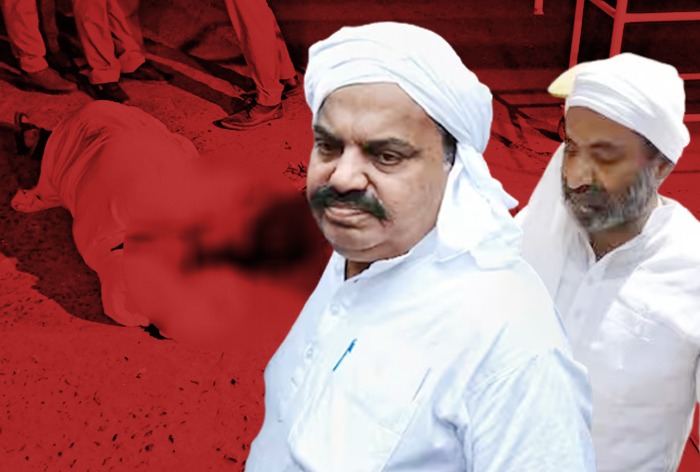
When the TV channels flashed the gruesome murder of gangster-politician Atiq Ahmed and his brother Ashraf in a police cordon in Prayagraj on the night of April 15, some people celebrated it. It was reported in the media that the members of the Bharatiya Janata Party’s youth wing celebrated it by bursting crackers. My neighbour with whom I go for morning walk appreciated the way the murder was systematically planned and meticulously executed. “It is good that he is killed”, he said with a lot of satisfaction. He could be representing the views of many who are brainwashed by the Hindutva ideology. The so-called educated people swallow what is being dished out by the godi media without any critical thinking.
The response of two ministers of Yogi Adityanath Cabinet to the horrible murder raises suspicion. One of them has called it the result of “karma”! Another minister termed it divine justice. The Chief Minister has ordered a judicial enquiry by a three-member team. Will an enquiry committee ordered by the Chief Minister bring out the truth and bring the real culprits to book? Since 2017, as many as 183 encounter killings or extrajudicial deaths have taken place in UP, and the list includes the son of Atiq Ahmed and his associate who were gunned down in Jhansi two days before the killing of Atiq and his brother. A few days ago, the UP Chief Minister made a statement in the Assembly that he would bring the mafia to the ground. Against this backdrop, the gruesome killing of Atiq and Ashraf needs a thorough and impartial investigation monitored by the Supreme Court.
The cold-blooded murder of the two from a point-blank range, in the presence of armed policemen, leaves many questions unanswered. First of all, there are two different versions regarding the reasons for medical check-up. According to one version, the two brothers were taken to hospital for medical check-up as per the legal requirement. An arrested person in police custody is to be taken for medical check-up before being produced in the court. But in this case, the two brothers were taken for medical check-up at an odd time, 10 pm on April 15. It is quite unusual to take the accused persons for medical check-up at night. Atiq and Ashraf were on a four-day police remand in the Umesh Pal murder case.
According to another version given by the police, Atiq and Ashraf complained of uneasiness and a team of policemen, headed by SHO Maurya, took them to Moti Lal Nehru Zonal Hospital for medical check-up. A question arises how both brothers complained of uneasiness at the same time. The story appears to be unbelievable.
As reported in the media, there was enough space before the hospital for parking the police vehicle in which the accused were taken. But instead of taking them till the hospital entrance in an ambulance, they were paraded to the hospital on foot. It was a serious lapse on the part of the Police to make high-profile criminals walk, exposing them to high risk. What was the need for allowing the journalists to take bites from the accused? The assailants, because of the police’s lapse, were able to disguise themselves as journalists and could shoot at the duo from a close range.
Another security lapse from the part of the Police was their failure to check and verify the ID of the journalists while allowing them to interact with the accused. The three assailants had false IDs of journalists and a camera.
Yet another security lapse pointed out by many is that the police force of 20 was quite inadequate, taking into account the serious threats Atiq Ahmad had faced. Secondly, the killers fired as many as 20 rounds, but not a single bullet was fired by the policemen. Atiq and Ashraf fell to the ground. The visuals show the shooters closing in raining bullets on them. Still, not a shot was fired by the cops.
It is to be remembered that Atiq Ahmed himself had pleaded in the Supreme Court for security, apprehending his own murder. The SC refused to hear him. It said that he was under the protection of the state. The fear of Atiq turned out to be true on 15th April night. The state miserably failed to protect him.
The video of the murder circulated on social media shows that the murderers -- identified as Arun Maurya, Lovelesh Tiwari and Sunny Singh -- were shouting the slogan, “Jai Shri Ram”. The three assailants, after completing their task without any resistance from the police force present on the spot, surrendered to the police.
Invoking Lord Ram’s name has become a shield for criminals these days, especially if the victim of the murder is a Muslim. The violence committed against Muslims is usually condoned if the perpetrators of the crime shout the slogan “Jai Shri Ram”. Were the killers, by identifying themselves with this slogan, communicating the message that they committed the twin murder on behalf of those who believe in this slogan, asked Apoorvanand in his article in The Wire?
Some political observers are questioning the timing of the murders. According to them, the murder was organized to divert the attention of the explosive expose by Satya Pal Malik, the former Governor of Jammu and Kashmir, on the negligence and security lapses regarding Pulwama terror attack. In an interview with Karan Tapper for The Wire, Malik said that the Home Ministry refused to give planes to transport jawans, forcing them to go by road. When he brought this issue to the attention of the Prime Minister, he was told both by the PM and the National Security Advisor Ajit Doval to keep quiet.
What has happened in the murder of Atiq and Ashraf is killing the rule of law. The rule of law states clearly that it is not the task of the government to judge and punish a person; it is the task of the judiciary. The role of the government is to prosecute a person who has committed a crime by following the due process of law and to bring him/her before the court. The encounter deaths or extra judicial killings taking place in UP are a blatant violation of the rule of law. The UP government has the responsibility to arrest a gangster like Atiq Ahmad and present him before the court, but it has no right to eliminate him. "Eliminating crime does not mean killing criminals. The court is there to provide justice,'' Bihar Deputy Chief Minister Tejaswi Yadav said, reacting to the gruesome incident. One of the terrorists, Ajmal Amir Kasab, who was caught in the 2008 Mumbai terrorist attack, was punished only after the due process of law that took about four years.
Rule of law says that no one has the right to take other’s life without recourse to due process of law. Unfortunately, in India, law is applied differently to different groups of people. Criminals, gangsters and even persons who are falsely accused of crimes, belonging to a particular community, are eliminated without following the due process of law.
Equally worrying is the change in the mindset of a large section of Indian society. Hate speeches against Muslims and Christians and taking revenge against them for the presumed crimes committed by their forefathers centuries ago are not only justified but also celebrated. The two communities, particularly Muslims, have become the object of hatred by a large section of Indian society brainwashed by the Hindutva forces. Any violence on them is justified and celebrated and the masterminds of the violence are glorified. Celebration of the ghastly murder of Atiq and Ashraf is the dangerous sign of fascism.
There is no question of justifying the crimes committed by Atiq Ahmad and his family members. According to the UP police, about 100 FIRs are registered against him. There is no doubt those who commit crimes are to be given punishment as per the law of the land. But no government has the right to eliminate anyone accused of crime. If the government becomes the prosecutor and the judge, surely it is a safe road to fascism.
.jpg)
.png) Cedric Prakash
Cedric Prakash
.jpg) Elsa Lycias Joel
Elsa Lycias Joel
.jpg)
 A. J. Philip
 Jacob Peenikaparambil
.jpg)
.png) John Dayal
John Dayal
.jpg)
.jpg)
.png) Joseph Maliakan
Joseph Maliakan
.png)
.png) Robert Clements
Robert Clements
.jpg) Cedric Prakash
Cedric Prakash
 ICPA
ICPA