

.png) Jaswant Kaur
Jaswant Kaur
.jpg)
Ask any youth or school student about their career choice. Most will come up with popular answers like doctor, engineer, teacher, IAS officer, or IPS officer. If one travels to tier-2 and tier-3 cities or rural regions, an additional answer may come up: a government job. Yes, without linking to any specific career stream, job type, or education, most want a "sarkari naukri," just like their parents. The craze for a government job starts as soon as students clear Class 10th or 12th. They don't even wait to complete their higher education.
At a time when several new career options have emerged, students still prefer to become doctors, engineers, teachers, or Sarkari babus, eyeing not only the financial benefits but also the social prestige associated with these professions in the country.
But how many of those aspiring to become doctors, engineers, teachers, or sarkari babus actually fulfil their dreams? Except for a few sporadic stories, most successes come from families who either have enough money or can borrow money to pay hefty fees to the coaching centres that promise them a seat in the colleges to pursue the career of their choice. Of course, not all clear the entrance exams on the first attempt. Many drop mainstream education to give attempt after attempt until they feel it's not worth it.
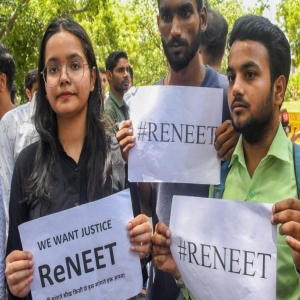
In their struggle to secure a seat in popular medical or engineering colleges or universities, they lose a lot of money and time, yet most of them face huge disappointment. After such an enduring struggle, if one gets to know that the entire process of conducting the entrance exam was rigged, one would feel cheated and frustrated. That's exactly how 24 lakh youth of this country who appeared for NEET this year or nine lakh people appearing for UGC NET might have felt. While the exams were cancelled before the results were announced in the latter case, NEET results certainly raised many eyebrows.
As many as 61 students topped the exam with a perfect score of 720 marks in an exam with negative marking for every wrong answer! This is higher than the number of seats available for admission in AIIMS, New Delhi, the premiere and most sought-after national institution in the field of medicine. Overall, the entire quota of 100,000 students will be consumed by those who scored 80 per cent marks, leaving no room for those who could not get the desired rank.
Unsurprisingly, the National Testing Agency (NTA), the organisation that conducts the exam, has come under scrutiny. The first news of a paper leak came a day before the exam. Media reports suggested that Patna Police had arrested a gang. Patna was not the only place where allegations of question paper leaks cropped up; there were a few other northern states as well. However, the NTA denied all these allegations through a Press release, claiming that the integrity of the exam was maintained prior to the declaration of the results. Besides, multiple FIRs were filed related to impersonation and other malpractices during the exam.
In such a scenario, it is normal to expect the cancellation of exams. However, the NTA not only maintained its stand but also declared the result on June 4 instead of June 14. Additionally, a system of grace marks was introduced overnight, citing a Supreme Court judgment (writ petition 551 of 2018) for the Common Law Admission Test (CLAT) despite the huge difference between the two cases.
The court had devised a normalisation formula for giving grace marks to the students who had lost time during the exam, as the counselling process had started by the time the hearing of the case began. The NTA revealed the process of giving grace marks only when the general public started raising questions about the scores. There was no prior announcement. Reports suggest that 1,586 students were given grace marks, which raises many more questions than answers. Looking back at the previous year's results, 6,803 students secured marks in the range of 650 and above. This year, the number shot up to 21,724, an increase of around 320%!
Apart from this, the way the registration window was opened multiple times before the exam also raised a lot of questions about how the NTA operated. The matter came up for hearing in front of the Supreme Court, which ordered a retest for only 1,536 students. This certainly does not offer any solace to those who won't be able to get admission to any of the government medical colleges, despite several questions raised about the results. The court has insisted that counselling should begin from July 6, despite the next hearing being scheduled for July 8.
Meanwhile, the mastermind behind the NEET paper leak case has admitted that the paper was sold for Rs. 30-32 lakh a day before the exam. The students were given the question paper and the answer sheet and asked to memorise the answers before the exam!
Be that as it may, the fate of 24 lakh students who appeared for the exam with high hopes of getting a seat in their preferred medical college is at stake. The same goes for those who appeared for the UGC NET exam, aspiring to become teachers. The centralisation of these exams has certainly created more trouble than it has solved. The prospects of getting a seat in a medical college are already bleak. If the competition to get into the stream is not fair, what kind of options does a student from a poor socio-economic background, or even a middle-class student from a small town, have?
Well, the recently released "The India Employment Report 2024: Youth Employment, Education, and Skill", published by the International Labour Organisation, offers an answer. The report revealed a glaring mismatch between the educational qualifications and the kind of occupation youth are employed in. There is a huge gap "between the demand for jobs and their supply, leading not only to higher levels of unemployment and longer waiting periods but also to educated youths with a graduate degree or higher readjusting their expectations to take up jobs for which they would otherwise be treated as overqualified."
If this problem is not resolved, our youth may choose to either become part of the informal economy, leave the country, or choose an option that at least takes care of their day-to-day expenses, even if the job requires lower qualifications! A few may choose to open their own enterprises. Small wonder, we have 65 million informal or unincorporated sector enterprises employing 110 million workers, according to the National Sample Survey Organisation's Annual Survey of Unincorporated Sector Enterprises (ASUSE) for 2021-22 and 2022-23.
It is well known that most of these organisations are unincorporated or informal workplaces, which means they won't fall under the purview of legislation like the Employees' Provident Fund Act or the Employees' State Insurance Act. In other words, the workers (if at all they can be called workers legally) employed in such enterprises are highly likely to be paid below minimum wages despite the fact they are contributing a gross added value (GVA) worth Rs. 15.4 lakh crore!
In the name of employment, we would only be creating situations where people are forced to work as bonded labour of sorts! This is certainly not the way we, as a country, should treat our demographic dividend. There is a dire need to overhaul the entire machinery entrusted with securing a bright future for the youth of this country. We certainly need more hands that can be trusted with a lot more confidence and accountability.
.jpg)
.png) Cedric Prakash
Cedric Prakash
 ICPA
ICPA
 ICPA
ICPA
 ICPA
ICPA
 ICPA
ICPA
 ICPA
ICPA
 ICPA
ICPA
.jpg)
 A. J. Philip
.jpg)
.png) Jacob Peenikaparambil
Jacob Peenikaparambil
.jpg)
.png) John Dayal
John Dayal