

.png) Jacob Peenikaparambil
Jacob Peenikaparambil
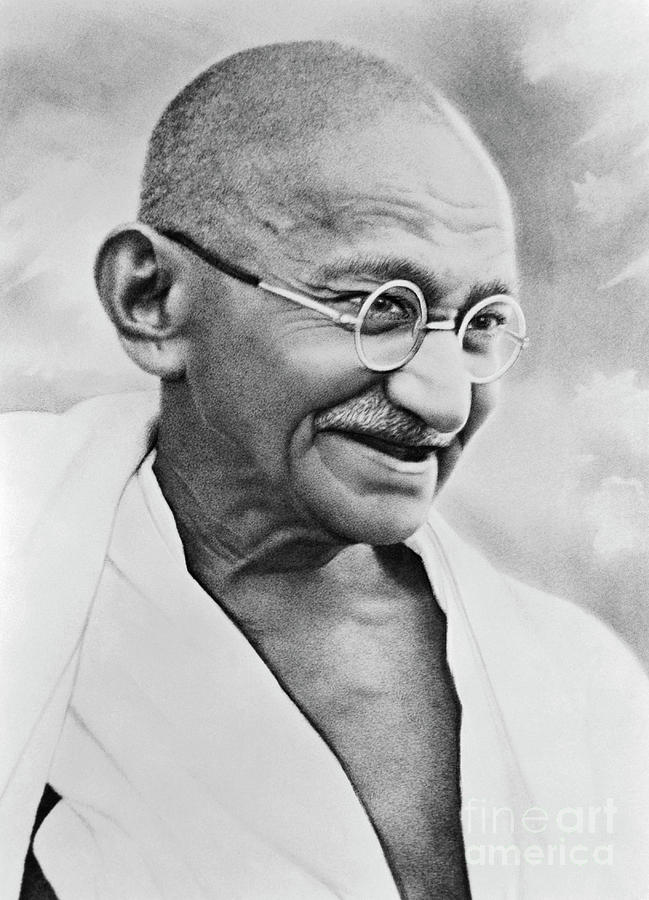
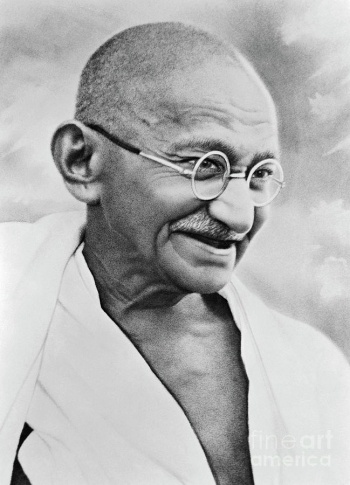
If the proliferation of hate speeches against the minorities, especially Muslims, has been a disturbing trend since 2014, diatribes against Mahatma Gandhi, the father of the nation, have been another distressing phenomenon in India. Mahatma Gandhi appears to be a great threat to the supporters of a particular ideology even after 74 years of his death. Targeting and tarnishing the name of Mahatma Gandhi has been in the DNA of the members of the Sangh Parivar. They have been accusing him of siding with the Muslims and responsible for the partition of India. Praveen Togadia, former International Working President of Vishwa Hindu Parishad (VHP), an affiliated organisation of the RSS, had declared during the height of anti-Muslim riots in Gujarat in 2002 that "terrorism came because Gandhi's ideology is being followed in this country".
There has been a quantum jump in the attacks on Mahatma Gandhi ever since the BJP came to power at the Centre in 2014. Some Sangh Parivar members began to portray Naturam Godse, the assassin of Gandhiji, as a “patriot”. Sakshi Maharaj, a BJP MP from Uttar Pradesh, and Pragya Thakur, the Bhopal MP, had the audacity to describe Naturam Godse as a “patriot”.
In 2019, on the death anniversary of Mahatma Gandhi, Hindu Mahasabha’s National Secretary Puja Shakun Pandey shot an effigy of Mahatma Gandhi with a toy gun and celebrated the day as Shauraya Divas. Anil Viji, a senior minister in the BJP government in Haryana, said that Gandhi’s picture would eventually be phased out of the currency notes. Later he was forced to retract his statement.
The latest slur on Gandhiji was made by Kalicharan Maharaj at a Dharma Sansad in Raipur on 26th December. “Mohandas Karamchand Gandhi destroyed the country and I hail Naturam Godse for his assassination,” said the Maharaj. While the mainstream BJP leaders, especially those holding constitutional posts, avoid openly criticizing Gandhi, the lower-level leaders of the Sangh Parivar continue their vituperative statements against Gandhi.
Besides hate speeches against Gandhi and glorifying his assassin by erecting his statues and building temples for him, efforts are being made to erase Gandhi’s memory from the pages of history. According to some independent political observers, the purpose of Prime Minister Narendra Modi installing a grand statue of Subhas Chandra Bose under the grand canopy near India Gate, built by the British, is more of discrediting the Congress and watering down the role of Mahatma Gandhi as the central figure of the National Movement than honouring Subhas Chandra Bose.
At the inauguration of the hologram of Bose, as a prelude to the installation of the statue, Modi said, “Forgotten heroes are now being remembered”. It is also a part of the strategy of usurping national heroes on the pretext that the Congress neglected them. As the RSS did not take part in the freedom movement, it is in the process of creating a new history of its involvement and leadership in the freedom struggle.
Even though Gandhi was killed physically in 1948, his ideals are alive not only in India but also all over the world. It is true that the majority of the Congressmen and many so called Gandhians have forgotten or dumped Gandhi, but it will be a herculean task to kill Gandhian thoughts. The soul of Gandhi could be following the Hindu right-wing members and pricking their conscience whenever they indulge in hate speech and lynching innocent people for the sake of their ideology. Use of vituperative language against Gandhi could be a natural reaction to calm their conscience.
According to Ramchandra Guha, “the RSS was deeply influenced by two of its ideologues -- Vinayak Damodar Savarkar and Madhav Sadashiva Golwalkar -- and both of them deeply detested Gandhi”. In fact, Savarkar was made an accused in the Gandhi murder case, though eventually he was exonerated of all charges. While Savarkar believed in violence, Gandhi was a pacifist.
Pluralism is one among the most important Gandhian thoughts. Gandhi upheld the coexistence of people belonging to different religions, as he believed that the essence of all religions is one and only their approaches are different. “Our ability to reach unity in diversity will be the beauty and the test of our civilization,” said Gandhi.
On the other hand, the ideology of RSS is to make India a Hindu Rashtra. Golwalkar in his book, “We or Our Nationhood Defined” envisages an India where Muslims and Christians will be treated as second class citizens. For him Muslims, Christians and Communists are “internal threats to the nation”. “The foreign races in Hindusthan must either adopt the Hindu culture and language, must learn to respect and hold in reverence Hindu religion, must entertain no idea but those of the glorification of the Hindu race and culture, i.e., of the Hindu nation and must lose their separate existence to merge in the Hindu race, or may stay in the country, wholly subordinated to the Hindu Nation, claiming nothing, deserving no privileges, far less any preferential treatment — not even citizen’s rights”. (“We or Our Nationhood Defined” by M.S. Golwalkar)
The second reason for the Hindu Right Wing organizations to hate Gandhi could be their opposition to the concept of non-violence. For Gandhi, non-violence and forgiveness were non-negotiable and he used nonviolent resistance and struggle (satyagraha) as a powerful means to liberate India from the slavery of the British rule. Gandhi believed that the “weak can never forgive and forgiveness is the attribute of the strong”. On the other hand, the Sangh Parivar considers that forgiveness and non-violence are the signs of weakness. That is why they present maryada purushottam Sri Ram as a warrior with bow and arrow. They want to take revenge for the wrong doings of the Muslim rulers of India in the past by punishing the Muslim community of today.
It is evident from a quote from the book of Golwalkar that the Sangh Parivar endorses violence ideologically: “To keep up the purity of the Race and its culture, Germany shocked the world by her purging the country of the Semitic Races -- the Jews. Race pride at its highest has been manifested here. Germany has also shown how well nigh impossible it is for Races and cultures, having differences going to the root, to be assimilated into one united whole, a good lesson for us in Hindustan to learn and profit by.”
The haters of Mahatma Gandhi should realize that the best means for ensuring peace and prosperity of any country are the acceptance and practice of pluralism in terms of religion, language, culture, race, ethnicity etc. and non-violent means of conflict resolutions. Diversity is the order of nature and creation. Therefore, imposition of uniformity is a challenge to God, the creator, and an extreme form of arrogance on the part of human beings. It is a recipe for disaster.
Secondly, violence only begets violence. The countries that got independence through the use of violence had to pay a heavy price. Because of the creativity and courage of Gandhi, India was saved from huge loss of human and material resources during the freedom struggle. Violence or war is not an option because of the dangerous volcano of nuclear weapons on which the world is sitting today. Any conflict in any part of the world negatively affects the whole world because of the inter-connectedness. In 2020, the total world military expenditure was about $ 1.981 trillion. India was the third highest military spender after the US and China, according to World Population Review. India’s military expenditure was $72.9 billion in the same year. If this huge amount is used for alleviating the sufferings of people, the world would have been a far better place than what it is today.
If the nations opt for pluralism, a lot of conflicts and bloodshed can be avoided. If they adopt non-violent means of conflict resolution, especially dialogue and mediation, a huge amount of money could be saved and it could be used for the welfare and well-being of their people. Therefore, Mahatma Gandhi and his adherence to pluralism and non-violent means of conflict resolution are very relevant today. Let the commemoration of the martyrdom of Mahatma Gandhi on 30th January bring about an attitudinal change in all those who advocate hatred and violence.
.jpg)
.png) Cedric Prakash
Cedric Prakash
 ICPA
ICPA
 ICPA
ICPA
 ICPA
ICPA
 ICPA
ICPA
 ICPA
ICPA
 ICPA
ICPA
.jpg)
 A. J. Philip
.jpg) Jacob Peenikaparambil
Jacob Peenikaparambil
.jpg)
.png) John Dayal
John Dayal