

 Pachu Menon
.jpg)
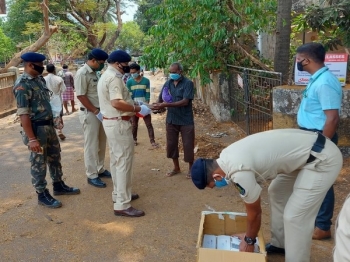
In response to the deteriorating law and order situation in Goa, the Chief Minister has repeatedly said that external elements are solely responsible for the rising crime graph in the region.
Despite reports of criminals from outside the state indulging in nefarious activities emanating from every corner of Goa, the state police force has been an epitome of efficiency, thoroughly meticulous with its policing ways, comments and opinions from various quarters to the contrary notwithstanding.
Monitoring criminal activities in the state, for that matter, has come with its own share of pitfalls for the men in uniform.
Besides the expertise shown by the criminals in evading arrest by the police, their ingenuity at carrying out some of the more sophisticated crimes has cast the force in the mould of perpetual losers who are outsmarted at every turn by the goons.
Despite a track record which maintains the crime detection rate in the state at an exceptional high, the Goa Police seem to flounder every time they are confronted by criminals who are seemingly adept at employing the latest of techniques while commissioning crimes. But the Chief Minister’s claims on the crime scenario in Goa is just a generalization on the state of affairs prevalent and without actually ‘familiarizing’ oneself with the nuances of crime that has the state in its throes, it would be difficult to understand the state’s predicament vis-à-vis the ever-escalating crime rate.
The unchallenged presence of foreign cartels operating from Goan shores is a truth the local police have to come to terms with. Besides the ‘professional’ approach to their clandestine activities, the syndicates are known to have infiltrated police ranks thus compromising preventive actions being planned against them.
As a criminal business ‘enterprise’ which is said to thrive on the corruption existing within the system, it becomes difficult to tackle organized crime with the meagre resources available with the state police. Criminality within the system is indeed a serious problem.
The underworld-politician-police nexus which is clearly visible, and ‘visibly ignored’, could well be attributed to the helplessness of the law enforcement agencies when confronted by typical situations.
With the criminals always managing to stay a step ahead of the police, this argument gains more credence. Moreover, the detection of crime largely depends on an efficient network of informants developed by individual police officers.
Nevertheless, personal egos and professional rivalry have hampered the smooth functioning of police departments across the country and at times senior officers have been at loggerheads with their political bosses over a number of issues.
Classic examples of criminals evading the long arm of justice and cocking a snook at the incompetent ways of the cops are legion.
Moreover, with splinter gangs operating along the fringes of the syndicates, local criminals and gangs find an inevitable place in their larger designs by default.
It is rumoured that Goa is a principal hub of international drug trade, apart from being a known centre of consumption. So, it is obvious that the ‘established’ hubs will have local players being drawn into the ‘business’ as ‘carriers’ and ‘pushers’.
Maintaining very low profiles, foreign cartels operating in Goa have made headlines only when some drug-related crime or death has been reported. But investigations into such matters usually hit a roadblock and are shelved for want of concrete evidence.
Petty crimes and thefts are just not up their alley! Yet, gang wars and murders have become the order of the day in Goa.
While the CM’s “External Elements” implication is rather too vague a definition, it is understood that he is referring to those who come from outside the state and indulge in criminal activities here.
Goa is a highly favoured global tourist destination and while welcoming visitors who are equally in awe of the splendour and serenity of the place, it has also inadvertently thrown the doors open to those with a criminal bent of mind. The ease of moving across the country has also had a detrimental effect on the peaceful ambience of the region.
Felicitating criminals to give shape to their reprehensible plans and moving out of the state in ‘the next train available’, a spate of criminal activities has been sending shockwaves across the state for quite some time now.
Ignorant about the antecedents of those suspected to be involved in the crime, it is usually the modus operandi that has helped police crack seemingly impossible crimes.
Amidst the tumult over these rampant cases, the law enforcement agencies have also had to contend with a case now-and-then attracting a lot of attention and involving influential personalities.
Barring a few stray incidents where they have been conspicuous by their complicity in some sensational crime, the locals by and large have preferred to stay on the right side of the law.
This then brings us to the most relevant question in this context! Is Goa falling prey to the fast-paced development it has been experiencing the last few years!
If the mega-projects which have invited unprecedented presence of a large contingent of men and machines at various sites in the state are not scenes of alarm in themselves, the ever-increasing population of migrant labourers employed in the industrial estates in the state have not been anything less shocking.
However, with a few gruesome murders reported in the state in the recent past bearing the distinct stamp of ‘local’ involvement, many are of the opinion that these disturbing instances have explicitly bridged the ‘outsider-insider classification’.
While citing reasons to justify the rising trend in crimes in the state today, very few will sit back and think of the reasons which lead to lawlessness in the society.
A price-hike of essential commodities which has never shown a logical pattern to it and unemployment among the youth are some of the sure recipes for disaster.
With a setting that reminds one of the dismal situation in Punjab where disillusionment with life has driven many youngsters to drug addiction and indulging in petty crimes to sustain the dependence, will Goa too witness a similar scenario in the near future?
.jpg)
.png) Cedric Prakash
Cedric Prakash
.jpg) Elsa Lycias Joel
Elsa Lycias Joel
.jpg)
 A. J. Philip
.png) Jacob Peenikaparambil
Jacob Peenikaparambil
.jpg)
.png) John Dayal
John Dayal
.jpg)
.jpg)
.png) Joseph Maliakan
Joseph Maliakan
.png)
.png) Robert Clements
Robert Clements
.jpg) Cedric Prakash
Cedric Prakash

 ICPA
ICPA