

.png) Ram Puniyani
Ram Puniyani
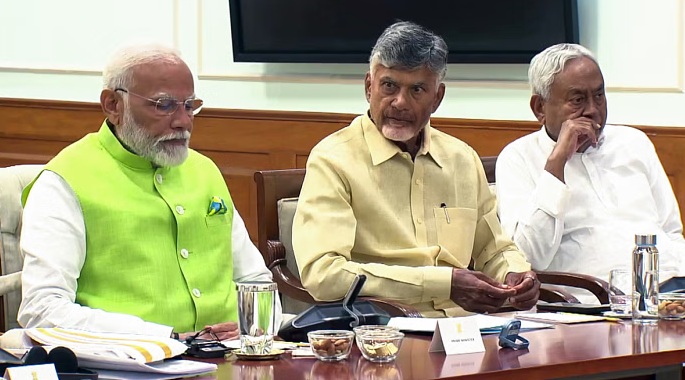
Amid the general elections, BJP President JP Nadda stated that the BJP is now self-sufficient and does not need the support of RSS for elections. It is well known that in most elections, the progeny of RSS and RSS itself backed the election work for the BJP. After the diminished performance of the BJP in these elections, there is now a significant statement from RSS Chief (Sarsanghchalak) Mohan Bhagwat about the conduct of parties during elections. Though couched in general language, it is directed mainly toward Modi and BJP. In addition, a top RSS functionary, Indresh Kumar, stated that arrogance has caused the BJP seat share to decline. RSS quickly disowned this statement, and Indresh Kumar withdrew it and certified that India could only progress under Modi's leadership. Many commentators have taken Mr Bhagwat's statement as a sign of a rift between RSS and BJP.
What did he say? In the concluding speech to the RSS training camp, he stated that during elections, the dignity and values of our culture are not maintained. The opposition has been treated as the enemy. In contrast, the opposition should be treated as articulating the alternate viewpoint, and attempts should be made to reach a consensus between the ruling and opposition parties. He lamented the continuing violence in Manipur. He also talked about the rising arrogance.
While couched in general terms, all this is apparently aimed at Modi-BJP. One recalls Modi's use of mangalsutra, mujra, buffalo, and INDIA alliance, giving all the reservations to Muslims, among other falsehoods, in a blunt and uncultured manner. Possibly, it only marginally affected the number of seats the BJP might have won. The primary reason for the decline of BJP vote share and seats is the people's problems-oriented narrative by the INDIA alliance. It rightly raised rising prices, unemployment, regular paper leaks, farmer's issues, and increasing poverty. Unlike Modi's crass phrases and blunt articulations, its language was generally dignified. While INDIA presented a reasonably united front in many places, for BJP-NDA, Modi, who had declared himself as God, was the central figure around whose name the elections were fought by the NDA.
So why has Bhagwat undertaken this step? Why did he not open his mouth so far if he was serious about these issues? Why was he mute when Mahua Moitra and Rahul Gandhi were expelled from Parliament or when 146 MPs were suspended? Why was he quiet when Modi was using crass language during the elections? Why was Bhagwat silent on Manipur violence until now? Indeed, he has no interest in any of these issues raised in his speech. He knew that if he opened his mouth to these issues, BJP's electoral fortunes would dip, which would not be acceptable to Bhagwat.
So why is he opening his mouth now? Modi's methods during election campaigns have lowered his and his party's dignity, even among sections of the populace who are diehard supporters of the BJP. Its credibility has been hit, and its parliamentary misdemeanour has further enhanced Modi's dictatorial image. So Bhagwat wants to tone down those effects to protect the RSS progeny, the BJP, from further damage, which may reflect in future elections.
As such, Bhagwat knows that Modi has fulfilled the Hindutva agenda in the best possible way. Article 370 has been abrogated, the magnificent Ram Temple has been inaugurated, and UCC is now implemented in one state while the central initiative is in the pipeline. It must have been a matter of joy for RSS that issues of cow-beef and love jihad have come on the centre stage, further intimidating the Muslim community. The ghettoisation of the Muslim community is on the rise, as exemplified by the case in Gujarat, where a Muslim state employee allotted a quarter is opposed by the other residents on the pretext that this one Muslim family will be a threat to the housing complex.
How Muslims are made invisible all around is also seen by the fact that in schools, the likes of Tripta Tyagi can ask all the class students to slap their Muslim classmates one by one. The stories of Muslim families not getting housing in the localities are infinite and shameful. With Modi in the lead, the centre does not have a single Muslim minister. BJP did not field a single Muslim candidate in the elections.
RSS has been the biggest beneficiary during the Modi rule. The number of its branches has proliferated to more than double. Pro-RSS ideologists have taken over important positions in colleges and universities. The textbooks have been saffronised. For example, the Babri mosque is now not addressed as a mosque but as a three-domed structure. In the name of the Indian Knowledge System, faith-based knowledge is being promoted, and things like Darwin's theory or the Periodic Table are out of textbooks.
So, why this storm in the teacup? As the BJP is far short of the majority, allies like Nitish and Naidu must be taken along. Right from Gujarat's Chief Minister days, Modi has worked in full majority with a total and unquestioned say in the government. In 2014 and 2019, the NDA was just for show. Even the BJP was there for the sake of formality. All decisions were taken by Modi himself, be it the Corona lockdown, demonetisation, or promotion of Adani-Ambani. He had the first and last word. So can he take along Nitish and Naidu? Nitish has already got the caste census in his state, while Naidu has a four per cent reservation for backward Muslims.
It is true that these allies operate more at a pragmatic level rather than at the level of principles; still, some differences will crop up in the future. So, it is a gentle way of telling Modi to mend his dictatorial ways. It also hints that a search for a more accommodating person to lead the NDA might be on.
As such, RSS must be all smiles as its agenda has gone several notches up; slight ego clashes, as seen in Modi's behaviour, don't matter in the long run to the fountainhead of Hindu nationalist ideology.
.jpg) Stanislaus Alla
Stanislaus Alla
.jpg) Stanislaus Alla
Stanislaus Alla
 Adv. Rev. Dr George Thekkekara
.jpg)
 A. J. Philip
.jpg)
.png) John Dayal
John Dayal
.jpg)
.png) Jacob Peenikaparambil
Jacob Peenikaparambil
.jpg)
 P. A. Chacko
.png)
.png) Robert Clements
Robert Clements