

.png) Sunny Jacob
Sunny Jacob
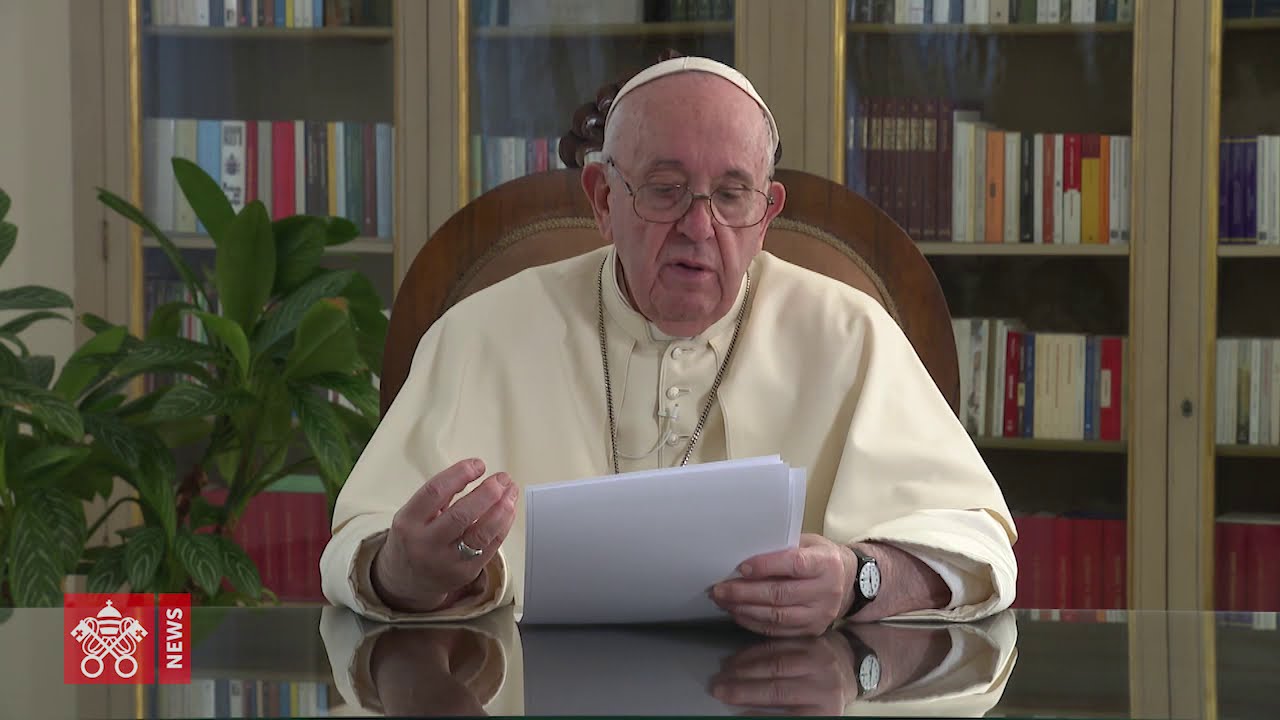
Pope Francis believes that Catholic Education must play a big role in shaping the world today. On the 13-15 October 2022 there was a Catholic Global education conclave organised by the USIG, on behalf of the Global Compact proposed by Pope Francis. This was the third such meeting on Global Compact, organised by the Catholic Education Commission. Representing the Global Network of Jesuit Education, Jose Mesa SJ, Fr. Luiz Fernando Klein SJ and Sunny Jacob SJ participated in this three-day conclave. There were 400 leaders of education from various congregations, from all regions of the world, attending the conference.
It was on 12 September 2019, Pope Francis launched an invitation to dialogue on how we are shaping the future of our planet and the need to employ the talents of all, since all change requires an educational process aimed at developing a new universal solidarity and a more welcoming society. To this end, he endorsed a Global Compact on Education to rekindle our dedication for and with young people, renewing our passion for a more open and inclusive education, including patient listening, constructive dialogue and better mutual understanding. “We must unite our efforts in a broad educational alliance, to form mature individuals, capable of overcoming division and antagonism, and to restore the fabric of relationships for the sake of a more fraternal humanity”, the Pope exhorted Catholic educators.
To this end, Pope Francis endorsed a global event, that took place on 14 May 2020 on the theme Reinventing the Global Compact on Education. The current meeting in October 2022 rekindled our dedication for and with young people, renewing our passion for a more open and inclusive education, including patient listening, constructive dialogue and better mutual understanding. “Never before has there been such need to unite our efforts in a broad educational alliance, to form mature individuals capable of overcoming division and antagonism, and to restore the fabric of relationships for the sake of a more fraternal humanity,” Pope said in his message to Catholic educators.
According to the Pope, “every change calls for an educational process that involves everyone. There is thus a need to create an ‘educational village’, in which all people, according to their respective roles, share the task of forming a network of open, human relationships. According to an African proverb, “it takes a whole village to educate a child”. We must create such a village before we can educate all without discrimination and hatred.
Through the Global Compact in education, Pope Francis calls for a new era of educational commitment involving all members of society. “Today we want to state that our religious traditions, which have always played a leading role in schooling, from teaching literacy to higher education, reaffirm their mission of integrally educating each individual: head, hands, heart and soul. To think about what we are feeling and doing. To feel what we are thinking and doing. To do what we are feeling and thinking. The beauty and harmony of what it is to be fully human.”
For this reason, he invites families, communities, schools, universities, institutions, religions, rulers, men and women of culture, science, sport, artists, media professionals, i.e. the whole of humanity to sign a compact on education by committing themselves personally to take up the following seven commitments:
• To make human persons the centre of every educational programme, in order to foster their distinctiveness and their capacity for relationship with others against the spread of the throwaway culture.
• To listen to the voices of children and young people in order to build together a future of justice, peace and a dignified life for every person.
• To encourage the full participation of girls and young women in education.
• To consider the family as the first and essential place of education.
• To educate and be educated on the need for acceptance and in particular, openness to the most vulnerable and marginalized.
• To be committed to finding new ways of understanding the economy, politics, growth, and progress that can truly stand at the service of the human person and the entire human family, within the context of an integral ecology.
• To safeguard and cultivate our common home, protecting it from the exploitation of its resources and to adopt a more sober lifestyle marked by the use of renewable energy sources and respect for the natural and human environment.
Pope Francis says that every change needs an educational journey, to rebuild the fabric of relationships, bring to maturity a new universal solidarity, and give life to a more welcoming society. To this end, it is necessary to form a new humanism to overcome the cultural and anthropological metamorphosis of today’s society. This makes it possible to give substance to each person’s identity, taking care of all its dimensions, consolidating its psychological structure, thus preventing it from fragmenting and disintegrating in the face of incessant and rapid change.
Today, there is need for a renewed commitment to an education that engages society at every level. Let us heed the plea of the young which opens our eyes to both the urgent need and the exciting opportunity of a renewed kind of education that is not tempted to favour grave social injustices, violations of rights, terrible forms of poverty and the waste of human lives.
These seven areas give us ample opportunities for each region to work out and commit ourselves courageously to developing an educational plan, investing our best energies, and introducing creative and transformative processes in cooperation with civil society.
It is time to look to the future with courage and hope. May we be sustained by the conviction that education bears within itself a seed of hope: the hope of peace and justice; the hope of beauty and goodness; the hope of social harmony.
It is good to learn about the work that is being done so far on the development of the COMPACT, with the presence of the main institutions that are promoting it. The three-day conclave shared significant experiences that are underway and that can inspire the options and commitments of our Congregations and regional bodies. Based on the proposals and directives of Pope Francis and the Catholic education, we can reflect on the new steps we can take to continue promoting this exciting educational challenge. If we work together, we can make our education truly global and transformative.
I think, the Global Compact is an invitation for all educators. In the words of Angelo Vincenzo Zani, former secretary of the Congregation for Catholic Education; “It is an invitation to discuss how we are building the future, to renew the passion for education … to train the actors of a more fraternal humanity. It may unleash the potential for specific projects and views … creating synergies and networks. We must face the new context responsibly and work together…”.
To achieve all these seven proposals of Pope Francis, we need to build better networks of educators. We cannot work alone anymore. There are several global and regional networks working on the Global Compact. As Jesuit School Global Network, it is an invitation for us to network with other networks to enrich and enhance our Catholic and Jesuit education.
“We call on particularly men and women in culture, science and sports, artists, media professionals, in every part of the world, so they too sign this Compact and, with their own testimony and work, become ambassadors of the values of care, peace, justice, goodness, beauty, acceptance, and fraternity. We should not expect everything to come from those who govern us, that would be childish. We enjoy a space of shared accountability where we can initiate and generate new processes and transformations. Let us be an active part in the rehabilitation and aid of wounded societies.” (Pope Francis, “Global Compact on Education”).
Yes, these words of Pope Francis give us the direction and necessary impetus to make us relevant global educators. Let us join the Global Compact and work as one body, as Catholic Educators.
(The writer is Assistant Secretary of Global Jesuit schools Network. sunnyjacobsj@gmail.com)
.jpg)
.png) Cedric Prakash
Cedric Prakash
 ICPA
ICPA
 ICPA
ICPA
 ICPA
ICPA
 ICPA
ICPA
 ICPA
ICPA
 ICPA
ICPA
.jpg)
 A. J. Philip
.jpg)
.png) Jacob Peenikaparambil
Jacob Peenikaparambil
.jpg)
.png) John Dayal
John Dayal