

.png) Chhotebhai
Chhotebhai
This is indeed a strange title. It is borrowed from the Vatican II document Gaudium et Spes, "The Pastoral Constitution of the Church in the Modern World". Let me quote it. "The Church admits that she greatly profited and still profits from the antagonism of those who oppose or persecute her" (GS 44). Perhaps "benefit" would have been a better word choice than profit. Let's not quibble over words and get to the point. What do we understand by persecution? Is it good or bad for us?
I would first distinguish between persecution, harassment and isolated instances. Persecution means a planned pogrom against a particular community, especially by those in power. Harassment is the use of various government agencies to hound a community and make life miserable for them. Perhaps the most harassment of Christians is in the North East.
There have been calls to remove Christian tribals and Adivasis from the ST list despite it being a constitutional provision. There was also a demand that Christian institutions and personnel stop wearing or using religious symbols. This is the height of provocation. I wonder if the proponents of this would dare a Sardar to remove his pagri or kara, both distinctive religious symbols of Sikhism. Such demands are indicative of clandestine government support.
Another form of harassment is the denial of FCRA licences for foreign aid. Social welfare licences are also not being renewed or faulted on flimsy grounds. Non-renewal of old land leases is another pressure tactic.
Isolated incidents are seldom so. They are usually part of a greater conspiracy that reaches a flashpoint. My guru, Fr Deenabandhu OFM Cap, always said nothing happens in a moment. It is a gradual build-up over time, often covert.
Let us now ask ourselves a few questions. Is persecution a virtue to be glorified? What do the Bible and Vatican II say about persecution? The first question is indeed a conundrum with no clear answer, but as we move forward, we may find some light at the end of the tunnel.
In the New Testament (NT), the word persecute is used 10 times, persecution 14 times, and martyr just once. Persecution seems integral to the profession of the Christian faith. It is portrayed as a blessing in the Gospels. We are told that we will be persecuted. We must be prepared for this. Nevertheless, we are advised to flee persecution and pray for the persecutors.
Persecution of Christians is also perceived as a direct attack on Jesus himself as addressed to Saul: "Why are you persecuting ME?". Other NT writers like Paul also seem reconciled to persecution. Paul says it will not separate us from Jesus. He recommends that we be content with persecution.
Vatican II teachings endorse this biblical approach. Tertullian of Carthage in Africa had said in the second century, "the blood of martyrs is the seed of the church" and "the first reaction to truth is hatred". Further, "the greater the number of persecutions that are inflicted upon us, so much greater the number of other men who become devout believers". That is why Vatican II says, "The Church considers martyrdom as an exceptional gift and as the highest proof of love". As stated initially, it even sees it as "profitable"!
All this sounds idyllic on paper, but before exulting "Alleluia," I ask a simple question: "How many of us are willing to be martyred for the faith?" If the answer is a deafening silence, then we need a more pragmatic approach to persecution or martyrdom.
In recent times, we have witnessed the death of Christians in the Dangs area in Gujarat in 1998 and later in Kandhamal, Orissa. There was the burning of Graham Staines and his minor children, the brutal killings of nuns Rani Maria and Valsa John and the custodial death of Rev Stan Swamy. Did the church "profit" from these deaths? Perhaps not. It then seems that contrary to biblical exhortations, persecution and martyrdom are neither desirable nor beneficial.
Some may now point to Stephen's martyrdom and Saul's consequent conversion. We need to delve deeper before drawing conclusions. Firstly, Stephen was no ordinary person. Acts devotes 54 verses to his testimony. He begins authoritatively with "listen to me" and ends on a challenging note: "With heaven my throne and earth my footstool, what house could you build me"? He continues, "You stubborn people with uncircumcised hearts and ears, you are always resisting the Holy Spirit".
Are these questions addressed to us today as well? He says, "Name a single prophet that your ancestors never persecuted". He had signed his own death warrant. His clothes were kept at the feet of Saul, who would have heard him saying, "Do not hold this sin against them".
This unusual incident would have been playing on the mind of Saul, the zealot who was hell-bent on persecuting the Christians. On his way to Damascus, he may have had time to reflect on these events, finally leading to the light from heaven throwing him to the ground. A word of caution here, as stated above, nothing happens in a moment.
The circumstances of Stephen's martyrdom differ somewhat from the Indian incidents I recounted earlier. Hence, there was no Saul becoming Paul. Stephen was walking into this with eyes wide open, and he knew only too well the consequences of his words and actions, but he did not shy away from them. It was voluntary and heroic.
Besides, social, RTI and Dalit activists, journalists and trade unionists have also been killed for their beliefs or the causes that they espoused. They were heroic acts for social justice but cannot be bracketed with what we usually call Christian martyrdom.
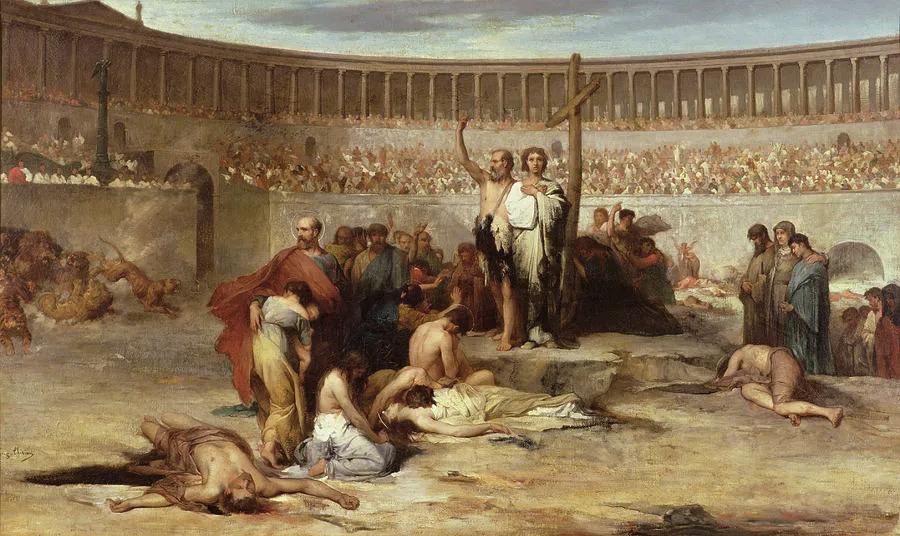
Church historians would know that Christians, then known as "people of the way", were persecuted for 300 years in the Roman Empire. The Colosseum in Rome is a mute testimony to the thousands thrown to wild animals, to the delight of the bloodthirsty Roman crowd.
This persecution ended in 313 CE when Emperor Constantine issued the Edict of Milan. However, Emperor Theodosius signed the Edict of Thessalonica in 380 CE, making Christianity the State's official religion. I now pose a hypothetical question. What if Christianity continued to be persecuted? Would it have survived, and if so, in what form?
There is no Constantine or Theodosius to protect Christians today. We need to protect ourselves and take whatever precautionary measures we can. I have a few simple suggestions:
1. As Rev Cedric Prakash SJ never tires of saying – keep your papers in order. Don't give your adversaries an opportunity to attack you.
2. Avoid all forms of aggressive evangelisation, especially anything denigratory of other religions. Let us not pretend we are the chosen few and all the rest are going to Hell! I recall a recent statement of Pope Francis, "I hope that there is nobody in Hell". He asserted that this was not a doctrinal statement but his personal feeling. So let's not breathe fire and brimstone at others. How and when to evangelise is another issue entirely beyond the scope of this piece.
3. We are Indian Christians, not Roman or European ones. Remember what Mahatma Gandhi said, "I like Christ but I don't like Christians". He was probably exposed to the more Westernised style of Christianity, where neo-converts abruptly jettisoned all forms of Indian culture that they mistakenly linked to Hinduism.
In conclusion, we cannot welcome persecution as a virtue, especially if it happens to someone else. Let us do whatever we can to promote peace and harmony among all peoples.
.jpg)
 A. J. Philip
.png) Cedric Prakash
Cedric Prakash
.jpg)
 P. A. Chacko
.jpg)
.jpg)
.jpg) Thomas Menamparampil
Thomas Menamparampil
.png)
.png)
.png) Robert Clements
Robert Clements
.jpg)
.png) Chhotebhai
Chhotebhai