

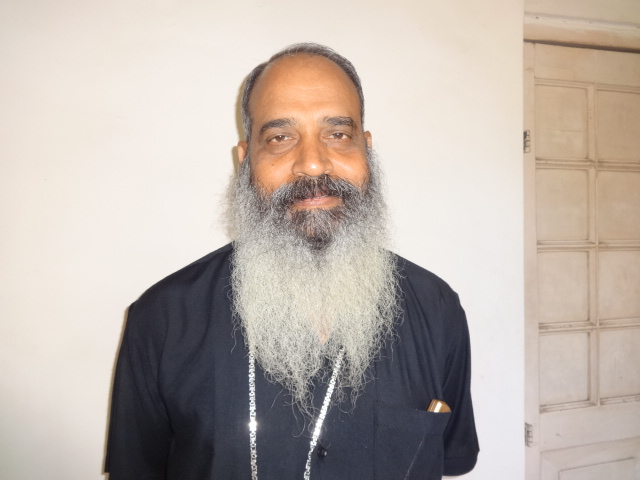
.png) Dr Suresh Mathew
Dr Suresh Mathew
Q. 1 - What is the Christian vision of inclusive society?
Ans - In his encyclical Fratelli Tutti (on Fraternity and Social Friendship), Holy Father Pope Francis has clearly said, “No authentic, profound and enduring change is possible unless it starts from the different cultures, particularly those of the poor.” (#220). The Christian Vision of Inclusive Society springs from the Gospel. Among many examples, one I would like to cite is the parable of the Good Samaritan where the Samaritan chooses to take care of an injured Levite (Jew) when the Samaritans and the Jews did not approve of each other socially and culturally.
Jesus had proclaimed his mission the need to include those on the peripheries of the Society: “The Spirit of the Lord is upon me, because he has anointed me to bring good news to the poor. He has sent me to proclaim release to the captives and recovery of sight to the blind, to let the oppressed go free….” (Luke 4.18)
The Catholic Church down the history has reminded us through its dynamic social teachings the need to include the poorest of the poor (the anawims) in all our projects of welfare and development. In Caritas in Veritate (On Integral Human Development in Charity and Truth), Holy Father Benedict XVI reminded us of the need for discernment in any development.
Leaving out people on the peripheries or margins is not the Christian vision of Charity. Christian charity aims at bringing them into the mainstream. Mathew 25 spells out a list of the people who stand in need of inclusion: The hungry, thirsty, naked, sick, lonely and imprisoned. Mother Teresa was an epitome of inclusion of the underprivileged according to Jesus’ vision of just and humane society.
Q. 2 - Why are the Christians inherently charitable? What is the Christian way of serving the poor?
Ans - The Christians are inherently charitable because the crux of the gospel is mercy. The Lord clearly said: I want mercy, not sacrifice. Love and mercy are the surest signs of the followers of Christ. The Christian way of serving the poor is the surest way of serving God because Jesus himself said that what you did to the least of my people you did it to me (Mathew 25). Jesus’ mission itself was for those who were on the margins of the society. He came to give good news to the poor, blind, captives and the downtrodden (Luke 4:18). His vision of the Kingdom of God meant the rule of love and compassion, forgiveness and fraternity, justice and reconciliation. As clarified in the parable of the Good Samaritan, ultimately goodness towards others which is service alone, matter in religion and life. Jesus was the merciful face of God, the Father, conveyed Pope Francis in his apostolic exhortation.
Christian way of serving the poor is a mandate of Jesus and his mission which we are called to fulfill. We are called to continue and complete the mission of mercy entrusted by God to Jesus. Religious conversion is an internal call of Jesus to any individual to accept him as God and to follow his life and mission. One who serves the poor is already following Jesus anonymously. Serving the poor is an act of conversion of the heart more than religious migration. However, we cannot serve the poor without loving Jesus who was poor and who served the poor in every way. Therefore, acts of charities in Christianity are not just external deeds of philanthropy but heartfelt imitation of Christ Himself.
Q. 3 - Does the church align with political movements such as leftist/rightist, Marxist, capitalist, socialist, Maoist?
Ans - The Church draws its inspiration primarily from the Holy Scriptures (The Bible). The Holy Fathers down the history have issued encyclicals, apostolic exhortations, and pastoral letters giving guidelines to the developments of the modern world and its changing context. These are important sources of the church and its behaviour. The theology of the church which interprets the signs of the time in the light of the Holy Scriptures is another source of its guidelines. All of these form the moral corpus along which the Church will align. The Church is ever willing to align with any movement or ideology that is in congruence with the values or principles emerging from these sources. Basically, any political movement or ideology that contradicts the values of Jesus and those enshrined in His teaching will not be acceptable to the Church, be it what it may.
Sometimes the entire movement may not be acceptable but some part of it may be liberative. For example, the end of the Marxist ideology is the egalitarian society which may not be averse to Christ’s vision and mission of the Kingdom of God but the means to attain it permitting violence will not be acceptable to the Church. So also in any movement and ideology, its end and means both must be pure, as Mahatma Gandhi propounded too.
Q. 4 - How does the Church involve in acts of justice, while contributing to nation-building and working in tandem with the governments?
Ans - The enormous service of the Church in the field of education serves towards promoting values namely justice among generation after generation. Many influential people of this nation and their children have proudly benefited from it. Yet, the Church has given priority to social justice and reconciliation following the social teachings of the Holy Father. After education and health, the yeoman service of the Church is in the field of social action. By social action I mean not just social work towards welfare but a dynamic action of building solidarity against social injustice and violations of human rights. The Church has not hesitated to take support of the legal system in order to attain justice and protect human rights of the oppressed. There are ample cases of priests, nuns and lay persons martyred because they fought persistently against the oppressive forces.
The Church has always adhered to the goal of nation-building as its priority through its thousands of religious and lay personnel involved in services of education, health, social action, pastoral care and communication. It has always believed in working in tandem with the Government policies, plans and projects that are in consonance with the values of the GOSPEL and oriented towards the wellbeing of the poor and the oppressed. Where it has been necessary to raise objection to any government plan, policy or project not in favour of the poor and the marginalized, the Church has boldly raised its voice in favour of justice and human rights. The Church considers itself a loyal supporter to the ruling governments towards fulfilling dreams and aspirations of its citizens in a way that does not violate Gospel values.
Q. 5 - An impression has been created that the Church hasn’t extended enough support to the activities of priests like Stan Swamy in their fight for the rights of Tribals and Dalits. What is the reality?
Ans - Through the leadership from the Jesuit provinces, the Church did constantly keep the issue of justice to Fr. Stan and all the 15 other arrested in the Bhima-Koregaon case alive and burning in the media. The Jesuits left no stone unturned to provide the legal and moral support to get bail to Fr. Stan.
Of course, due to exceptional Covid circumstances translating these localized efforts into a nationwide protest got truncated. Much is happening to keep alive and burning the spirit of social justice set ablaze by the life and mission of Fr. Stan. We should not allow the flame to extinct by making it not just a concern of the Jesuits alone but a serious concern of the Gospel and therefore of the Universal Church.
Q. 6 - The arrest of Stan Swamy had evoked protests from several quarters. How do you respond to the allegation that the Church’s response had been lukewarm in this regard?
Ans - This has been answered in the previous question.
Q. 7 - There seems to be an effort to divide Catholic priests into two streams – one supporting Marxist ideology and others who are moderates with conservative ideology following the status quo. What is your take on this?
Ans - The question of any priest supporting Marxist ideology does not arise. Marxist ideology is not in conformity with the Gospel values in as much as it seeks to promote violence. The Bible and the Gospels came much before Marx. It is Jesus’ proclamation and mission to proclaim liberty to the captives that forms the core of our inspiration and motivation. So, Marxist cannot become our dividing line, rather the Bible and the Gospel become the uniting line for the clergy and the faithful. It is unfortunate that Marxism is identified with liberation theology because of the element of liberation of the oppressed common among the two.
Q. 8 - There are people who say that the involvement of a few church personnel in the fight for the rights of Tribals and Dalits is not a religious or spiritual one. Hence they should desist from engaging in such activities. Do you agree with this view?
Ans - If our involvement in the struggle for justice on behalf of the Tribals and Dalits springs from our belief and Jesus and his life and mission, it is the noblest thing to do and must be encouraged. There are NGOs doing it without explicit acknowledgement of Christ but in conformity with Gospel values. We should collaborate with them. The Church personnel who are involved out of their belief in the Gospel values are inspired religiously and spiritually.
Q. 9 - Do you think that the Church has to be more pro-active in the struggles for the rights of Tribals, Dalits and others?
Ans - Yes, we need to shun our fears of being a minority and come out even more boldly against proliferating untruth and injustice in our country relying on the strength of Christ within. Remember, the path of Christ is the path of paying a price even through one’s own life. Jesus did it for the Dalits and Tribals of his time; we need to do it for the marginalized of our time. There cannot be new life in Galilee if it chooses to remain a safe zone and not traverse the pathway of Golgotha!
Q. 10 - Is it not a fact that the Church has become more ‘institution-oriented’ than ‘people-oriented’?
Ans - It is indeed a concern that the Church. We have to change our way of administration in a way that leaves us free for people by sharing power and responsibility with the laity. This is meant by what is called collaboration or mission partnership. The predominant leadership or model of church is the spiritual one. We cannot allow it to become NGOs that do good without bringing people closer to God. Pope Francis has time and again exhorted shepherds that they should have the smell of the sheep! Closeness to people is the very meaning of Emmanuel, the incarnation of God in today’s world. There cannot be good news in our institution without the people-oriented identity and charism of it.
Archbishop Thomas Macwan
Archdiocese of Gandhinagar
.jpg)
 A. J. Philip
.png) Cedric Prakash
Cedric Prakash
.jpg)
 P. A. Chacko
.jpg)
.jpg)
.jpg) Thomas Menamparampil
Thomas Menamparampil
.png)
.png)
.png) Robert Clements
Robert Clements
.jpg)
.png)
.png) Chhotebhai
Chhotebhai