

 P. A. Chacko
Is our Indian judiciary getting derailed? There are signs and symptoms that some engine trouble is affecting it.
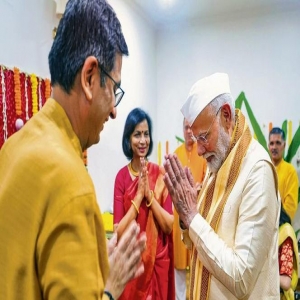
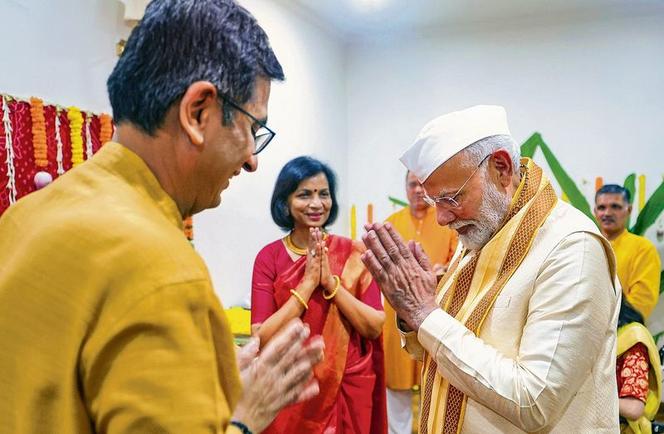
It was not without reason that the just-retired Chief Justice Dhanajay Chandrachud was taken to task by the legal fraternity, retired judges, and social critics for his antics of having the executive head of the nation alongside him for Ganesh puja in his private residence. He also came under censure for the way he 'fathered' the Ayodhya judgement after consulting and communing with his Hindu god for inspiration and solution.
In 2022, Chandrachud noted that although the Places of Worship Act of 1991 prohibits the conversion of a religious site to another faith, 'determining the religious character of a place, as a procedural tool, might not necessarily violate the law.'
This observation was made in the Gyanvapi mosque case. But legal experts and activists point out that it opened the hornets' nest, releasing hordes of religious fanatics to claim the existence of Hindu gods or Shiv lingas under mosques across India. The venom is spreading from Ayodhya to Gyan Vapi to Ajmer Sharif to Shahi Jama Masjid to Krishna Janmabhoomi to whatever your communal imagination extends.
Critics have pointed out that the distance between the two national pillars, the executive and the judiciary, has narrowed down.
We have had a judge resign and join the BJP party and stand for election. Beneath his black robe was the saffron outfit as a judge, they say.
And now we have a sitting judge of the Allahabad High Court flouting all constitutional and civic norms to pull the bandwagon of the saffron party. His pronouncements were not just improper but anti-national. Mr Shekhar Yadav went out all the way to insult the Muslim community and announce publicly that the only Constitution India should have is that which is according to the wishes and whims and tracts and traditions of the Hindu majority community. From this, it could be clear that his judicial pronouncements, too, might have been coloured with a saffron tinge.
By devaluing the sacred Constitution, which he is duty-bound to protect as a judge, he has violated all norms of constitutional propriety. As a result, he has merited nationwide protest and censure. Many are demanding his resignation and even impeachment.
The slip is showing, Mr Justice. That is the verdict the Indian judiciary appears to be meriting.
This does not mean that there are no finer elements in the judicial arena. Not all are crawling before the Big Brother Executive. Many function with sense and sensibility in interpreting the Constitution and delivering just verdicts according to the principles of equality, justice, and fair play.
But at the same time, there are visible trends that try to arm-twist the judiciary. Some judicial officers have displayed a tendency to oblige the powers that be or play a safe game by not offending the 'taskmasters.'
"The bedrock of our democracy is the rule of law and that means we have to have an independent judiciary, judges who can make decisions independent of political winds that are blowing." (Caroline Kennedy)
.jpg) Stanislaus Alla
Stanislaus Alla
.jpg)
.png) Cedric Prakash
Cedric Prakash
.jpg) Elsa Lycias Joel
Elsa Lycias Joel
.jpg)
 A. J. Philip
.png) Jacob Peenikaparambil
Jacob Peenikaparambil
.jpg)
.png) John Dayal
John Dayal
.jpg)
.jpg)
.png) Joseph Maliakan
Joseph Maliakan
.png)
.png) Robert Clements
Robert Clements
.jpg) Cedric Prakash
Cedric Prakash