

.png) Aarti
Aarti
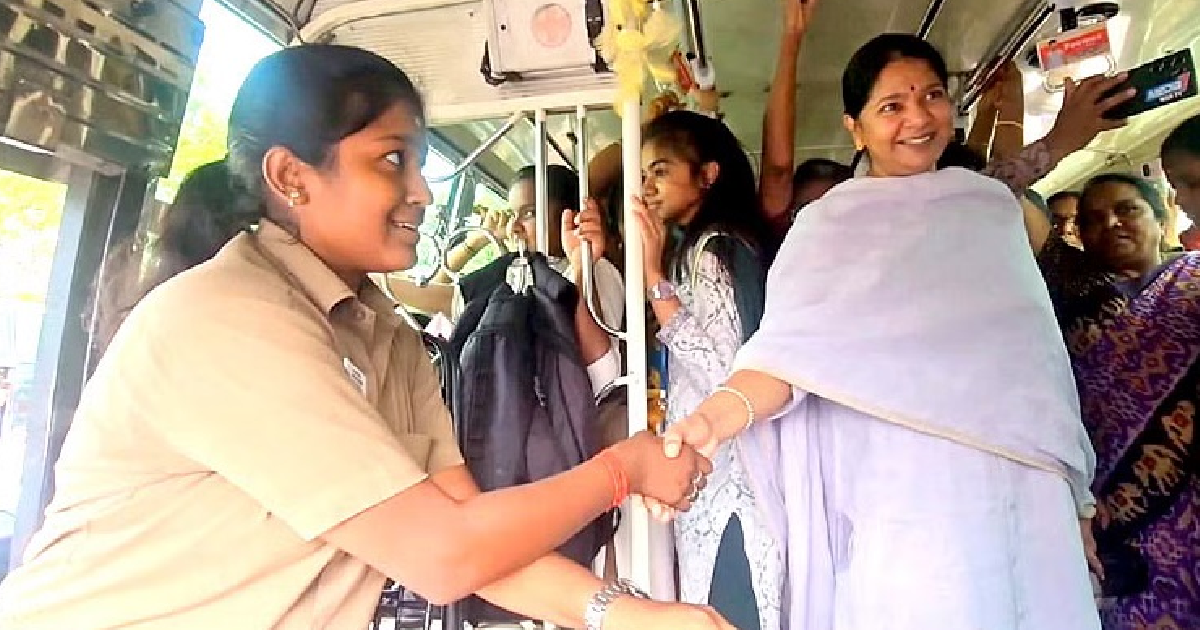
When 24-year-old Sharmila, a diploma holder in Pharmacy, took over the steering wheel of a private bus on 31 March 2023 in Tamil Nadu's Coimbatore, her joy knew no bounds. During her 5 a.m to 10 p.m. shift, she made 12 trips, driving about 30 km between Gandhipuram and Somanur.
On 13 June this year, Vanathi Srinivasan, MLA and BJP’s national women’s team leader, travelled in Sharmila’s bus, it got highlighted in the local media.
Ten days later, on 23 June, Dravida Munnetra Kazhagam MP Kanimozhi travelled in the same bus driven by Sharmila. But no sooner than the trainee conductor Annammal asked Kanimozhi to purchase a ticket, it triggered a spat between the crew -- the driver and the conductor.
Sharmila brought the unsavoury incident to the notice of the bus owner who alleged that her behaviour tantamount to seeking publicity. Even though Sharmila contended that she had informed her manager in advance about the planned visit of Kanimozhi it was denied by the manager. In the meantime, an argument broke out between her father and the bus owner after which Sharmila was allegedly asked to leave.
Feeling offended that her father was ill-treated by the bus owner, she is said to have quit the job.
On 26 June, actor-turned politician Kamal Haasan, President of Makkal Needhi Maiam, honoured Sharmila with a car as a token of his support to enable her become a driver-entrepreneur.
Sharmila had begun learning to drive and park auto-rickshaws, two-wheelers, and cars since her seventh standard. After driving an auto-rickshaw and occasionally taxis for four years, she ultimately obtained her license for heavy vehicles. Although her desire to succeed as a female bus driver in a male-dominated sector ought to inspire other women but the cause for concern is that more needs to be done at a macro level to bridge the gap so as to help women get greater access to jobs and resources.
There are many Sharmilas who are doing so much unpaid work at home. According to the latest NFHS data (2019-2021), though 88.7 percent of married women participate in key household decisions, only 25.4 percent of women, aged 15-49 years, who worked in the last 12 months (2019-2021), were paid in cash. It is essential that women’s empowerment begins at the household level. Girls and boys should be raised in an atmosphere of freedom and a culture of mutual respect and they should be provided with access to education. An assured job after education will empower girls economically.
The NITI Aayog’s Sustainable Development Goals Index for 2019 had among others reportedly portrayed the major gender pay gap (females earn 78 percent of wages earned by males in regular salaried employment), lack of adequate representation in governance (14.4 percent in Parliament, but 44.4 percent in local government) besides high crime rates against women and girls.
The good news is that India has climbed eight places in the annual Gender Gap Report, 2023. In terms of gender parity, from the 135th position last year, we are now ranked 127 out of 146 countries.
However, much needs to be done in terms of economic participation and opportunity, educational attainment, health and survival and political empowerment.
Studies have shown that organisations with more women representation have achieved 22 percent higher productivity, 40 percent better customer retention and 27 percent more profitability.
So, achieving gender equality in our country has its own set of challenges. But where there is steadfast will, there is a way. For instance, though women were absorbed into the Short Service Commission (SSC) as they were denied permanent commission in most branches of the Indian Army, the aggrieved took legal recourse. In February 2020, a Division Bench of the Supreme Court while passing the order on permanent commission to women officers in the army had observed, “If society holds strong beliefs about gender roles – that men are socially dominant, physically powerful and the breadwinners of the family and that women are weak and physically submissive, and primarily caretakers confined to a domestic atmosphere – it is unlikely that there would be a change in mindsets”. Finally, the glass ceiling was shattered, and women officers were granted permanent commission in the Indian Army.
The society and the community ought to join hands to empower women economically.

.jpg) Stanislaus Alla
Stanislaus Alla
.jpg)
.png) Cedric Prakash
Cedric Prakash
.jpg) Elsa Lycias Joel
Elsa Lycias Joel
.jpg)
 A. J. Philip
.png) Jacob Peenikaparambil
Jacob Peenikaparambil
.jpg)
.png) John Dayal
John Dayal
.jpg)
.jpg)
.png) Joseph Maliakan
Joseph Maliakan
.png)
.png) Robert Clements
Robert Clements
.jpg) Cedric Prakash
Cedric Prakash