

.jpg) P. A. Joseph
P. A. Joseph
.jpg)
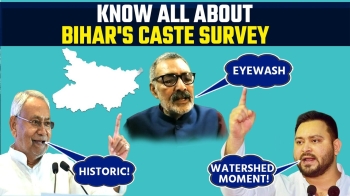
As India is growing and developing in many aspects it is good to reflect where India is being led by politicians with their agenda and opaque plans. The recent caste survey in Bihar has shown the number of people belonging to different classes and castes. It reveals that the State has extremely backward classes 36%, other backward classes 27.1%, scheduled castes 19.6%, general 15.5 % (including Brahmins 3.6% and Rajput 3.4 %). This in a way reveals the need of representation of people (as per the strength of castes and classes) in the administration of the state. When similar surveys are done in all the states as opposition I.N.D.I.A. demands, it would be clear how the future of the government would be. Caste-wise survey is not to divide India but to see that democracy is of the people, by the people and for the people. No one should be excluded from governing/serving India.
In this context, it may be beneficial to reflect upon ‘race’. ‘Race’ is relatively a new word. But the ‘energy’ behind it is very old. Race applies only to the humans. We don’t speak of race of elephants, mammals, fish, etc. It implies that one human collective can be more vulnerable, intelligent, beautiful, creative than others. Race carries consciousness; it is a declaration of superiority and inferiority. Superior group dominates over the inferior by various means of power like properties, luxurious housing, education, job, dress, expensive cars, use of weapon, etc.
Nazis defined themselves as “Arian race” and declared themselves as “ubermenschen” which means “super human”. Arian race was white; it claimed superiority, and supremacy over millions of humans who were also white, such as Jews etc. These include French, Spanish, Swedish, and many others. It claimed supremacy over any black, yellow, and brown humans. To claim superiority meant domination, enslaving, torture, subjugation, and even killing. The Aryan superhumans were Germans. Their viciousness, mercilessness, brutality, etc. were unleashed in the name of race. It engulfed the human society in most destructive human conflicts endured by humans, World War ll. It enveloped the whole earth. It was total war. Six million Jews and five million others from inferior races in Europe were methodically murdered in thousands of facilities (death chambers) built to exterminate them. Huge killing centers were set up in Auschwitz and Buchenwald.
In the Atlantic, slave trade brought millions of West African slaves to Europe, American colonies, and Brazil. The dealing with slaves was disgracing and murderous. An ideology was construed that “races are unequal”, the white race is far superior, slave trade and slave owners are not immoral, and hard dealing with them is not to be blamed, because they are less than humans, if not animals. Slaves are personal movable property, like domestic animals, washing machine, furniture, etc. These can be sold or exchanged at one’s will any time. Education was forbidden to slaves or their little ones, and they were not supposed to travel in cities. They cannot drive, vote, or be with the whites.
All these were accepted practices of the whites. All slaves in the American colonies were black and all the slave-owners and bosses were white. Slaves are subhuman or in bestial conditions. White men raped the black women, and there were no objections or punishments in the society for the same act. Once a slave is not in good terms, he may be killed any time. Apart from the cruelties mentioned, the African slaves were not allowed to practice their cultural programmes, their way of worship, their get together etc. These were totally forbidden. All these had indirect and clear support from the religion of the west and the American people. (Reference: Universal Human, by Gary Zukav).
After reflecting about slave trade, it is in place to think of what is happening in our country. 80% of the people are living in villages. In far-flung villages we have people of all castes. Some are named as low castes as the German whites termed the blacks. The so-called high castes do not allow the low caste people even to draw water from the common wells, and the water hand pumps. If a low caste enters the door step of the high caste, the whole house is polluted. The women folk have to cover their head if a Brahmin passes by. So many unwritten laws are made for the scheduled casts and tribes.
In Rajasthan, in Banswara district there is the private house of a so-called high caste. The people passing in front of his house have to remove the chappal and walk barefoot. Those who use cycle have to get down and push the cycle. Women have to cover their head in respect. In any business dealing what he says is the final word, and because of this no one goes to him. In Uttar Pradesh during the Navratri, the market is not allowed to have any non-vegetarian items, not even eggs. In the month of July, when Hindu devotees carry water from the Ganga, for two weeks all the shops selling non-vegetarian food are to be kept closed. Like this there are so many controls being made to annoy the so-called low caste.
Now coming back to the survey in Bihar, the state has taken the courageous step. It is hoped that the other states would follow the programme. The saying that caste Census would divide India is not true. It would open the mind of people. Ultimately the country belongs the people. Let the majority decide in the spirit of democracy.
.jpg)
.png) Cedric Prakash
Cedric Prakash
.jpg) Elsa Lycias Joel
Elsa Lycias Joel
.jpg)
 A. J. Philip
.png) Jacob Peenikaparambil
Jacob Peenikaparambil
.jpg)
.png) John Dayal
John Dayal
.jpg)
.jpg)
.png) Joseph Maliakan
Joseph Maliakan
.png)
.png) Robert Clements
Robert Clements
.jpg) Cedric Prakash
Cedric Prakash
 ICPA
ICPA