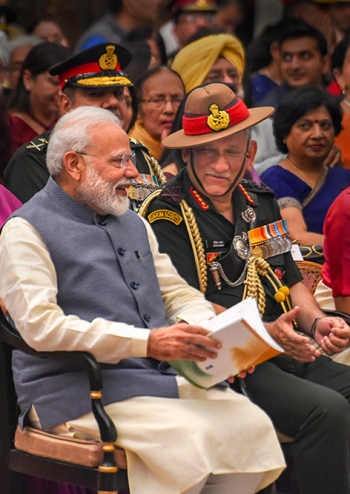


.jpg) Mathew John
Mathew John
.jpg)
Every autocrat has his/her chosen factotums whose prime function is the projection of the leader as the talisman of national power. They are tasked with sounding out in the public arena what is in the mind of the leader, not only for gauging the public response to his ideas but for working out the modus operandi for implementing them. Their public pronouncements are replete with contradictions, simplifications and factual inaccuracies which, time and again, oblige them to walk back earlier statements using the standard ploy of being “misquoted”. They provide the justification for the mis-steps and blunders of their leader, invariably yoking all his/her actions to the common good.
Under the current regime in India, the factotums have been doing their thing in full media glare, articulating a world view that privileges national interests above democracy and freedom, and barely conceals the totalitarian impulse. Last year, the CEO of NITI Aayog (National Institution for Transforming India) set the cat among the pigeons at an event sponsored by Indian mining company, Vedanta.
A cynically amoral dyed-in-wool bureaucrat lamented the fact that tough reforms were very difficult in the Indian context as “we are too much of a democracy”. Unable to withstand the resultant blowback from his outrageous comment, he later whimpered that his comments were misconstrued and what he meant was that “India is too much of a democracy to mirror a China model”. Nobody believed his retraction, though the government used its influence with the ‘godi’ media to get many publications to withdraw their reports on his initial comments.
The factotum-in-chief of this regime by a long way, more loyal than the king, is the Chief of Defence Staff, General Bipin Rawat. Under any other dispensation, he would have been sacked long ago for holding forth on issues that are beyond his remit. He caused huge embarrassment and even imperiled national security with his injudicious and thoughtless comments. In 2017, as the Chief of Army Staff (COAS), he gratuitously boasted that the Indian armed forces were prepared for a two-and-a-half front war which implied repelling a coordinated aggression by Pakistan in the West, China in the North as well as internal insurgencies. It was his version of the “ghar me ghus ke maarunga” machismo of his Master.
This stupid remark could not have served any purpose other than to raise the hackles of our adversaries. A senior security expert was quick to tell him: “Currently, India does not have the initiative and is not in a position to simultaneously engage with both its adversaries. It does not have the intention, resources, political and military will, or the leadership to do so. Nor does the Ministry of Defence (MOD) visualize such a situation.”
At a time when the situation in Kashmir is poised on a knife’s edge, the motormouth General has been guilty of making irresponsible statements that have only further alienated the Kashmiris. In 2017, he defended his soldiers using civilians as human shields in the fight against terrorists. Despite the fact that the tactic of using innocent civilians as guinea pigs to slaughter is an unconscionable human rights violation, he justified it on the grounds that his soldiers were fighting a non-traditional war in Kashmir that required, to quote his heartless term, “innovations”.
Clearly oblivious of the sanctity of human rights, the General was at it again last week, observing that people of J&K “are now saying that they will lynch terrorists”, and in his view, this rough and ready street justice vigilantism is a “positive sign”. He followed up with a mystifying comment: “Whether this is a message for the terrorists or whether it is being played up by intelligence agencies, I would say it is a good card that is being played.” One is left wondering whether the “lynch terrorists” statement is merely the wishful yearning of a homicidal establishment.
The General’s latest gaffe has left the Ministry of External Affairs (MEA) red-faced. As early as January 2021, NDTV reported that China has built a new village of about 101 homes in Arunachal Pradesh. This was corroborated by a Pentagon report titled “Military and Security Developments Involving the People’s Republic of China”, which also mentioned the village. On 11th November, the MEA, in a carefully worded statement, acknowledged that China had undertaken construction activities in areas that it has “illegally occupied over decades”.
The official statement of the MEA was immediately contradicted by the General who denied any intrusion, stating that China has carried out construction well within its own territory “for billeting and locating their civilians or for their military in the future.” The China spokesperson could not have done a better job of justifying the illegal construction! But then, the incorrigible General was only mirroring his Master’s stance that “not an inch” of our territory has been lost! Orwellian doublespeak at play?
Perhaps the most sinister public declamation by an acolyte of this regime was National Security Adviser (NSA) Ajit Doval’s cautionary tale to Police probationary officers last week, warning the law enforcers about the threat posed by civil society, i.e. you and me. Here are some of his outrageous quotes: “It is civil society that can be subverted, suborned, that can be divided, that can be manipulated to hurt the interest of a nation”; “the quintessence of democracy does not lie in the ballot box. It lies in the laws made by the people who are elected through those ballot boxes”; “their (laws) implementation is more important than the legislation.”
His statements are straight out of the recipe book of a Police State where the citizen is a servile subject duty-bound to accept without demur the laws laid down by the rulers. The top cop’s perverse interpretation of democracy vests absolute power in the political executive, with the people who elected them reduced to mere supplicants. His misanthropic conviction, absurd as it is, is that civil society is a potential threat to an orderly society and therefore must be reined in to ensure that the laws are implemented. He betrays his intellectual shallowness by privileging implementation of a law above the law itself, or was he implying that once a law is enacted, absolute powers should be transferred to the police and security agencies? Regrettably, this is what has been happening in the last few years.
His illiberal counsel to the IPS officers should come as no surprise as man Friday has merely expressed as doctrine what was earlier enunciated by his lord and master. During the Diamond Jubilee celebrations of the Gujarat High Court, the Prime Minister lauded the judiciary for safeguarding the rule of law and for protecting national interest and security. At the same time, he heaped scorn on the andolanjeevis or professional protesters who, he claimed, were spreading anarchy.
The frontal attack on civil society and the sanctification of the rule of law comes at a turbulent time when the regime has been trying to ram down laws that, to use Howard Zinn’s evocative term, are “congealed injustice”. The raw courage displayed by the common man in the fight against iniquitous laws such as the CAA and the farm laws has proved that the building of an equal and just society is not possible without the active participation of the main stakeholder, i.e. civil society. In these fraught times, we would do well to remember the great American political activist, Ralph Nader’s cautionary warning: “There can be no daily democracy without daily citizenship.”
(The writer is a former civil servant)
.jpg)
.png) Cedric Prakash
Cedric Prakash
.jpg) Elsa Lycias Joel
Elsa Lycias Joel
.jpg)
 A. J. Philip
.png) Jacob Peenikaparambil
Jacob Peenikaparambil
.jpg)
.png) John Dayal
John Dayal
.jpg)
.jpg)
.png) Joseph Maliakan
Joseph Maliakan
.png)
.png) Robert Clements
Robert Clements
.jpg) Cedric Prakash
Cedric Prakash
 ICPA
ICPA