

.png) Aarti
Aarti
.jpg)
|
Widely being circulated over the social media |
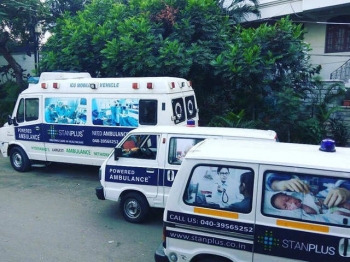
Many years back, on the day a friend’s father arrived by train, there was no public transport due to an ongoing “bandh”. His son had reached the railway station using a borrowed bicycle to explore how to bring his father home. However on the way he could negotiate with an ambulance driver who finally settled to drop his father for Rs 100/- . On reaching home, the man was quite disturbed that his son had paid an exorbitant amount for a mere 3 km distance which by bus would not have exceeded Rs 5/-.
Be it as it may.
With several add on facilities available in ambulances, which are considered as hospitals on wheels, during pre-COVID days, such services, according to reports were generally available in many cities in the range of Rs 500-1000 and 2000-3000 with oxygen facility per trip.
Presently, particularly amidst the COVID-19 surge, as the nation is facing unprecedented challenges, it is rather disconcerting that many unsuspecting citizens are literally at the receiving end of unscrupulous elements who seem to be fleecing them without any reason or rhyme.
Whether cheating is driven by economic necessity or is it that some individuals look at such circumstances to cheat others out of their money. There are no easy answers.
A tip of the ice berg is the “hospital bed scam” reported in Bengaluru. A couple of days back after Mr Tejasvi Surya MP alleged of a scam in booking of hospital beds for COVID patients in Bengaluru, where officials of the Bruhat Bengaluru Mahanagara Palike colluded with private nursing homes and hospitals to block beds and reserve it for exorbitant rates, so far seven persons have been arrested.
News reports are replete with allegations of ambulance drivers be it in Bengaluru or Jalandhar, Delhi or Ludhiana demanding huge sums to transport COVID patients or dead bodies even for very short distances.
Ambulance drivers who have been arrested were found to charge approximately Rs 8500/- to Rs 9000/- for 2 km distance, Rs 10000/- for 4 km, Rs 14000/- for 6 km going up to RS 42000/- for 25 km and so on.
Last month, in Bengaluru, two persons were arrested and their ambulance seized for demanding Rs 60,000/- from a woman to ferry her father's body to the crematorium. The hapless woman pleaded with the ambulance driver and his accomplice that she did not have that much money, barring her mangalsutra and requested them to lower the amount. Refusing any negotiation, they were about to abandon the body on the road when the woman called 100. No sooner the police arrived, the duo agreed to take the body to the crematorium at about one fourth the original cost initially demanded but the next day the police arrested them.
But the arrest of an ambulance driver on May 6 who allegedly charged Rs 1.20 lakh to transport a patient for a distance of 350 km from Delhi to Ludhiana shows that fleecing seems to be unparalleled. Thanks to the social media. The receipt provided by the ambulance driver was shared on the social media by the patient’s daughter. The police not only swiftly swung into action and arrested the driver but helped her get the entire money back.
Faced with reports of overcharging by private ambulance drivers, some of the State Governments have put a cap on ambulance charges. Haryana has fixed Rs 15/km as hire charges for advance life support ambulances (ALS) and Rs 7/km for basic life support (BLS) ambulances. The regional transport authorities have been authorised to slap a minimum penalty of Rs 50000/- on ambulance drivers or owners if found charging above the prescribed rates.
Even as the Delhi High Court has directed the Delhi Government to treat a PIL alleging there was overcharging for ambulance services and cremations as a representation, the ambulance hire charges in Delhi have since been regulated. According to new rules, the maximum rate has been capped at Rs 1500/- per call up to 10 kms and Rs 100/- per extra km. The BLS ambulance fare has been fixed at Rs 2100/- per 10 kms and additional km at Rs 100/-. The fare for ALS ambulance has been notified at Rs 4100/- up to 10 kms and Rs 100/- for every extra km. Further, some of Delhi’s three-wheeled auto rickshaws have been converted into makeshift ambulances to ferry COVID-19 patients and the service is free.
Various studies have shown that cheating is governed by one’s moral development. Such actions do arise as a result of a highly subjective reasoning process that includes three types of arguments – how one thinks about the world, how one thinks about other people and how one thinks about themselves. Notably, an individual’s decision to cheat or not cheat occurs at a subconscious level due to situational forces of which one is hardly, if at all, aware.
Many individuals see every crisis as an opportunity, particularly, in situations where they think their actions are anonymous and or where they feel there is little chance of getting caught. Individuals also weigh the benefits of such unethical actions against the costs of committing it and decide accordingly.
In this hour of crisis, there is an imperative need for every one of us to rise to the occasion and help one another. It needs to be realised that tens of thousands of volunteers are toiling day and night amidst the pandemic, doing their bit. Importantly, it is an emergency which should not be seen as an opportunity to fleece.
.jpg)
.png) Cedric Prakash
Cedric Prakash
 ICPA
ICPA
 ICPA
ICPA
 ICPA
ICPA
 ICPA
ICPA
 ICPA
ICPA
 ICPA
ICPA
.jpg)
 A. J. Philip
.jpg)
.png) Jacob Peenikaparambil
Jacob Peenikaparambil
.jpg)
.png) John Dayal
John Dayal