

.jpg) F. M. Britto
F. M. Britto
.jpg)
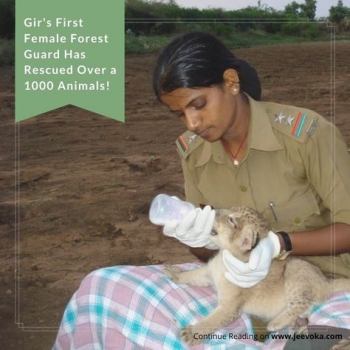
After the untimely death of Rasila Wadher’s father, her mother in Bhanduri village laboured hard to feed and educate Rasila and her younger brother. After completing her graduation in Hindi, the 21 years old Rasila then struggled to get a job to support her poor family.
She applied for the post of forest guard too, though no females were then selected for that. As she had been good at sports, Rasila was appointed the first female forest guard in Gujarat’s Gir National Park in 2007.
Being a young girl, she was given only the desk work inside the office. Instead of fighting with her colleagues and officers, Rasila decided to prove that women were no less than men. Her biggest fear was not of fierce animals, but of being removed from the team because of her gender. “I decided to work like a man. And if I work like a man, no one will doubt my potential,” she says.
An injured lioness was found in Dedakadi area of Bhavnagar district of the state. Though the lioness was debilitated, she was ferocious. Rasila joined the five men team to rescue the animal. The operation lasted an entire night. That was the turning point in her career.
A leopard had then fallen into an under-construction well in Jalandhar village of Junagadh, Gujarat. The rescue team from Gir National Park, some 1000 km away, arrived. The young Rasila got into the cage. The male members lowered the cage into the well of some 40-50 feet.
Tranquilizing the animal with a dart gun, she helped the leopard enter into the cage. Pulling it out of the well, the team members then released it in the Gir forest.
Rasila was then promoted to head the Gir’s Rescue Team. The lady, who wore one star in her uniform, now wears three stars. For the first time in its history a woman leads the team of 18 male trackers, going beyond the four districts of the state.
Heading the team, the young lady has rescued more than 1100 wild animals, including some 400 leopards, 200 lions, crocodiles, pythons and birds since 2007.
The task has become more challenging since the lions frequently stray close to human habitations. The animals also meet with accidents on the railway tracks that are passing through the forest.
“Mine is a 24 hours duty because you never know what will happen and where,” she says. At times the married Rasila takes her baby along when there is no one else to care him at home.
Besides rescuing the injured animals, they also take care of the orphaned ones and tackle poaching. “No single life has been so far lost during the rescue operations,” she says proudly.
“Animals will not trouble you unless you trouble them first,” she says. “Show them love and they will return it,” she adds.
Besides courage, dedication and hard work, Rasila has genuine love for the animals. Her exemplary spirit has drawn global applause.
Anyone who has no feelings for animals has a dead heart.”

.jpg) Stanislaus Alla
Stanislaus Alla
.jpg)
.png) Cedric Prakash
Cedric Prakash

.jpg) Elsa Lycias Joel
Elsa Lycias Joel
.jpg)
 A. J. Philip
.png) Jacob Peenikaparambil
Jacob Peenikaparambil
.jpg)
.png) John Dayal
John Dayal
.jpg)
.jpg)
.png) Joseph Maliakan
Joseph Maliakan
.png)
.png) Robert Clements
Robert Clements
.jpg) Cedric Prakash
Cedric Prakash