

.png) Dr. Pauly Mathew Muricken
Dr. Pauly Mathew Muricken
They speak in scientific tones,
Professional and low,
One argues for a speedy cure,
The other, sure and slow
To one so humble as myself
It should be a matter for some pride
To have such noted fellows here,
Conferring at my side” -- Sara Teasdale, the American Lyric Poet
The prophetic words conveyed by Journal of the American Health Association, a peer-reviewed International Journal, way back in 1892 were indeed a wake-up call and an eye-opener. It succinctly painted a condemnable trend against serving medical practitioners. It warned: “No physician, however conscientious or careful, can tell what day or hour he may not be the object of some undeserved attack, malicious accusation, blackmail or suit for damages”.
Reports of violence against doctors are intensifying day by day and present a horrifying picture across the country. It has become a rising bane. Violence takes the form of either verbal abuse or aggressive gesture. Very often the aggressors are patients themselves acting under the influence of drug and alcohol. Incidents of violence occur more during night duty. Sometimes violence leads to grievous hurt and even murder. Still law makers and enforcement agencies have not opened their eyes to address this perennial issue and growing menace, adequately and effectively, to deter the occurrence of such maladies in future.
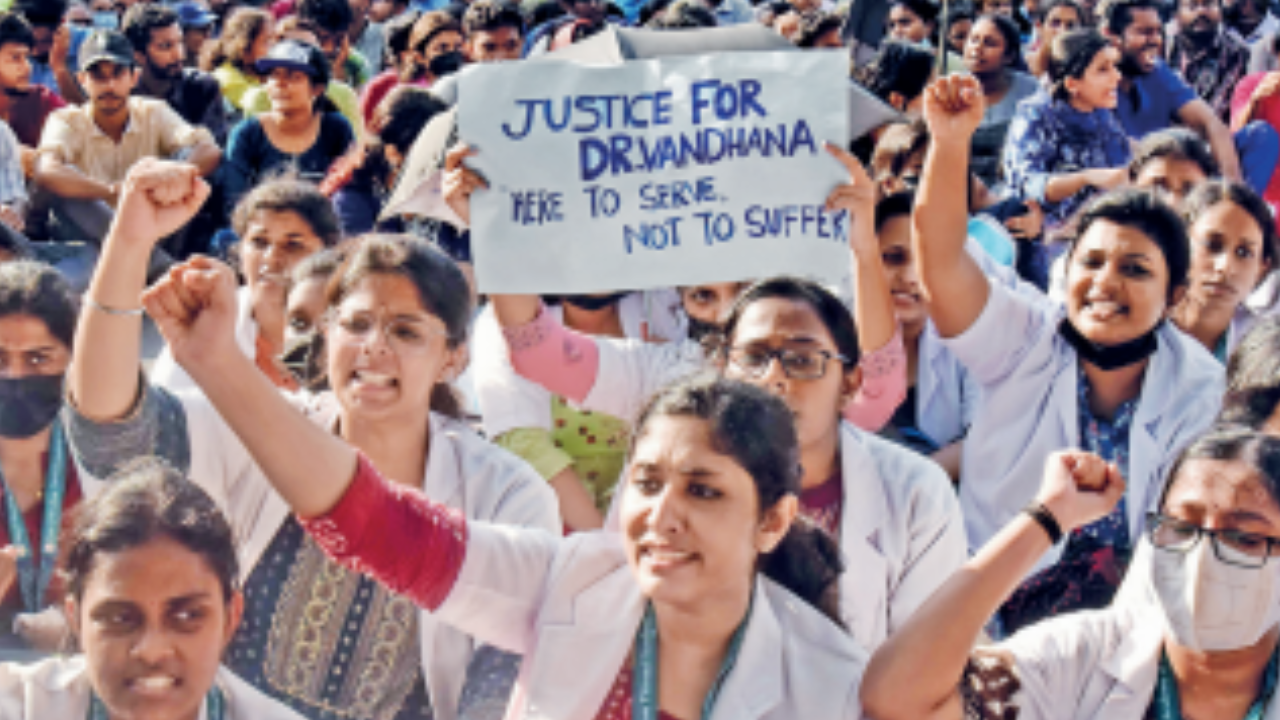
The incident that occurred in Kerala was shocking the conscience of all. The villain was none other than the patient himself. The martyr was a young doctor on duty, with a glorious future. She was entitled to the right to safety and security at the workplace. She had her freedom from interference with her life and dignity. She stood by the Hippocrates Oath till the last breath of her life to serve humanity by caring for the sick, promoting good health, and alleviating pain and suffering. In the said pursuit, she succumbed to her injuries.
She held close to her heart the core working values and principles that guide modern medical practice. Her life was her message. She practiced profession with conscience and dignity. The health of the patient was her first consideration. The oath of Maimonides was her daily prayer. She stood by her affirmation, “In Thy eternal providence, Thou hast chosen me to watch over the life and health of Thy creatures. I am now ready to devote myself to the duties of my profession. Help me, Almighty God, in this great work to do good to men, for without Thy help nothing I do will succeed.
Attacking the doctor is the weakest form of show of strength. The occurrences of assault against doctors are not always ‘heat of the moment’ reaction, but cruel, diabolic, cold blooded and calculated acts. Sometimes it is not the patients who take the law in their hands, but rather their relatives and bystanders. Such acts infuse fear in medical practitioners and destroy their confidence and prospects.
Protecting the Angels
There is a need to ensure safety and security of healthcare workers at the working premises. As per the provisions of the Constitution of India, ‘health’ and ‘law and order’ are State subjects and hence these are legislative areas to be attended to by the State Legislature. It is the responsibility of the State Governments to set up mechanisms to prevent violence against doctors including, but not limited to, imposition of penalties or setting up Helplines to extend immediate help to such doctors who are victims of violence.
Perpetrating violence against healthcare professionals is a criminal offence. But it needs to be dealt with effectively under the Indian Penal Code, Criminal Procedure Code and Special law so that doctors/clinical establishments discharge their professional pursuits without fear of violence.
Alleviating the Fear
Doctors are also human beings, to be treated with dignity and self-respect. Often, they forget their ‘self’ and sacrifice for the cause of the patients. They dedicate their whole for the service and well-being of the patients, even giving up their personal obligations and material enjoyments. They constitute the asset of the nation to be protected and respected by the Society and State. Their agony is our agony, their fear is our fear, and their insecurity is our insecurity. Their problems are our own problems to be resolved collectively.
Respecting the Dignity
Violence on doctors is an injury to their body and mind. It is an assault on their dignity. Dignity is the salt of life and it is the most precious perfume. Just as patients raise a slogan for dignity and respect, doctors are also equally entitled to dignified treatment at the workplace by the patients and their bystanders. They have a right for reasonable accommodation. They cannot be the sufferers always. Measures to inculcate a sense of security and safety among the doctors on duty are the need of the hour.
They have been wounded repeatedly and their wounds have to be healed through effective legislative and governmental measures that recognize the ‘charter of rights’ for doctors and build a safe workplace environment. Governments and Institutional mechanisms are often concerned with recognizing the charter of rights of the patients and seldom concerned with evolving a charter of rights for the medical service providers.
For security purposes, Government Hospitals should be reckoned as ‘sensitive areas’ and their security can be left to be managed by designated and trained security force. Installation of CCTV cameras and round-the-clock Quick Reaction Teams with effective communication/security gadgets, particularly at casualty, emergency and areas having high footfalls could be considered as part of the policy action. Entry has to be restricted for undesirable persons. Well-equipped centralized control room has to be established for monitoring and quick response.
FIR has to be instituted in time against aggressors without delay. Doctors should be freed from excessive work burden and pressures. Security measures for night duty have to be tightened. Above all, global doctor-patient ratio has to be achieved and infrastructural facilities and equipment have to be improved.
Guardians of Health
Safety and security are the basic needs for every individual. McLeod S.Maslow’s ‘hierarchy of needs’ emphatically considers safety and security as constituting basic needs in the pyramid of needs. Right to work in a safe environment without the threat of violence is therefore the basic need of every medical practitioner. World Health Organization has defined ‘workplace violence’ in the health sector as incidents where staff is abused, threatened or assaulted in circumstances relating to their work, including commuting to and from work, involving an explicit or implicit challenge to their safety, well- being, or health.
A doctor may invoke self defence against violence in circumstances justified by law. Self-defence is a part of the right to life. Ashworth A.J., in an article titled ‘Self defence and the right to life’ published in Cambridge Law Journal highlights that freedom from interference can only be preserved by restricting everyone’s freedom to exercise power over others. Perhaps the most fundamental and universal restriction is that placed on the use of force by one individual against another.
Challenges to the doctors on the security front have to be viewed predominantly and seriously. Violence should be recognized as a legal ground for denying treatment. Violence leads to fear, inability, and hesitancy to work. It is rather unfortunate that in a civilized society, guardians of health are constrained to garner attention for their legitimate needs through silent forms of protest like wearing a black band on the protest day or withdrawing from work .
Preventive Measures
The Medical Protection Acts passed by various States have become ineffective in meeting the challenges in connection with prevention of violence or damage to property. It has constantly failed to protect Medicare Service Persons and Medicare Service Institutions. The prescribed punishment of imprisonment up to 3 years and fine up to Rs. 50,000 is hardly having any deterrent effect on the wrongdoers. State has to address this issue as a unique problem by bringing in a comprehensive legislation that enhances the penalties to have deterrent effect. It should also envisage victim compensation as a deterrent measure. Time has become ripe for such stringent measures. The boundless sacrifices of Medical Practitioners shall never go unnoticed. They have consecrated their lives to service of humanity.
A unique right should be recognized in favour of doctors obligating that patient should respect the dignity of the doctor and other hospital staff as human beings and as professionals. Whatever the grievance may be, patient/caregivers should not resort to violence in any form and damage or destroy any property of the hospital or the service provider.
As the Kerala Government has proceeded with Ordinance route to ensure the safety of healthcare professionals and hospital staff by appropriately amending the provisions of Kerala Healthcare Service Persons and Healthcare Service Institutions (Prevention of Violence and Damage to Property) Act, 2012, let it be a model legislation focusing on deterrence and stringent enforcement and thereby plugging out the rising bane of violence against healthcare service personnel and building up a safe working environment that protects their safety and security at the workplace.
Let the martyrdom of the young doctor pave the way for recognizing the ‘charter of rights’ of healthcare service providers and make the society and the public vigilant in honoring the medical profession with respect and dignity.
(The writer is a prominent Lawyer, an acclaimed writer and a distinguished academician based in Kochi)
.jpg)
 A. J. Philip

.png) Cedric Prakash
Cedric Prakash
.jpg)
 P. A. Chacko
.jpg)
.jpg)
.jpg) Thomas Menamparampil
Thomas Menamparampil
.png)
.png)
.png) Robert Clements
Robert Clements
.jpg)
.png)
.png) Chhotebhai
Chhotebhai