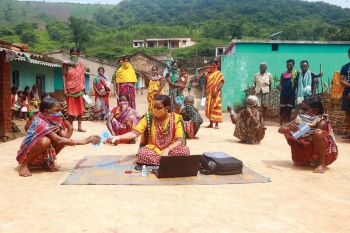


.jpg) F. M. Britto
F. M. Britto
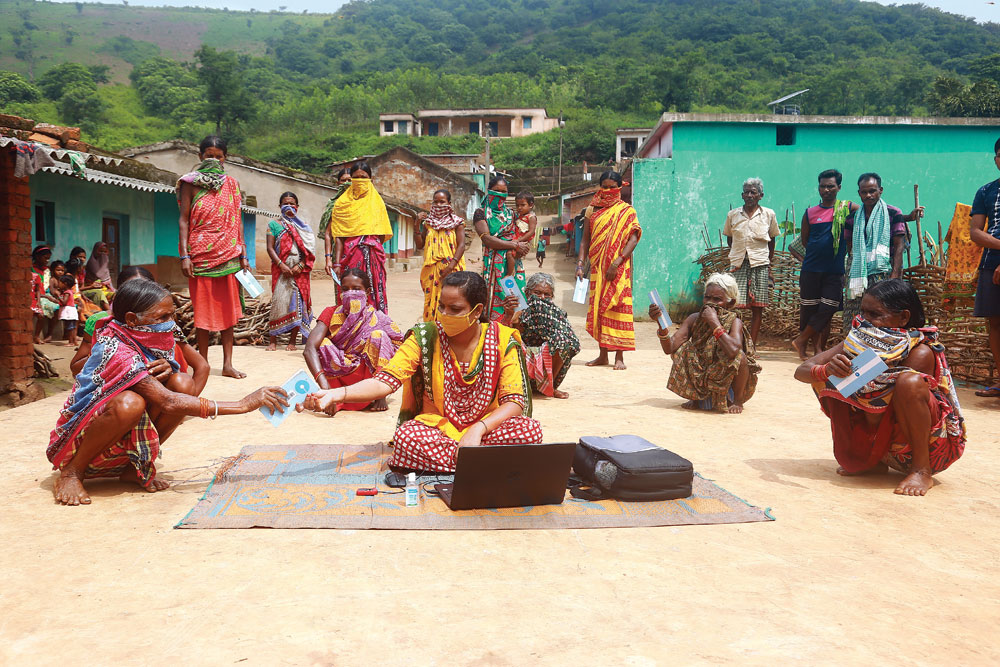
As she reaches a village, Salami Shashankar tells a reliable person to inform the people about her arrival. “Bank Madam has come,” word quickly passes around from one to another.
Searching for large shade of a tree, Salami then sits there spreading the leaves like a mat. As usual, the 27 years old girl has come to the far away village riding the pillion rider on her brother’s bike, carrying about Rs 40,000 and all the necessary documents. She has become the only medium for the tribals to do their bank transaction during the Covid-19 lockdown.
When the villagers gather, she also introduces various state and central governments’ schemes. Salami also assists them to write and submit their applications to benefit the government subsidies.
She also reminds the illiterate villagers during these Covid-19 pandemic days to maintain social distancing, wear masks and wash their hands with sanitizer she carries along.
Salami was earlier scared to go alone in the Maoist area, carrying huge amount of cash. “Miscreants could easily murder me for the cash but I kept praying to God. I knew he will save me from danger as I am on my way to help his people,” she says.
She leaves home every morning at about 8 A. M. After working for five to six hours, she returns to the bank before 4 P.M. so that the bank could enter the account.
After graduating in 2019, the labourer’s daughter wanted to help the uncared tribals living in remote villages around her Toyaput village in Koraput district of Odisha.
The 10 days residential training provided by the UNFPA-supported Mission Uday (Sunrise) enthused Salami to commit herself towards serving these hapless people. She borrowed money to purchase a laptop to enhance her knowledge.
The Odisha Livelihoods Mission then hired her in Dec 2019 as a contractual staff member. Her duty was to assist a self-help group.
The Laxmipur branch of the State Bank of India then employed her as an outsourced employee to reach out to the 20 remote tribal villages near her village. She started doing the banking services sitting in a small room of her village panchayat office.
When the Covid-19 lockdown was imposed, Salami realized that the far away tribals cannot come to the 19 km far away bank to avail their money. Besides lack of public transport, these illiterate villagers also would not be able to maintain the various safety norms. And the poor villagers were also in dire need of money.
Realizing that she just could not sit there waiting for the people to come to her, Salami wanted at any cost to reach out to her customers. So she began to visit the tribals in their far away villages to distribute their money.
Affectionately people call her “Bank Madam”. She has thus brought the bank to the tribals’ door. Her selfless services have won her appreciation, not only by the tribal villagers but also her colleagues and officers.
“The greatest happiness in the world is in helping the people you don't know and seeing them happy.”
(Serving the marginalized in a remote Chhattisgarh village, F. M. Britto is also a freelance writer and author. He can be contacted at: francismbritto@gmail.com)
.jpg)
.png) Cedric Prakash
Cedric Prakash
.jpg) Elsa Lycias Joel
Elsa Lycias Joel
.jpg)
 A. J. Philip
.png) Jacob Peenikaparambil
Jacob Peenikaparambil
.jpg)
.png) John Dayal
John Dayal
.jpg)
.jpg)
.png) Joseph Maliakan
Joseph Maliakan
.png)
.png) Robert Clements
Robert Clements
.jpg) Cedric Prakash
Cedric Prakash
 ICPA
ICPA