

.png) Jacob Peenikaparambil
Jacob Peenikaparambil
If the year 2020 was marked by the tragedies caused by the second wave of Covid 19, the year 2021 will remembered for both for the death and destruction cause by the second wave of the pandemic as well as increasing hate speeches and violent attacks on the minorities, especially Christians. The media had reported the right wing groups burning the effigy of Santa Claus and disturbing Christmas celebrations in a school in Karnataka on the eve of Christmas. The culmination of the harassment of Christians was the denial of the renewal of the FCRA (Foreign Contribution Regulation Act) registration to the Missionaries of Charity, a charitable organization founded by the noble laureate Mother Theresa.
The month of December also witnessed the horrific hate speeches by the so called saints of the Dharam Sansad held in Haridwar. Deeply offensive speeches were made during the meeting. Hindus were exhorted to take up arms and calls were made for violence and genocide of Muslims. None of the leaders of the BJP condemned the anti-national and anti-people statements made by the saints. Most of the leaders of opposition parties also maintained silence fearing the loss of Hindu votes in the forthcoming assembly elections.
The police administration was notoriously slow to act against the hate mongers until one person made a complaint. Even then the police registered cases only against three persons, even though many were indulging in rampant hate speeches. No action has been taken on the leaders who organized the meeting because they are the hard core supporters of the BJP. The police are often adopting a double standard. On one hand, a group of hate mongers are left free to spill the venom of hatred against minority communities. On the other hand, several false cases filed against social activists and comedians point to weaponization of law.
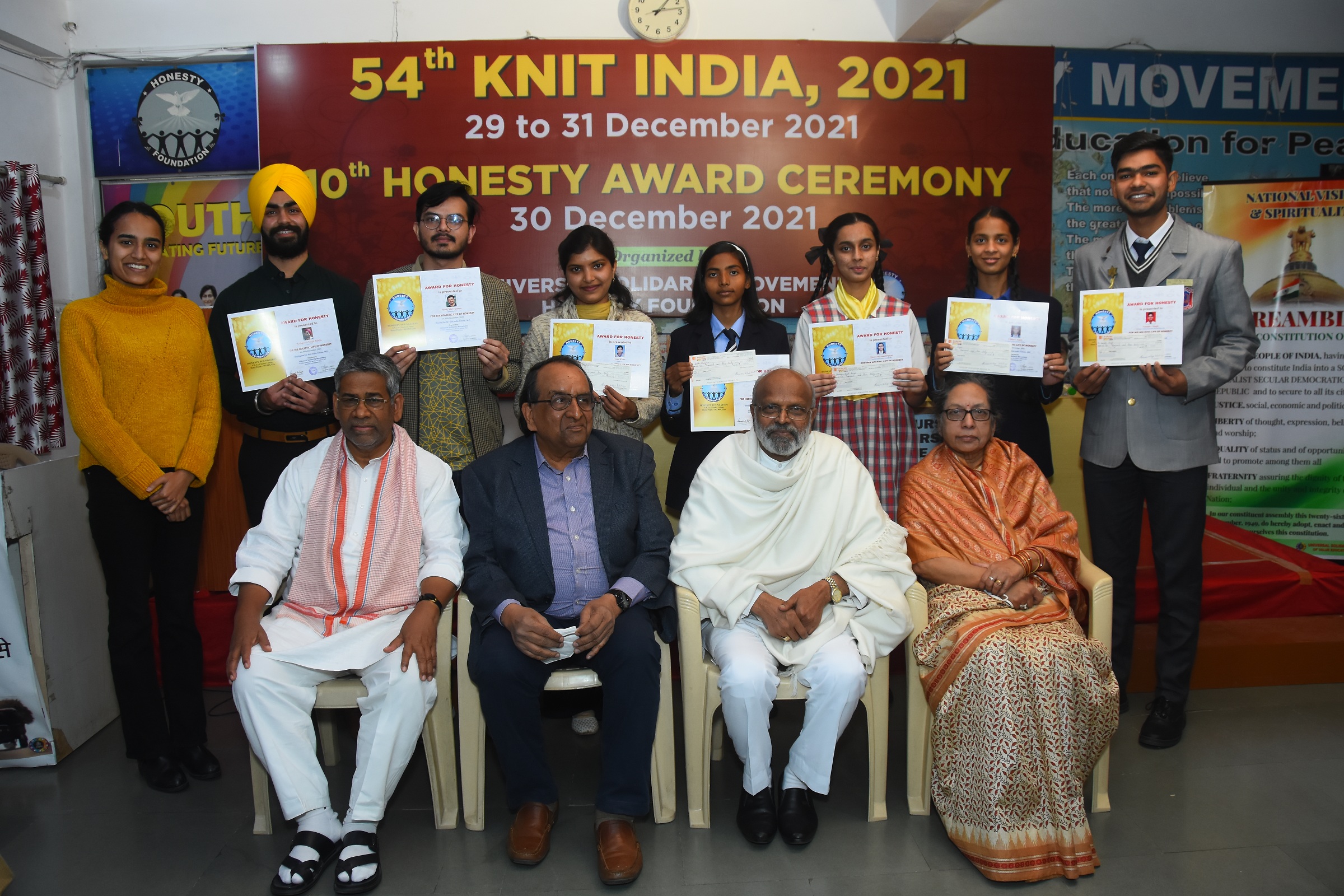
In the backdrop of increasing hate speeches, violent attacks on the minorities for dividing the people of India on the basis of religion, the Universal Solidarity Movement (USM) Indore organized the 54th Knit India. The central message of the 54th Knit India that was held from December 28 to 31 at the Universal Solidarity Movement (USM) Indore was unity of all Indians while accepting, appreciating and promoting diversities. The participants reaffirmed their conviction that what units all Indians is the millennial heritage of India i.e. Vasudhaiva Kutumbakam (The whole universe is a family) and the Constitution of India.
The participants heard from different experts and reflected once again on the core constitutional values: Justice, Liberty, Equality Fraternity, Individual Dignity and the fundamental rights and duties for all citizens. Four sessions on the Indian Constitution enriched the participants with regard to the richness and relevance of Indian constitution,
Taking into account the current scenario of coronovirus, Knit India 2021 was organized both offline and online. About 30 participants from 6 states of India participated offline and a good number of students, teachers, parents and friends of USM participated online.
One of the specialties of the 54th Knit India was building bonds among the participants since the number of participants who took part offline was small and they were all staying in the USM community. They all felt a family atmosphere and a bonding through mutual sharing that took place during the four days. Knitting India was taking place through informal interactions and relationship building.
Another speciality was that about a dozen USM alumni who have been part of USM from two to twelve years shared their life story and how the values they imbibed from the USM have been influencing their personal and professional life. A common thread that was found in the sharing of these young people is transformation that helped them to evolve a broad and inclusive vision for life, to become more sensitive and compassionate to the poor and the needy, to accept and appreciate pluralism and to care for mother earth.
In the midst of hate mongering and thousands of divisive and fake messages sent on the social media platforms, a few sentences from the sharing of the young people are indeed smoothening and encouraging.
Along with the inspirational sharing by the young people some of the motivating talks by persons with grass root level experiences made the Knit India 2021 an opportunity for great learning. Prominent among them is Meenakshi Natrajan former Member of Parliament and currently involved in training leaders in Panchayati Raj Institutions in different states of India.
Ms. Meenakshi Natrajan in her speech on “Nation Building” compared the State and the Nation to a house and a home. The state is only a framework with laws and structures, but what make a nation is its people, their aspirations, their dignity and their inter-relationships, she said. Nation building is a continuous process of empowering the citizens and making them partners. A nation is built when freedom is given to all citizens to express their voice of dissent. Nation is not built by Kshamata alone but mainly by mamata.
Ms. Sanjoly Banerji, a young social activist from Punjab, who dropped out of MSW course in Christ University after the first year in order to focus on her activities for empowering women and girl children, said that her vision is to make justice available to all Indians. Justice means access to opportunity and resources. She said emphatically that in the absence of Justice there cannot be peace. Promoting mental health and menstrual hygiene are two of her important interventions. Her sister Ananya is a partner in the mission of Sanjoli.
Mrs. Lovina D’Souza, a faithful member of USM for the last 23 years and presently working as a CEO of a company in the USA said that the practice of Five Paths of self transformation taught her to make time for doing something meaningful for others. “Saying that I have no time is only an excuse”, she said. “Only when we think about others will we be able to bring about change in ourselves”, she added. According to her, women have to come forward to empower women. Sometimes women become blocks in the empowerment of women.
Dr. MP Raju, a senior advocate of Supreme Court, in his presentation on the topic, “Constitutional Values Preserving the Soul of India” said that the core values of Indian constitution are summarized in the preamble: Justice, Liberty, Equality and Fraternity that ensures the dignity of individuals and unity of the nation. He also said that the preamble could be summed up in one word, “Love” or Fraternity. Unity of India cannot be sustained with force but only by ensuring the dignity of individuals. That is why even a terrorist like Kasab, was given the opportunity to defend himself in the court of law. Unfortunately, today the dignity of Individuals is trampled upon by the state and the non-state actors, making a mockery of the Indian Constitution.
Mr. Chinmay Mishra, a well-known Journalist, spoke about the challenges before the young people to defend the constitutional values and principles. He reminded the young people of the pledge taken by the members of the Constituent Assembly which mentions the promotion of world peace and the welfare of mankind. The young people of today are fed with enmity with the neighbouring countries and enmity against certain communities. The core of the constitution of India is FRATERNITY and DIGNITY of every individual. In this backdrop Chinmay Mishra referred to misogynistic questions that demean the dignity women were asked in the CBSE 10th class examination. He also mentioned burning the effigy of Santa Claus by some right wing groups. He said that it is symbolic of killing the aspirations of millions of children and youth of our country.
He also said that denouncing people who have dissenting views, children of upper caste refusing to eat the food cooked by a dalit in a school in Uttrakhand and the consequent dismissal of her from job, increasing crimes on children, continuance of child labour, overexploitation of natural resources are nothing but violation of the Indian constitution. He asked the young people to ask questions to their parents, teachers and elders and search for answers to the questions related to killing the soul of India, the constitution.
Mr. Vinod Pahar, a social worker from Maharashtra shared with the participants his life story of social interventions from the age of 12. Understanding about the life and teachings of Mahatma Gandhi and Vinobha Babe helped him get rid of the prejudices against Muslims and Christians and work for Hindu-Muslim unity in his town Dhulai. He empowered hundreds of women by adding value to the work of women by upgrading and marketing the items prepared by women like godadi and puran poli, a sweet item popular in Maharashtra. His concept of education is very pertinent when he says that the present education is making people violent whereas the true education should make people non-violent, sensitive and compassionate.
The cumulative effect of the Knit India 2021 is a renewed commitment on the part of the participants to practice and disseminate the constitutional values, especially pluralism, fraternity and individual dignity. They realized and experienced that a pluralist India with unity of minds and hearts can be built if the people of India practice fraternity.
.jpg)
.png) Cedric Prakash
Cedric Prakash
.jpg) Elsa Lycias Joel
Elsa Lycias Joel
.jpg)
 A. J. Philip
 Jacob Peenikaparambil
.jpg)
.png) John Dayal
John Dayal
.jpg)
.jpg)
.png) Joseph Maliakan
Joseph Maliakan
.png)
.png) Robert Clements
Robert Clements
.jpg) Cedric Prakash
Cedric Prakash
 ICPA
ICPA