

.png) Francis Sunil Rosario
Francis Sunil Rosario
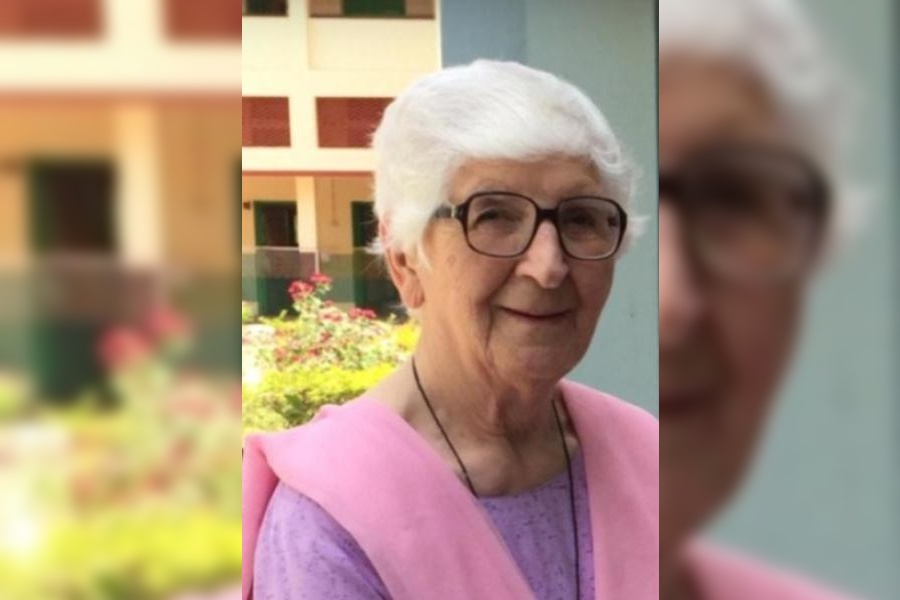
The life and mission of Sr. Maeve Hughes, IBVM, are beautifully encapsulated in the words of the Psalm:
"To you I stretch out my hands,
Like a parched land, my soul thirsts for you."
………………………………
"I put my trust in you,
Make me know the way I should walk:
To you I lift up my soul."
(Psalm 142/43)
Born in Ireland, she became Bengali to Bengalis and Adivasi to Adivasis. Motivated by incarnational spirituality, she emptied herself in the service of Christ (Phil. 2:6–8), becoming "all things to all men and women." Her life was a living kenosis—an offering of self to God—through servant leadership and a deep commitment to education, enabling students to become leaders in their communities.
Sr. Maeve entered the Institute of the Blessed Virgin Mary in Loreto Abbey, Rathfarnham, in 1946 at the age of seventeen. She professed her first vows in 1949 and arrived in India in 1950 with Sr. Jude Hales. For over 77 years, she devoted herself entirely to her mission in India.
A woman of profound faith and unwavering conviction, Sr. Maeve lived nearly a century. Her administrative talents were quickly recognised; she served as Headmistress of St. Mary's School, Entally, for 12 years, and later as Principal of Loreto, Dharmatala and Loreto College (1974–75).
A brilliant academic with a gift for languages, she earned a Master's in Bengali Literature from Calcutta University and served as Headmistress of a Bengali-medium school—a rare feat for a foreign-born nun. She carried forward the legacy of the Loreto Sisters, including St. Teresa of Calcutta, who once held the same post.
In The Telegraph (July 23, 2025), academic and author Julie Banerjee Mehta wrote:
"Sister Maeve Hughes, 96, was a scholar, author, and innovative principal of Loreto College, Calcutta. She balanced discipline with compassion and inspired hundreds of young women to pursue higher studies and teaching. She spoke Bengali like a native and spent her final years teaching Dalit students in Ranchi."
Ms. Mehta fondly recalled seeing Sr. Maeve immersed in archival research after long administrative days, always writing and thinking deeply.
Professor Sucheta Mukherji of Loreto College remembered her as:
"Organised, super-efficient, quick to respond. She trusted the hardworking and chastised the idle. She would listen in on classes to assess teaching quality. With a Master's in Bengali and experience teaching at Jadavpur University, she aimed to build an institution of excellence, not a finishing school."
Dr. Anuradha Chatterji, former head of the History department, described her as:
"A tough disciplinarian and acknowledged scholar with published work. Her wisdom, commitment, and gentle mentoring inspired me through the years."
For 13 years, Sr. Maeve led Loreto College to academic excellence and UGC recognition. Though at the helm, she remained grounded in grassroots service and empowerment.
Dr. Jacqueline Lewis, Professor of Psychology at Minnesota State University, recalled:
"A consummate academic, she demanded excellence. She was a wonderful mentor who encouraged me to pursue a PhD and an academic career."
Her prophetic voice resonated in her pioneering book, Epic Women: East and West (Asiatic Society), a contribution to women's studies that bridged India and Ireland. She highlighted the often-overlooked roles of women, such as those of Draupadi and Shakuntala, offering a corrective to the male-dominated narratives in ancient literature.
Even after a debilitating stroke that impaired her vision, Sr. Maeve continued her mission. In Ranchi, she taught English at St. Xavier's School and at IGNOU, mentoring young religious sisters and guiding the Daughters of St. Anne. She wrote the life of Mother Delphine Harte and ensured its translation into Hindi.
Despite her missionary life, she remained devoted to her family. She rejoiced in the visits of her nephews and nieces—Sean, Barry, Aine, and Cormac—and delighted in their children's lives and photos.
In 2021, at the age of 93, she travelled alone to her beloved Ireland. After her return, her health declined. From 2022 onwards, she began to experience loss of memory, sight, and hearing. She was blind and deaf in her final years.
She would have celebrated 80 years of religious life on September 24, 2025.
At the end of her earthly journey, though she could no longer see or hear, she bore her suffering in quiet dignity. Like St. Paul, she could say:
"I consider that the sufferings of this present time are not worth comparing with the glory that is to be revealed to us…" (Romans 8:18–21).
Sr. Maeve had already tasted God's glory on earth. Her life was a sacred song: "Glory to God in the highest, and peace to the world." She was a living testament of God's love for humanity.
Adieu!
.jpg)
 A. J. Philip
.jpg)
.png) Jacob Peenikaparambil
Jacob Peenikaparambil
.jpg)
.png) Cedric Prakash
Cedric Prakash
.jpg)
.png)
.jpg)
.png) Ram Puniyani
Ram Puniyani
.png)
.png) Robert Clements
Robert Clements
.jpg) Cedric Prakash
Cedric Prakash
.jpg)
 Pachu Menon