

 P. A. Chacko
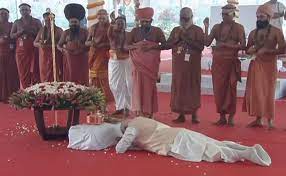
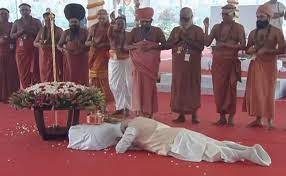
The Inauguration ritual enacted by Prime Minister Narendra Modi, flanked by a host of Hindu religious heads, at the new Parliament building on May 28 smacked of a Brahmanic ceremony to herald the Hindu Rashtra in the making. Even a decade before the final Ayodhya verdict by the Supreme Court, the temple was in the making part by part. What remained was putting together the ready-made parts. That is what happening now.
The attempts of the RSS, the BJP, the Bajrang Dal, and other Sangh Parivar outfits have been ever active for the past few decades to build up to this crescendo the devaluation of the Temple of democracy, the old Parliament building, “the symbol of India’s rebirth to yet higher destinies.” The Hindu Sadhus and Sadwins have been making open political statements to assert that this nation, with its majority community, has the divine sanction for being a Hindu Rashtra. The enthronement of Modi as Prime Minister in 2014 emboldened the propaganda bandwagon. The so-called secular Constitution has no worthwhile claim for its continuance, so the Saffron brigade would assert.
The zealots and bhakts have been trying to make us believe that India’s independence was not in 1947, but in 2014 when Modi became the Prime Minister. Loud-mouthed politicians dishing out visceral invectives against national minorities, lynching mobs and foot soldiers creating terror, advocacy of pauranic texts to replace school and college lessons, targeted bulldozer and demolition politics, erasing Mughal history at one stroke, Hinduized names of roads, railway stations and national institutions, etc. all fall in line.
Even the patriotic song ‘Sare jahan se acha’ has been thrown into the dust bin alongside the Mughal history. This enduring patriotic song was originally made for children. It made all Indians proud of a nation with its heralding secular sense and fellowship. In summary, it says, our land of Hindustan is better than any other nation; ours is a beautiful nation with its variety.... Religion does not teach to hate each other, Hindustan is our country.
Just because the poem, published in 1904, was written by Muslim poet Allama Muhammad Iqbal, it sounds obnoxious to the right-wing Hindu nationalists. In the bulldozer demolition spree of text books, this poem has been removed from a course on BA Honours in Political Science in Delhi University. This only shows how far we can go with our mud-headed stupidity.
One bhakt went to the extent of declaring that he preferred Godse to Gandhiji. Such people advocate that the time has come to devalue the Mahatma and glorify his killer. Some have suggested that Godse be declared national hero and national martyr. With a political agenda, Vinayak Damodar Savarkar’s photo was installed in the Central Hall of the old Parliament building. And, strategically, the inauguration of the new Parliament building was fixed to coincide with the birth anniversary of Savarkar who was said to collaborate with the British with his apologies. Surely, he will find a prominent place in the new Parliament House, probably face-to-face with Mahatma Gandhi. A new film glorifying Savarkar is already exists.
The devaluation of the Adivasis and the Dalits is complete with keeping President Draupati Murmu at arms’ length during the inauguration of the new Parliament building. The President is the first citizen of India. Article 79 of the Constitution states that the Parliament consists of the President of India and the two Houses of Parliament, namely the Council of States (Rajya Sabha) and the House of People (Lok Sabha). Recognizing the President as the Head of the State, the Constitution gives him/her the privilege of summoning, proroguing, addressing and sending messages to Parliament. The President can dissolve the Lok Sabha, promulgate ordinances, return legislations passed by Parliament, make recommendations for introducing money bills, give assent to bills, grant pardons, reprieves respites, etc. Yet this head of the nation and head of the Parliament was not allowed to inaugurate the new Parliament building. Even with the wildest of imaginations, one fails to understand why this great personality was not given the right and privilege to inaugurate the Parliament building.
Political thinkers are active in giving various reasons. Some say it is because President Draupati Murmu is a Tribal. Did someone say that the presence of tribal President could have polluted the august Brahmanic aura that surrounded the venue? Some others say it is because she is a woman. Still others say it is because she is considered a mere figurehead while the Prime Minister is the de facto all-in-all; it is an indication of what lies ahead; the Prime Minister could soon be the de jure and de facto all-in-one too.
Arrogating to himself the right to inaugurate the nation’s Parliament building, Modi wanted to be the centre piece. Political observers point out that Modi’s exercise, coated with Hindu rituals and using Sengol as symbol of power transition, is indicative of his possible claim of religion-backed divine right to rule India. In Roman, Mesopotamian, Judaic and monarchic traditions, the Emperor or the King was all-in-all and claimed to rule with divine right, sanctioned by gods and goddesses; and Sceptre or Sengol has been part of monarchy and ruling dynasties across the world as symbol of power.
Today, most absolute monarchies have shrunk, while a few others function as constitutional monarchies. In most cases, the Sengol has become a museum piece. However, the BJP government wants to use this Sengol as its rod of power. The nation has already watched with consternation the use of the ‘sengol batons’ on the striking sports persons on the day of the erection of the Sengol by the Prime Minister. The Sengol power by not arresting the person accused of sexual molestation provoked the wrestlers to decide to throw the medals on the chest of Mother Ganga.
Home Minister Amit Shah’s version of the Sengol as symbol of transfer of power has been contradicted by people who looked into historical facts. Some have pointed out that there was no such transfer of power through a formal Sengol ceremony. Critics say that, in any case, Sengol must be consigned as a museum piece. The Constitution of India, which is the fundamental law for the Parliament and the nation, should be the guiding force in our democratic set up.
.jpg)
.png) Cedric Prakash
Cedric Prakash
.jpg) Elsa Lycias Joel
Elsa Lycias Joel
.jpg)
 A. J. Philip
.png) Jacob Peenikaparambil
Jacob Peenikaparambil
.jpg)
.png) John Dayal
John Dayal
.jpg)
.jpg)
.png) Joseph Maliakan
Joseph Maliakan
.png)
.png) Robert Clements
Robert Clements
.jpg) Cedric Prakash
Cedric Prakash
 ICPA
ICPA