

.jpg) Don Aguiar
Don Aguiar
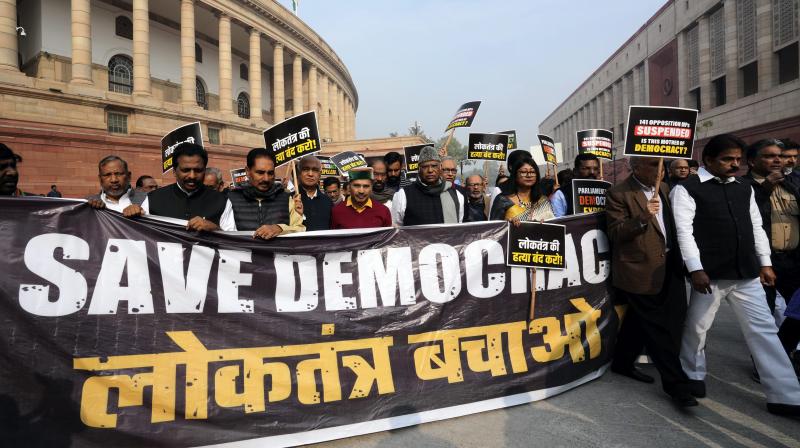
Loksabha elections are underway in India. These crucial elections will determine the existence of India's various institutions, especially the Indian Constitution.
For many, the election day holiday means a picnic, the movies, or something else, but not voting, because identification with the family is way bigger than national identity. If my family and I are doing well, I don't care about what is happening to the country. The idea that "there are others to vote, so what if I don't?" is quite prevalent in the country.
On Election Day, few turn up except those herded by political parties using money and whatever goading methods they utilise. This is an irresponsible way to exist. "Democracy" means rule by the people, of the people and for the people. This means that the power belongs to the people. Our people have yet to understand that this is our nation, and we build this nation. We are still in a feudal mindset. We think an elected person is a king or an emperor. This is partly due to a lack of education and information and partly to a lack of identification with the nation. Somebody is going to run this nation.
Finding a solution is imperative; it's a task for the present moment. For the current situation to conclude, casting your vote in the current electoral process this April/May 2024 is essential. When you do, it should be approached with increased seriousness and commitment. The aim should be to provide the Indian nation with a hopeful perspective for the future.
It is too early to fully comprehend the situation, as the electoral process is underway. Right now, it's a period of pain, sorrow, and anger. The Indian nation has to wait until these emotions subside before one can begin to reflect on the situation.
Nevertheless, India's people must approach this reflection by focusing on facts and reality. Whatever religion one follows, they remain here; they will not disappear. Therefore, India's citizens must find a way to engage with each other differently, moving away from the current state of affairs.
India is currently experiencing a dark period during which every institution is subverted, and an atmosphere of fear is created. People, ideas, and artistic freedom are held hostage to power politics.
Atrocities are faced by Christians in India. Mainly targeted are visible figures like priests and nuns. Churches are destroyed in many places, and Christian symbols are vandalised. International funding to Christian groups has been choked. Church outreach to the poor, the Dalits, once considered "untouchables" and indigenous groups, is affected. Prejudices have infiltrated independent institutions, such as the police, the EC and the courts. The impunity empowers Hindu militant groups to threaten, harass and attack Muslims and Christians with impunity.
India's other religious communities, opposition parties and secularists live in challenging times when there are persecutions, increasing polarisation on the grounds of race/caste/religion, growing inequalities with the poor getting poorer, mass spontaneous protests by the affected people and the rule of law being made a mockery by dictatorial regimes.
In response to these protests, the government calls in the police to beat, forcibly remove, and arrest the occupiers, hospitalising several. An autocratic style of functioning has jailed many opposition leaders and issued warnings to others.
Now, again, this same agenda is being weaponised against organisers fighting to end the election malpractices as the current government is desperate to continue to stay in power, to make India a Hindu nation where the rights of other religious communities will be restricted, and this could lead to difficulties for the minorities to continue the present freedom of religious worship.
Most recently, the opposition leadership faced disciplinary action and arrest from the government for organising nonviolent citizen protests in accordance with secular democratic principles as laid down by the Constitution.
The interpretation of the communal autocratic government agenda for many opposition political party members is that joining their party is the only acceptable way to come out criminal or corruption-free.
One of the early uses of their agenda was to punish citizens protesting their communal autocratic manner in ruling the nation. It's important to understand that these are more than unjust attempts at autocratic disciplinary action against minorities and opposition party leaders—this government's policy has a long history of repressing protest organisers and opposition leaders asking inconvenient questions about their doings.
Prime Minister Modi and his ministers keep reminding the nation of their agenda of making India an autocratic Hindu state from the present secular democratic Constitution of India.
On the surface, their agenda professes support towards development. However, as the prime minister and his ministers have pointedly reminded the nation, their agenda says interfering with the "duties and activities" of the government is "unacceptable." This means that protests and demonstrations will be banned in India, where "the work of the Government is carried out." The government's use of a communal agenda leaves little doubt about its purpose.
Nevertheless, the longer the communal autocratic government maintained its opposition to follow the secular democratic Constitution, the more it has fanned the flames of criticism and citizen activism.
Thanks to the tremendous resilience of the secular and democratic protestors and, to some extent, the courts, the government has slowed its pace in implementing its communal agenda.
Their agenda may rear its head again quickly should they be re-elected during the elections in April/May 2024. So Vote You Must for the installation of a Secular Democratic Government.
When the chips are down, as they are now, governments show their true colours. I am unaware of any government that loves its dissenters, their best and most authentic citizens.
The internet and social media are big factors as they help amplify accusations that the protestors are anti-government. Unfortunately, they ramp up the opposition's emotional, political, and personal aspects.
History makes it clear: Severely restricting when and where protesters can protest was always the main objective of the communal autocratic agenda.
For those protesting, though, history also provides an unexpected reassurance. It shows that those focusing on a secular democratic India as laid down by the Constitution follow a long, proud succession of brave citizens who have fought against colonialism, imperialism, apartheid, and exploitation. They continue a tradition of citizen movements holding their government accountable for creating a better world.
While these examples show that repression will come, they also see what will come next: victory and, one day, the judgment of history.
.jpg)
.png) Cedric Prakash
Cedric Prakash
.jpg)
 Pachu Menon
.jpg)
 A. J. Philip
.png) Jacob Peenikaparambil
Jacob Peenikaparambil

.jpg)
.jpg) Mathew John
Mathew John
.png)
.png)
.png) Robert Clements
Robert Clements
.jpg) A. J. Philip
A. J. Philip
.jpg) Jacob Peenikaparambil
Jacob Peenikaparambil