

.png) Varghese Alengaden
Varghese Alengaden
.jpg)
“I have already registered to be part of the Global Peace Convention and informed my staff that I would be busy for three days from 30th January to 1st February ”, said Dipak Choudhary a businessman (Chairman, Nishiindo Foods) from Veraval in Gujarat. Earlier Dipak had been to Dimapur in Nagaland to participate in the 2nd National Peace Convention. Though he has a very hectic schedule related to his business, he takes time to be part of the programmes organized by Universal Solidarity Movement. He was actively present in the recently held 53rd Knit India event from 28 to 31 December 2020.
Rtn Dr. Renu Singh is another example of a person who is balancing her family responsibilities with commitment to many social work programmes. One can learn from her how a married woman finds time to get involved in social movements without failing her duty at home and profession. She does not make excuses like ‘I have a family’; ‘it is too far and how can I travel alone so far’; ‘it is expensive’ and the like because her vision has become passion for her.
When she committed herself to be a member of Peace Committee of Rotary district 3040 she used to travel by taxi from Nagda to Indore, a distance of 120 km, for monthly meetings. She never failed in this task. She used to reach anywhere to be part of the activities related to Rotary and Peace Movement.
When her husband Dr. Suryakumar Singh was transferred to Kharach in Bharuch District of Gujarat she did not make excuse of being far away. With full support of her husband Dr. Renu Singh travels 65 km distance by road and boards a train from Surat to reach Indore in the morning after making an overnight journey. She participates in a meeting for two hours in the evening and travels back by night train to be back home by afternoon on the next day. She gladly takes this trouble every month. “When I am committed to a cause I should not be stopped by any obstacle or excuse. Moreover every meeting is an opportunity to learn. My husband understands the mission in which I am engaged and the people who are involved in the mission”. Dr. Suryakumar, her husband, takes leave to travel with Dr. Renu to participate in the yearly National Peace Convention which is held in different cities of the country.
Advocate Satya Narayan Lathi (72) is another example of commitment. From the inception of National Peace Movement he has been participating in every National Peace Convention in different parts of the country with his wife Aruna. She does not make an excuse of not knowing English to be absent from any session. Advocate Lathi inspires and motivates several persons from his village town Sonkatch to participate regularly in the National Peace Convention. Advocate Lathi also participates in the monthly peace committee meetings and other activities. Neither driving a distance of 70 km in the night nor other routine excuses stops him from being present for every meeting. He along with his friends organizes a peace rally and public meeting in Sonkatch on 2nd October every year to mark the birth anniversary of Mahatma Gandhi.
I recall what my professor of philosophy Dr. Thomas Ryan used to remind us four decades ago about time management and setting priorities. “If you want to get something done urgently, go to the busiest person”. Dipak, Dr. Renu and Advocate Lathi are examples of practicing this principle of time management and setting priorities.
Many women and men who have various responsibilities in the family and in the society make time to be part of the monthly peace committee meeting. They participate in the yearly National Peace Convention in the spirit of an annual pilgrimage. All of them commit themselves to promote peace, knowing well that they have nothing to gain financially except peace and fellowship of people who believe and work for human solidarity. I personally feel that they have understood what I speak often in my talks that “heaven is on earth and eternity is to be experienced in this life; service to human beings is worship to God and love is God”.
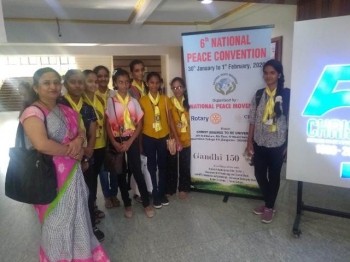
Since 2015, National Peace Movement in collaboration with other organizations has been organizing National Peace Convention every year from 30 January to 1 February in different cities of India. This peace initiative was launched by the Rotary International District 3040 as part of the first major focus area of Rotary International, ‘Peace and Conflict Prevention/ Resolution”.
The three hundred delegates gathered in Hotel Radisson Blu, Indore for the first National Peace Convention unanimously launched an organisation, National Peace Movement, to take this mission forward with people from all walks of life and faiths. National Peace Conventions were held every year in Dimapur (Nagaland), Goa, Kochi, Gurugram (NCR - Delhi) and Bangalore. Delegates came from all parts of India. They consisted of Rotarians, social workers, journalists, educationists, youth and students.
Inspired by the event participants committed themselves to organize more activities and seminars related to peace at the local and state level. Several Peace Clubs were formed and many activities were organized.
‘Light a candle instead of cursing the darkness’ was the motivating force behind the formation of the National Peace Movement and all activities related to it. Instead of blaming and criticising about the deteriorating conditions due to corruption, communal polarisation, violence and hatred all were motivated to take responsibility for creating a peaceful atmosphere wherever they were living and working.
Several persons who have participated once in a Peace Convention made it their priority to participate in every convention. They also got involved in organising local activities. There were several persons who have travelled to distant parts of the country to participate in every Peace Convention. Positive response of many was very encouraging.
Indifference of Christians :
The majority Hindu community doesn’t require promoting inter-religious harmony and peace activities. Minority communities who are targeted by the Hindutva forces need peace initiatives and inter-religious dialogue to enter into the mainstream and build friendship with other communities and organisations. But they are the least and the last people who show any interest and enthusiasm in these programmes. They make many excuses for not joining such events. Despite facing opposition and harassment frequently and being alienated, they don’t feel the need to be part of any mainstream activity.
The purpose of launching the National Peace Movement and organizing Peace Conventions across the country regularly in collaboration with secular organisations was again to restore the soul of India with its pluralistic heritage.
The central theme and concern of Christ was to build peace. He categorically said, “Blessed are the peacemakers, they will be called children of God''. Christians, very specially priests and religious should be the first to promote peace initiatives. Unfortunately they are the least interested in this mission of Christ. Seeing their disinterest and indifference what comes to my mind is the words of prophet Isaiah which Jesus applied to the indifferent Jewish priestly class, “This people will listen and listen, but not understand; they will look and look but not see, because their minds are dull and they have stopped up their ears and have closed their eyes” ( Mt13: 14-15)..
Seeing the indifference and inaction of many priests, nuns and leaders of the Church in this new way of evangelisation the following questions come to my mind: How long will we remain indifferent? How long will we wait for a miracle from above? How long will we wait for a Messiah to redeem us?
We don’t hear any reactions or statements from the Church leaders about any serious issues which affect millions of people of India. The prophetic Pope Francis is quick to make his opinion boldly against all major issues faced by the people in any part of the world. He calls for peace and justice fearlessly.
When will we act as prophets to the nations and work to bear lasting fruit and leave a legacy behind for the world to follow for years to come?
.jpg)
.png) Cedric Prakash
Cedric Prakash
.jpg) Elsa Lycias Joel
Elsa Lycias Joel
.jpg)
 A. J. Philip
.png) Jacob Peenikaparambil
Jacob Peenikaparambil
.jpg)
.png) John Dayal
John Dayal
.jpg)
.jpg)
.png) Joseph Maliakan
Joseph Maliakan
.png)
.png) Robert Clements
Robert Clements
.jpg) Cedric Prakash
Cedric Prakash
 ICPA
ICPA