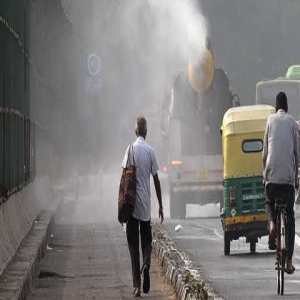


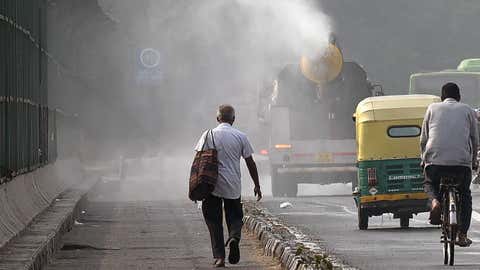
These days, we start our day with news-making headlines: "AQI deteriorates, "North India choking," and "AQI severely worsens." With the onset of winter, pollution blanketed north India so copiously that many schools were closed, outdoor activities were restricted, and one could see people wearing masks. Lots of assertions popped up, from stubbing burning to weather changes.
What has gone erroneous in the last few years? Chandigarh city was planned by the famous architect Le Corbusier; it was a masterpiece of urban planning. Chandigarh, which used to be the cleanest and most serene city, has turned into a place of congestion and poor air quality. Roads and markets, once peaceful, now remain jam-packed even on weekdays. The deplorable air quality, congestion, and traffic jams not only affect our social but also our mental well-being, leaving no space where one can sit away from the hustle and bustle of city life. I vividly remember a few four-wheelers on the broad roads, a sweet breeze during monsoon, and lush green surroundings. During the last few decades, Chandigarh has witnessed a population increase from 24,261 in 1951 to 10,54,686 in 2011 (Census data - Chandigarh Master Plan – 2031).
Population boom - sustainability and social cost
Environmentalists talk about sustainability, meeting our own needs without compromising the ability of future generations. Nonetheless, this term is bizarre in the context of India. Saving resources for 142.86 crores (World Bank, United States Census Bureau, 2023), which will double in the next few years, seems not viable without controlling the population boom. From resource depletion to environmental degradation, unemployment, increased crime, and inequality, the impacts are wide-ranging and interrelated.
There is no shortage of data reflecting the effects of the population explosion and its economic and social costs. Data on the growth of registered motor vehicles reveals that, amongst all categories, two-wheelers accounted for the highest number. It spiked from 0.027 million two-wheelers in 1951 to 243.68 million in 2020, followed by cars, jeeps and taxis with 436.5 lakhs (Road Transport Year, 2019-20). Additionally, rapid urbanisation leads to overcrowding, traffic congestion, the development of slums, and the lack of access to essential facilities. However, it is eccentric that the subject of population has not received due deliberation from policymakers and political leaders. Unfortunately, neither the ruling party nor the opposition discusses the population as their major agenda.
Implementation - a foremost concern
The Center and State Government have made a lot of efforts, for instance, Mission Parivar Vikas (MPV), a two-child norm policy by Andhra Pradesh and UP, to ensure a balance between population growth and resource availability. However, the ground implementation of such programs is still a matter in question. Data on health reflects that many South Indian states are seeing substantial drops in fertility rates. They adopted an approach focused on public sensitisation and maternal and infant healthcare. It is fundamental to comprehend that the successful models and examples must be replicated to strengthen existing family planning programs. The Government must acknowledge that rapid population growth could severely wreck development and be a main hurdle in reaching our primary goal of achieving sustainability and a high quality of life.
In quest of a haven for tranquillity
Amid the poor air quality, the quest for a haven for serenity becomes a requirement. The constant bustle of traffic and haze of smog have created a pining for tranquil spaces. The morning chirping of birds is replaced by continued honking. The pleasant earthy fragrance, breezy winds and restful morning walk seem like a dream. It would be doable if we reflect on the idea of controlling population explosion.
.png) Cedric Prakash
Cedric Prakash
.JPG)
 A. J. Philip

.png) Jacob Peenikaparambil
Jacob Peenikaparambil
.jpg)
.png) John Dayal
John Dayal
.jpg)
 Pachu Menon
.png)
.png)
.png) Robert Clements
Robert Clements