

.png) Dr Suresh Mathew
Dr Suresh Mathew
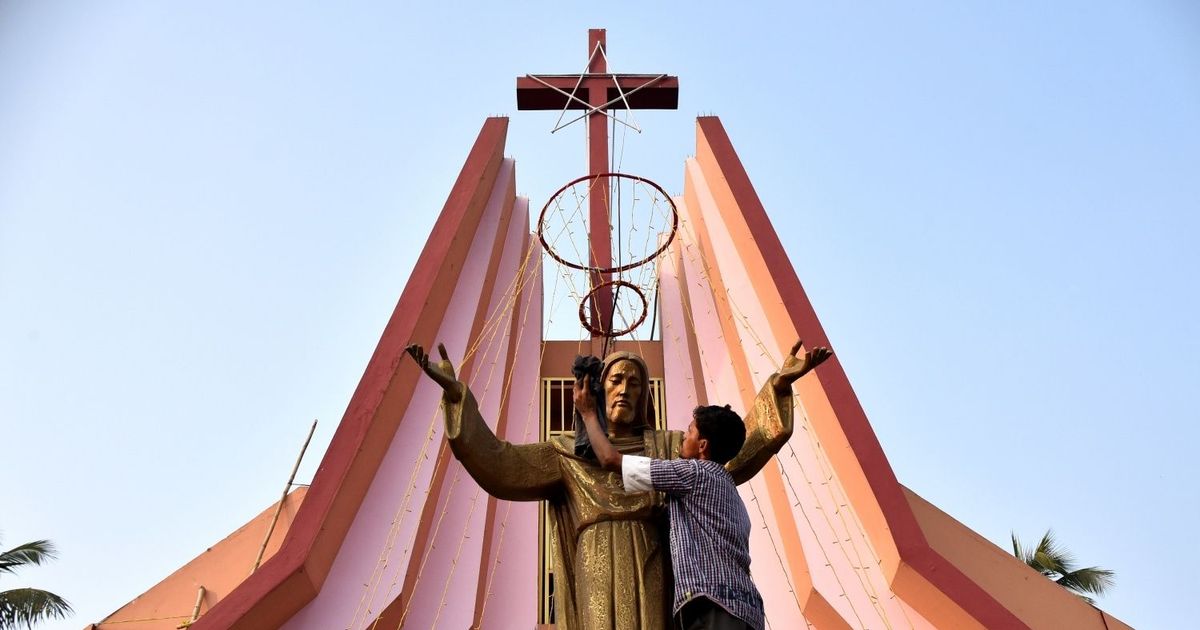
There are no forced or illegal conversions in Tamil Nadu. This matter-of-fact assertion is made in an affidavit filed by the State in Supreme Court. It further nails the lie on conversions, being spread by Sangh Parivar forces, stating that such claims are without any basis or proof. The Government made its position clear while the court was hearing a petition filed by a lawyer alleging forced conversion to Christianity as a cause for death of a school-going girl in the State. The Tamil Nadu government’s testimony is an assertion of the fact that there is not even an iota of truth in the petitioner’s ‘claim that incidents are reported every week throughout the country where religious conversion is done by intimidating, threatening, deceiving, and luring through gifts.’
As the Sangh Parivar offshoots continue their outlandish attacks on Christian communities, raising the most dishonest and fictional claim of forcible conversions, Tamil Nadu’s assertion should be an eye-opener for all. It should put the ‘conversion bogey’ to rest once and for all. The argument dished out for legislating the draconian anti-conversion laws in states like Uttar Pradesh, Madhya Pradesh, Himachal Pradesh, and Gujarat among others, falls flat. If a State like Tamil Nadu which has a Christian population of about 7 per cent confirms that there are no forcible conversions there, how could the allegation of conversion by states with less than half per cent Christian population stands the test of scrutiny. The negligible and stagnant Christian population in those states, and no convictions in ‘alleged conversion cases’ filed across the country, bring out the hollowness of the claims of Sangh Parivar.
There is nothing more ridiculous and erroneous than the oft-repeated conversion bogey. The Tamil Nadu government’s observations have major implications not only for the ongoing debate over ‘alleged conversions’ but also for the right to practice and propagate religion as guaranteed in the Constitution. Going a step further, the state government, quoting Article 25 of the Constitution, said that the acts of missionaries spreading Christianity by itself cannot be seen as something against law, provided their acts do not infringe public order, morality or other provisions of the statute.
While a state government sees nothing wrong in the minority community members exercising their constitutionally-granted freedom to practice, preach and propagate their religion, the anti-conversion laws curtail the very same rights given by the Constitution. The increasing number of attacks on Christians, their priests, pastors, worshiping places and institutions on trumped up charges of forcible conversions is nothing but a ploy to clear the road to Hindu Rashtra.
The Supreme Court is already seized of the matter as it is hearing a batch of petitions challenging the anti-conversion laws in five states. The apex court has, in fact, advised the petitioners to compile all the petitions in various states and move a consolidated petition so that the case can be transferred to the top court. The submission of the Tamil Nadu government that there are no forcible conversions in the State goes to prove that the anti-conversion laws are undesirable and offensive as the ‘crime’ they intend to tackle does not exist on the ground. It is futile to attempt to tackle a presumed crime that does not exist.
.png) Cedric Prakash
Cedric Prakash
.JPG)
 A. J. Philip

.png) Jacob Peenikaparambil
Jacob Peenikaparambil
.jpg)
.png) John Dayal
John Dayal
.jpg)
 Pachu Menon
.png)
.png)
.png) Robert Clements
Robert Clements