

.png) Dr Suresh Mathew
Dr Suresh Mathew
‘Riots (read ‘communal clashes’) don’t take place wherever BJP is in power.’ The saffron party leaders are fond of making this statement from every available public platform. Union Home Minister Amit Shah said so again on April 3 at a public meeting in Bihar. Exactly 30 days from Shah’s ominous declaration, on May 3, Manipur was on fire, nailing the party’s lie and falsehood. The North-East state, the BJP’s new-found grazing field, witnessed one of the worst communal clashes non-stop for three to four days. A lie can not become truth even if it is repeated several times.
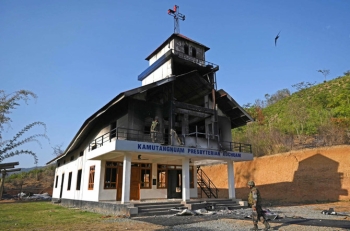
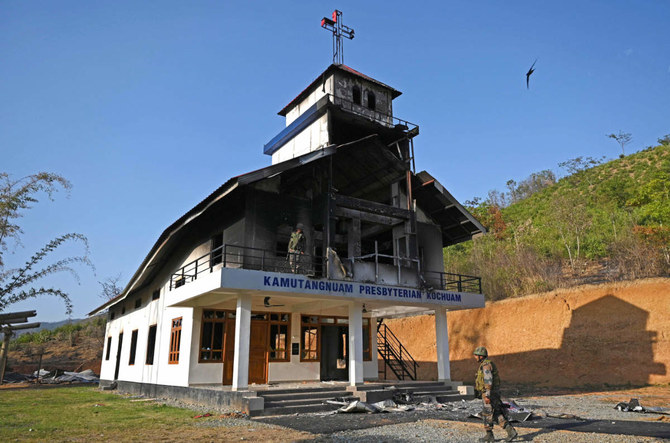
What happened in Manipur is apparently communal clashes between the Meiteis and the Kukis. While majority of Meiteis are Hindus, the tribal Kukis are mostly Christians. Undoubtedly, other tribals too joined the fight against Meiteis who are not tribals. However, from the day the clashes broke out, the government’s propaganda machinery worked round-the-clock to portray it as ethnic violence with no relevance to religion. But the burning embers of over 100 churches stand testimony to the communal venom being spread in the State. The fact that armed gangs were roaming around Imphal looking for people of a particular community on the basis of their ID cards let the cat out. The selective destruction of Christian houses, convents, schools, hostels and pastoral centre bears witness to the real nature and purpose of the violence. One should know that no violence erupts in a vacuum. The fleeing Christians, in thousands, who have taken shelter in relief camps, say there is something more to it than meets the eye.
The trigger for the violence came from a move to grant Scheduled Tribe status to the Meitei community based on an order from the Manipur High Court. The Supreme Court’s observation that the High Court does not have the power to decide on the matter and give any direction shows which side the truth lies. When the High Court does not have the power to dictate on the matter, what prompted the BJP government to make further moves in this regard? The government apparently wanted the Meitei community to have a share in the Scheduled Tribe pie. It is interesting to note that the BJP government at the Centre is objecting tooth and nail to granting Scheduled Caste status to Dalit Christians and Muslims.
The State government should gather gumption to repair the ruptured communal fabric. The state had witnessed communal harmony prior to the mayhem. The Christian community had not faced such attacks and assaults on their members, their houses or worshiping places. Their life has turned upside down after the BJP government came to power on the promise that ‘double engine government’ would take the State to the peak of progress; unfortunately, the opposite has happened. The State government cannot absolve itself of the responsibility of rebuilding the life of the victims.
The unprecedented violence evoked a feeble response from the top official forums of the Church like the CBCI. It was left to individual bishops to condemn the violence and pick holes in the government’s reaction to the situation. Archbishop Dominic Lumon of Imphal has urged the Christian community to chip in to help the victims. The Church has to take the initiative for the healing process in the State.
.jpg)
.png) Cedric Prakash
Cedric Prakash
.jpg) Elsa Lycias Joel
Elsa Lycias Joel
.jpg)
 A. J. Philip
.png) Jacob Peenikaparambil
Jacob Peenikaparambil
.jpg)
.png) John Dayal
John Dayal
.jpg)
.jpg)
.png) Joseph Maliakan
Joseph Maliakan
.png)
.png) Robert Clements
Robert Clements
.jpg) Cedric Prakash
Cedric Prakash
 ICPA
ICPA