

Testing Time for Democracy

Dr Suresh Mathew Dr Suresh Mathew
02 Nov 2020

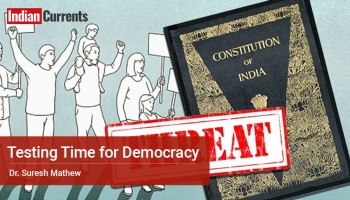
In an address to the global investors sometime back, Prime Minister Narendra Modi wooed them to invest in India, holding the democratic credentials of the country as the prime reason for them to do so. Contrast this with the latest report by the Sweden-based V-Dem Institute that studies the fate of democracy across the globe: “India has continued on a path of steep decline, to the extent it has almost lost its status as a democracy”. The report, in an unsparing criticism, states that the country is on the road to autocracy. V-Dem is an independent research institute set up in 2014 and has been publishing worldwide democracy report each year. 


The report is based on many parameters of democracy. It scanned factors like freedom of expression and free media; freedom of association; checks on the executive; quality of elections; and the rule of law. The country’s report card on each of these counts is distressing and deplorable to say the least. Political analysts say that the present state of freedom of expression and media is worse than the dark days of Emergency era of 1975. The government seems to be in a hurry to slap sedition and defamation charges against students, activists, academicians, journalists and general public for raising voice against its anti-people policies and programmes. Dissent has become anathema to the government; opposition parties and leaders are earning the ire of the investigating agencies and they are seemingly under pressure to act according to the whims and fancies of the government.


People’s protests and their voices are the pulse of democracy; democracy dies where protests are prohibited or ignored. The government of the day does not give a damn to the expression of people’s views as we saw during the anti-CAA protests. Agitation against anti-farmer and anti-labour laws also met with same arrogant attitude and apathy. The government uses strong arm tactics and the harshest laws to teach protesters and dissenters a lesson. The alacrity shown in booking people under sedition laws could sound the death knell of democracy sooner than expected.  

Also Read - Democracy in Decline:The Frightening Slide of Democracy in India by Ramesh Menon

Major pillars of democracy are shaken; Parliamentary proceedings and independence of judiciary have come into question. If the recently concluded Parliament session is any indication, the ruling party is hell-bent on pushing its agenda through the sanctum sanctorum of democracy without proper debate and discussion. Controversial Bills that are seemingly detrimental to the farmers and workers were ‘bulldozed’ through both Houses of Parliament. Another inexplicable development is en masse resignation of MLAs within few months of election and joining a rival party with diametrically opposite ideology and help it form the government. The same scenario is repeated during elections to Rajya Sabha seats to enable a particular party get its candidates win. Elections are losing their sanctity due to such back-door entries.   

Also Read - Dwindling Democracy : On Shrinking Democratic Space in India by Cedric Prakash

Another stain on democracy is the misuse of laws and putting people behind bars as part of an apparent agenda. Anti-cow slaughter and anti-conversion laws are just two of them which have been used and misused to spread canards against minority communities and unleash atrocities against them. The cumulative effect of all these aberrations and violations is that the country is moving on the road to authoritarianism. It is the most testing time for Indian democracy.

For Updates on Latest News 

Recent Posts

Bengal once welcomed missionaries who built schools, hospitals and presses, enriching the region's education, healthcare and reform. Today, priests are told to leave their parishes. The irony is devas
apicture CM Paul
17 Aug 2026
With Christians constituting barely 2.3 per cent of India's population, the charge of mass forced conversion defies logic. Yet anti-conversion laws pivot charity into "allurement," suspicion and crime
apicture Chhotebhai
17 Aug 2026
Dr RB Sreekala's work brings out something beautiful in Koodashappana: how a German Jesuit, Kerala's Malayalam tradition and Sanskrit learning came together to tell the story of Jesus in the language
apicture A. J. Philip
17 Aug 2026
Eighty years after Independence, the question is whether Indians remain free. With increasing threats to citizenship, dissent, faith and liberty, Swaraj demands a second struggle to defend freedom for
apicture Jacob Peenikaparambil
17 Aug 2026
The Old Testament is insistent on this point almost to the point of severity. When Moses approached the burning bush, he was told, "Do not come near; take your sandals off your feet, for the place on
apicture Dr K. M. George
17 Aug 2026
Nehru's Cabinet was surrounded by persons who did not share his ideology. They were retained mostly out of a sense of loyalty to old colleagues, persons who fought side by side for Independence.
apicture G Ramachandram
17 Aug 2026
You think I am a forbidden fruit, unworthy of your love. But I never think You are a forbidden fruit, Even though India forbids your Nagalim.
apicture Dr Suryaraju Mattimalla
17 Aug 2026
The truly confident leader does not need ridicule. He does not humiliate opponents or turn every speech into a performance about his own greatness. His strength is visible in restraint, fairness, humi
apicture Robert Clements
17 Aug 2026
Political independence was never Gandhi's final destination. He envisioned a Republic rooted in constitutional values, social justice and human dignity. Every Independence Day invites a single questio
apicture Joe Eruppakkatt
10 Aug 2026
The Arthashastra counsels engagement, accountability and informed leadership—not disappearance. A government that retreats from Parliament while students demand justice betrays not only democratic con
apicture A. J. Philip
10 Aug 2026