

.jpg) Jessy Kurian
.jpg)
"The view that 24 hours begins only from the formal arrest is contrary to the Constitutional mandate and Section 58 of BNSS," the Court said.
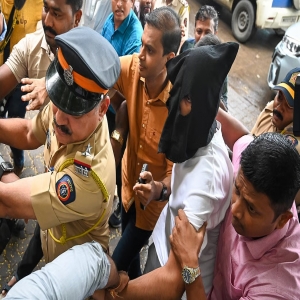
The Supreme Court held that the 24-hour constitutional deadline for producing a person before a Magistrate begins at the time of detention, not when the law enforcement agency records the arrest.
The key difference is that detention is a temporary restriction of movement for preliminary questioning or investigation. In contrast, an arrest is a formal legal process by which a person is taken into custody based on probable cause.
The common understanding was that the 24-hour deadline begins with the formal arrest, and law enforcement agencies were following the same procedure.
On November 5, Justices Ujjal Bhuyan and Atul S. Chandurkar, while passing an order in Sujit Das vs Union of India (SLP (Crl.) Nos. 12451–12453/2026), held that, as personal liberty is a fundamental constitutional safeguard, there is no distinction between "arrest" and "detention" for the purpose of Article 22(2) of the Constitution.
The Court also overruled the judgments of the High Court of Orissa in Artanab Oattbataj vs Union of India (2025), the High Court of Kerala in Arun K. Thomas v. Narcotics Control Bureau (2026), and the High Court of Madras in Kannan vs State of Tamil Nadu (2026), which had held that pre-arrest detention could be excluded while calculating the 24 hours under Article 22(2). It held that these decisions did not lay down the correct position in law.
However, the Court approved the Kerala High Court's decision in Biswajith Mandal vs Inspector, Narcotic Control Bureau (2025), which held that the 24-hour statutory deadline for producing an accused before a Magistrate under Article 22(2) of the Constitution begins from the moment a person's liberty is effectively curtailed rather than when the police formally record the arrest.
The Court clarified that the only period that can be excluded while calculating the 24-hour deadline is the time required to travel from the place of arrest to the Magistrate's Court. Time spent on investigation, enquiry, or search and seizure before a formal arrest cannot be excluded.
The Bench said that the ex
Article 22(2) of the Constitution mandates that every person arrested and detained in custody must be produced before the nearest Magistrate within 24 hours. Section 58 of the Bharatiya Nagarik Suraksha Sanhita (BNSS), 2023, prohibits police officers from detaining an arrested person without a warrant for more than 24 hours.
The Bench also expressed reservations about a two-judge Bench ruling earlier this year in Sukhwinder Singh vs Union of India, which held that the right to a speedy trial under Article 21 cannot override the stringent statutory conditions for granting bail under the Narcotic Drugs and Psychotropic Substances (NDPS) Act. The Court felt that this ruling failed to adequately consider the Supreme Court's 2021 three-judge Bench judgment in KA Najeeb vs Union of India, which held that prolonged incarceration and the denial of a speedy trial could constitute grounds for granting bail even under stringent laws such as the NDPS Act and the Prevention of Money Laundering Act (PMLA).
The facts of the case are that an appeal was filed by four persons arrested in connection with the seizure of 11.03 kg of Yaba tablets. The Tripura High Court denied them bail, holding that the stringent conditions under Section 37 of the NDPS Act must be satisfied in cases involving commercial quantities of contraband.
The accused persons challenged the legality of their arrest, claiming that they were detained on September 29, 2025, at 2 pm during a search and seizure operation but were formally shown as arrested only at 11 am the following day. The High Court rejected their argument, relying on the Supreme Court's earlier 2026 order in Sukhwinder Singh. The Court also held that prolonged incarceration and trial delays could not, by themselves, override the statutory restrictions on bail under the NDPS Act.
In a nutshell, the Supreme Court ruled that the 24-hour constitutional deadline for producing an arrested person before a Magistrate for remand begins when the person's liberty is curtailed through detention, not when the investigating agency records a formal arrest.
Directions to the Magistrates
The Court also passed certain directions to the Magistrates:
1. The 24-hour clock begins from actual detention, not formal arrest.
2. Detention beyond 24 hours without production before a Magistrate requires immediate release.
3. Only the necessary travel time to the Magistrate's Court can be excluded.
4. No artificial distinction between detention and arrest is constitutionally permissible.
5. No investigative buffer period outside Article 22(2) can be created.
6. Detention must also be reasonable under Section 58 of BNSS, even within 24 hours.
7. The Magistrate must record the actual date and time of detention and verify compliance with Article 22(2).
8. The Magistrate may refuse remand where detention exceeds a reasonable period, even if it is within 24 hours.
"Clause (2) of Article 22 does not sanction the creation of a new zone where the liberty of an individual is curtailed for investigative purposes but not formally shown as arrested. Creation or contemplation of such a buffer zone is unconstitutional," said the Court.
"The Constitution does not recognise any detention divorced from arrest… The prescription of the 24-hour time period would commence the moment a person is detained by the arresting authority, suspecting him to have committed an offence, when his liberty is effectively curtailed."
In conclusion, the Supreme Court ruled that no artificial "buffer period" or separate legal zone exists for detention. The 24-hour clock to produce a person before a Magistrate begins the moment their liberty is curtailed.

 Cedric Prakash
.jpg)
 Mathew John

 Jacob Peenikaparambil
.jpg)
 John Dayal
Jessy Kurian

.jpg)
 P. A. Chacko

 Robert Clements
.jpg) Jacob Peenikaparambil