

 John Dayal
.jpg)
Narendra Modi may strut around western capitals and wear the most colourful Rajputana turban to raise himself above mere mortals, but for the 500 or so candidates of the Bharatiya Janata Party in the Lok Sabha elections, and thousands more in the State legislative and municipal constituencies, it is an almost faceless party or Rashtriya Swayamsevak Sangh cadre who makes the difference between victory and defeat.
Meet the "Panna Pramukh," who is the shepherd and pied piper for the faithful party voter, the driving cog of the BJP's electoral machinery, who has helped Modi out-organise the Opposition where it matters - in the polling booth.
The growing difficulty of dislodging the BJP from power over the last 14 years cannot be explained by Narendra Modi's popularity, the party's command over money and media, or even the weakness of the Opposition.
The deeper organisational story is of the electoral apparatus the BJP, with the full collaboration of the RSS, has built over the years that reaches into neighbourhoods, collects information about voters, studies electoral behaviour and maintains a presence that survives the loss of individual elections.
Its strength lies in the combination of political organisation, data, and an increasingly contentious debate over the Election Commission's independence, ever since Rahul Gandhi first raised the matter of "vote chori" some five years ago.
The panna pramukh network, the use of data and artificial intelligence in election campaigns, and the changing relationship between the government and the constitutional institution entrusted with conducting elections now back the BJP's grassroots confidence and Modi's political arrogance.
The BJP's remarkable investment is in the smallest unit of electoral politics: the household.
The panna pramukh, literally the person responsible for a page of the electoral roll, is the BJP's most visible instrument of this strategy.
Each worker is assigned a section of the voters' list and expected to maintain contact with the families named on it, his flock varying with the size of the electoral roll, but the principle is consistent - he is someone who knows the voters, their social backgrounds, their concerns and, as far as possible, their political preferences.
The BJP-RSS organisational network developed the system, and it became particularly prominent in the 2014 general election, when Amit Shah directed the party's campaign in Uttar Pradesh.
It subsequently became an important feature of the BJP's electoral organisation in several states.
The panna pramukh is not merely a person who distributes leaflets or turns up during election season, but someone who remains in touch with voters, identifies local grievances, mobilises supporters and reports information through the party's organisational hierarchy, a system whose significance is easily underestimated.
Indian politics has traditionally depended on caste networks, local notables, including the rich with financial resources and feudal satraps who still have a social hold on many people, apart from community leaders and personal relationships.
The BJP has brought these relationships within a systematic party structure, correctly understanding that a worker who knows the families on his page of the electoral rolls is potentially more useful than a campaign advertisement seen by millions.
The party's electoral intelligence begins at the doorstep.
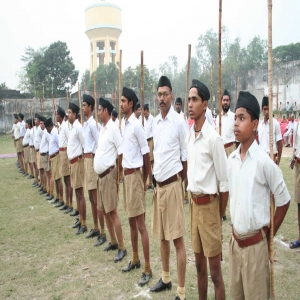
The RSS is an important organisational foundation despite its public position, which has generally been that it does not directly contest elections but encourages political participation and voter mobilisation.
Reporters covering grassroots politics and election campaigns have seen how the Sangh cadre network, built through daily shakhas in neighbourhood parks and decades of local activity, has repeatedly been an important resource for the BJP.
The relationship is particularly significant because it is not dependent on the party holding government office.
In Uttar Pradesh, RSS-linked workers played an important role in the BJP's organisational expansion before the 2014 general election.
Similar mobilisation networks have been reported in subsequent state elections. So the BJP can lose a state government without losing the organisational infrastructure that helped it win in the first place.
Its political machinery does not have to be rebuilt every five years, for the BJP has invested in permanent organisation.
This is an advantage the Congress and most regional parties have failed to match, as they often mobilise energetically during elections but struggle to sustain their presence between them.
The second development is the growing importance of electoral data, as every election produces a substantial amount of publicly available information.
Form 20, published by the returning officer, records the votes each candidate receives at individual polling stations, allowing political parties, researchers, and election analysts to examine voting patterns at the booth level.
This can reveal where a party has gained or lost support and where its campaign requires attention.
Booth-wise election results were available under the earlier paper-ballot system as well, but what has changed is how sophisticatedly political organisations can now combine electoral results with other information.
Age profiles, caste composition, welfare beneficiaries, local grievances, previous voting patterns and digital engagement can all become inputs into campaign planning.
Artificial intelligence and predictive analytics offer parties new ways to organise this information, identify persuadable voter groups, and tailor campaign messages.
The 2026 state elections have provided further evidence of AI-assisted campaigning, and reports from Tamil Nadu, West Bengal, Assam and Kerala describe the use of AI for regional-language content, digital war rooms, political messaging and the rapid production of campaign material.
The more serious issue is unequal capacity to use information, as data is valuable only when an organisation has the people, money, and political networks to act on it.
The BJP's booth-level workers provide that missing link between analysis and mobilisation. With its extensive grassroots network, the party can respond quickly to information about a constituency or a neighbourhood.
Any other party may have the same election data and analysis but lack the organisational capacity to use it.
The third issue is the Election Commission itself, now at the heart of a debate on constitutional accountability playing out in the Supreme Court, the media, and on the streets of New Delhi and various State capitals.
On March 2, 2023, the Supreme Court directed that the Chief Election Commissioner and Election Commissioners should be appointed on the recommendation of a committee comprising the Prime Minister, the Leader of the Opposition in the Lok Sabha and the Chief Justice of India. This arrangement was to continue until Parliament enacted a law governing appointments.
Parliament subsequently enacted the Chief Election Commissioner and Other Election Commissioners (Appointment, Conditions of Service and Term of Office) Act, 2023 on December 28, 2023, replacing the Chief Justice with a Union Cabinet Minister nominated by the Prime Minister.
The implication was that two members of the three-person selection committee belonged to the executive government led by the Prime Minister. At the same time, the Leader of the Opposition occupied a perpetual minority position.
The government maintains that Parliament has the constitutional authority to determine the appointment process, but opponents maintain that an institution expected to supervise elections involving the ruling party must be appointed through a process that inspires confidence in its independence.
To cap it, the new law also introduced Section 16, which protects serving and former Election Commissioners against civil and criminal proceedings for acts, words or decisions undertaken in the discharge, or purported discharge, of their official duties, an immunity not enjoyed by any other person in a Constitutional office.
The 'Vote Chor, Gaddi Chhod' slogans now reverberating through the country, targeting Modi and Chief Election Commissioner Gyanesh Kumar, are a result of that confrontation.
The controversy over the Election Commission has acquired greater urgency in the context of the Special Intensive Revision of electoral rolls.
Rahul Gandhi, the Leader of the Opposition in the Lok Sabha, has repeatedly alleged large-scale vote theft, accusing the Election Commission of permitting questionable inclusions and targeted deletions in electoral rolls, allegations the Election Commission has rejected in its affidavits in the Supreme Court.
In Bihar, the electoral roll contained approximately 7.89 crore voters when the Special Intensive Revision began on June 24, 2025, and the final roll, published on September 30, 2025, contained approximately 7.42 crore voters.
In Uttar Pradesh, the draft electoral roll published on January 6, 2026 contained approximately 12.55 crore voters, compared with 15.44 crore in the earlier roll and nearly 2.89 crore names, representing 18.70 per cent of the previous electorate, were not carried into the draft list.
For a country where millions of people migrate for work, where documentation is uneven and where poor and marginalised communities frequently struggle with administrative procedures, the consequences can be severe, disenfranchising a citizen without reason.
This is a political asymmetry which the BJP, with workers embedded in neighbourhoods, access to extensive electoral information and the resources to monitor revisions, uses to protect its supporters' names and identify possible changes.
Opposition parties with weak booth-level representation are at a disadvantage.
The Supreme Court's judgment of May 27, 2026, in the Bihar SIR proceedings upheld the Election Commission's authority to conduct the revision under the existing legal framework. However, the Court ordered greater transparency in publishing excluded voters and their reasons for exclusion, and directed that Aadhaar be accepted as an identity document.
The Opposition has, perforce, had to confront its own failures, particularly the Congress, which has suffered from organisational erosion, weak booth-level representation and an inability to sustain political engagement between elections.
The BJP's advantage is not simply that it has more workers. It has developed a political culture in which electoral preparation is continuous.
Its opponents too often begin preparing when the election schedule is announced, but by then, the battle for local relationships, information, and voter confidence may already be lost.
This is especially important when the party in power also possesses an unmatched organisational and technological advantage.
Patently, even if the Supreme Court does not deliver a ruling in time for the next state elections in 2027, the Opposition will have to return to the patient work of rebuilding its organisation at the booth and neighbourhood level.
The danger remains that the institutional safeguards which make electoral competition meaningful may not keep pace with the extraordinary concentration of political and organisational power now enjoyed by the BJP.

 Cedric Prakash
.jpg)
 Mathew John

 Jacob Peenikaparambil
John Dayal
.jpg)
.jpg) Jessy Kurian

.jpg)
 P. A. Chacko
 Robert Clements
.jpg) Jacob Peenikaparambil