

.png) Ram Puniyani
Ram Puniyani
.jpg)
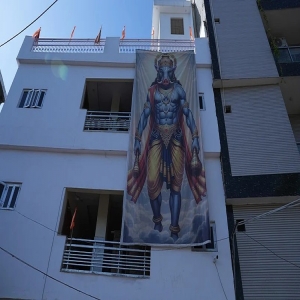
In Delhi's Tri Nagar, some Hindu families appear to have embraced a new form of devotion and a way to deter Muslim neighbours — pigs. The animals are kept in cages at homes, while the walls display posters of a powerful, pig-faced deity adorned in jewellery, much like other gods. This is happening in the locality near the Muslim locality. The Pigs in the cage are named Abdul or Rahman or some such name, and when any Muslim passes by, these words are shouted loudly.
Parallel to this is the well-decorated, armament-adorned picture of Lord Varaha, believed to be the third incarnation of Lord Vishnu. While some claim that this trend began a year ago, others hold that it is a phenomenon of just a few months. The dislike of Muslims for pigs is well known, and this is a method to provoke Muslims in some way. Such techniques are usually applied as a prelude to creating the walls of hatred amongst the communities.
One does not know whose fertile and hateful imagination has started this trend, one does not know whether this is restricted to only one locality in Delhi, but surely the danger is that this, one more divisive tool, will be picked up in more places, adding to the armamentarium of those who benefit from spreading hate and thereby violence.
Interestingly, Islamophobia has become a dominant global phenomenon after 9/11, propagated by the US media by coining the phrase Islamic terrorism. So, it was eye-opening and interesting to find that a similar thing took place in New York, in front of the House of its mayor, Zohran Mamdani.
Last month, MAGA supporters in New York organised a pig roast in front of Muslim mayor Zohran Mamdani's office. But the funniest part about such incidents remains that they're based on a misunderstanding rooted in ignorance. Hindus and Christians can eat all the pork they want and keep pigs as pets—that does not bother Muslims.
In the last few years, pig was not much of a pretext; it was the cow which dominated the scene. The pig was used by communal forces as an instrument of communal politics during the freedom struggle. That time, the pig and the cow were both in the forefront as the pretext for instigating violence. One recalls the outstanding miniseries 'Tamas' by Govind Nihalani, based on the award-winning novel with the same name by Bhisham Sahni. In this story, Nathu, an outcaste, is given some money by the Muslim politician to kill a pig and put it in the mosque. The communal politician is very clear that this will lead to violence, thereby increasing his social and political stature.
In recent times, there have been scattered incidents in which beef was kept in the temples to instigate the violence. In most cases, it was Bajrang Dal activists who had kept the beef. Four people, including the Moradabad district president of Bajrang Dal, Monu Bishnoi, have been arrested by the Uttar Pradesh Police for slaughtering a cow and trying to implicate a Muslim man in a false case. They have also been accused of conspiring against the police. A lot of cases of vigilante groups attacking those carrying cattle have surfaced. There is a big chain of such vigilante groups making merry in the name of opposing cow slaughter.
As such, the cow-related violence has led to the emergence of a phenomenon of lynching. There are horrific cases, and over 100 lynching have taken place over the last 10 years. Starting from Pehlu Khan in Dadri, the intensity of lynching has been reaching very horrific proportions. The details of these cases are heart-wrenching. One Junaid's is particularly very disturbing. A 16-year-old boy, Junaid Khan, was riding on a train with his brother. An elderly man asked him for a seat, which he immediately provided. But subsequently, a crowd of 25 men surrounded him and began chanting "beef-eaters" and "Pakistani." Junaid was stabbed and died.
What disturbs one is how communal forces devise new mechanisms to create hatred, after which violence invariably follows. A lot has been written on Hate speech by those indulging in communal politics. Cascading right from the PM, new hate slogans are floated and passed down. The foot soldiers of these tendencies take it further down and make the lives of Hindus and Muslim communities more miserable, so that the minority has to abandon their lives in the neighbourhood. They are more troubled after such incidents.
The famous ones from PM range from "Hum do, Hamare do" (we two ours two) to "they can be recognised by their clothes." From Adityanath's "Batenge toh Katenge" (if we [Hindus] are divided, we will be killed) are supplemented by equally dangerous ones from the opposing camp. In a highly controversial speech delivered in Adilabad in December 2012, AIMIM leader Akbaruddin Owaisi remarked that if the police were removed for 15 minutes, his community (referring to "25 crore Muslims") would demonstrate their strength against "100 crore" Hindus.
The most disturbing aspect of the present introduction of pig (Varaha) into the political battleground of communalism is the capacity of divisive forces to introduce new mechanisms into their politics. The intercommunity closeness, which was a hallmark of our Ganga-Jamuni tehzeeb (Syncretic culture), is going down the drain. This pig element will ensure that Hindus and Muslims can't even live in the same neighbourhood.
Already, Muslims are being forced into living in ghettos; with the pig elements coming in, being introduced by social engineering, now the gaps between the communities (Hindus-Muslims) will widen unless we nip it in the bud, unless we ensure that the artificially introduced adoption of pigs by Hindus is not discouraged.
People are free to choose their pets and Gods so far, as long as they don't cross the line to humiliate the other community. Just a reminder: Lord Varaha came as a saviour, whereas adopting pigs in this manner will have negative implications.
.jpg)
.png) Cedric Prakash
Cedric Prakash
 ICPA
ICPA
 ICPA
ICPA
 ICPA
ICPA
 ICPA
ICPA
 ICPA
ICPA
 ICPA
ICPA
.jpg)
 A. J. Philip
.jpg)
.png) Jacob Peenikaparambil
Jacob Peenikaparambil
.jpg)
.png) John Dayal
John Dayal