

.png) Jacob Peenikaparambil
Jacob Peenikaparambil
After the declaration of the results of the elections to four state assemblies in the first week of May, new governments were formed in West Bengal and Kerala: the Bharatiya Janata Party (BJP) in West Bengal and the United Democratic Front (UDF), led by the Congress, in Kerala. Not only were the policies and decisions of the two governments in sharp contrast, but the political atmosphere preceding their formation also reflected this difference.
In West Bengal, the declaration of the election results was followed by large-scale violence and intimidation allegedly carried out by supporters of the victorious party. Hours after the results were announced, numerous Trinamool Congress (TMC) party offices were ransacked, vandalised, and set on fire in districts such as Asansol, Tollygunge, Baruipur, Kamarhati, and Howrah. The TMC leadership accused victorious BJP workers of systematically targeting its cadres. At least four people were confirmed dead in the initial days of the unrest.
In contrast, the political atmosphere in Kerala was marked by jubilation among UDF supporters, and no incidents of violence were reported. Although UDF supporters expressed their dissatisfaction on social media over the inordinate delay in the Congress High Command's announcement of the Chief Minister's name, there were no incidents of violence.
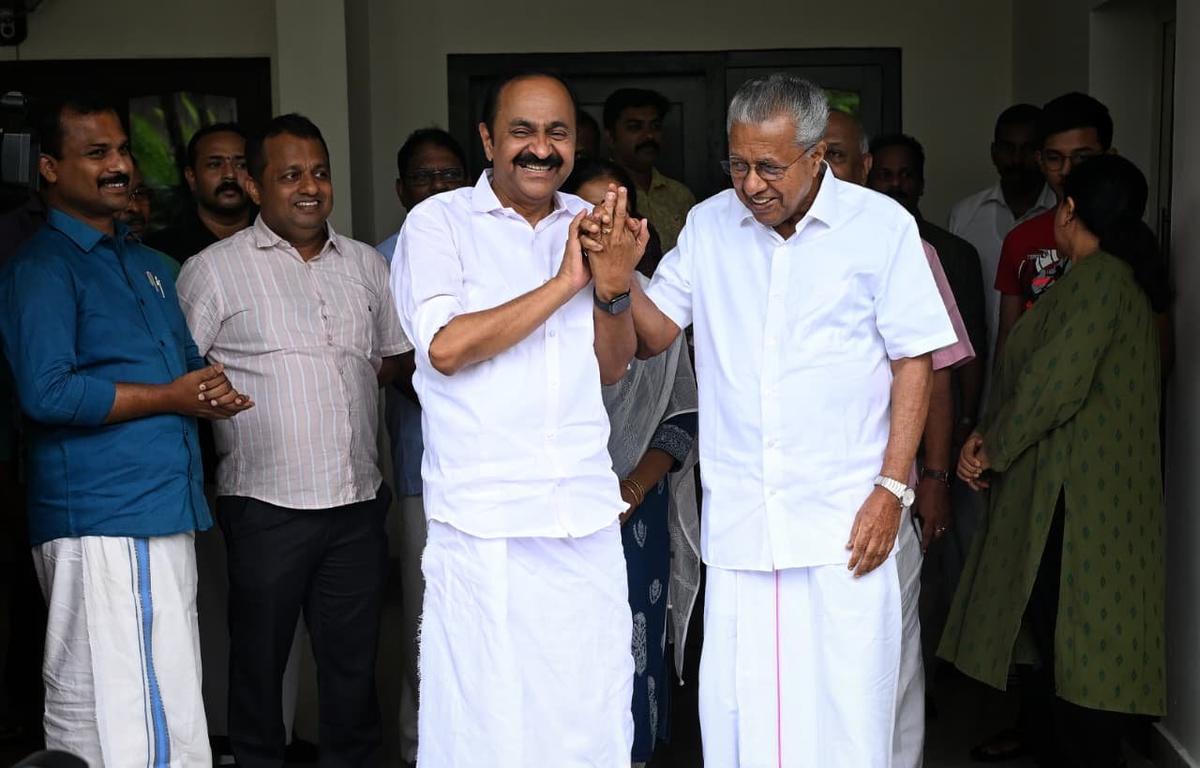
Once VD Satheesan's name was announced as the Chief Minister, he met the other contenders for the post, as well as the former Chief Minister, Pinarayi Vijayan, and personally invited him to the swearing-in ceremony. Vijayan graciously accepted the invitation and attended the event. Other opposition leaders were also present at the oath-taking ceremony to congratulate the new Chief Minister. The ceremony was a telling demonstration that, in a democracy, there can be political opponents, but not enemies. It was indeed a celebration of democracy.
At the same time, the oath-taking ceremony of Suvendu Adhikari as the first BJP Chief Minister of West Bengal highlighted deep political polarisation, underscored by the complete absence of top opposition leaders. The atmosphere resembled that of a victor celebrating an enemy's defeat.
As in other BJP-ruled states, the Suvendu Adhikari government's priority appeared to be implementing Hindutva policies and reversing many policies and schemes introduced by the TMC government led by Mamata Banerjee.
1. The government banned religious prayers and namaz on public roads, stating that they obstruct public movement and use of public property.
2. Strict regulations and bans were imposed on the public slaughter of cattle and buffalo. Cattle intended for slaughter now require certification. According to media reports, newly elected BJP MLA Rekha Patra sparked controversy after intercepting a vehicle transporting cattle in the Lebukhali area of Hingalganj and demanding to see the "birth certificates" of the cows.
3. The Cabinet cancelled all financial and religious assistance schemes operated by the Madrasa Department and the Information and Cultural Affairs Department.
4. Strict restrictions were imposed on public address systems, including a ban on high-volume loudspeakers at religious sites, such as mosques, during prayers.
5. Adhikari's government withdrew the state's petition in the Supreme Court challenging a 2024 Calcutta High Court order that had struck down the Other Backward Classes (OBC) status of 77 communities, 75 of which were Muslim. The new administration has also ordered a strict administrative review of nearly 15 million existing OBC certificates issued under the previous regime.
6. The Home Department directed district magistrates to construct "holding centres" as temporary transit facilities to detain suspected illegal immigrants and foreign prisoners awaiting repatriation. Opposition groups argue that these are early steps toward an aggressive National Register of Citizens (NRC)-style implementation.
7. The Suvendu Adhikari government made it mandatory for madrasa students to sing Vande Mataram during morning assemblies. This may conflict with the religious beliefs of Muslim students. In Bijoe Emmanuel v. State of Kerala, the Supreme Court held that compelling minority students to sing even the national anthem violates their rights to freedom of speech, ex
In short, the policies and decisions of the Suvendu Adhikari government create the impression that it is more focused on advancing a polarising agenda than on addressing the pressing economic, social, and governance challenges it has inherited, as The Indian Express observed in its May 25, 2026, editorial.
In contrast to the divisive, anti-minority policies of Suvendu Adhikari, VD Satheesan declared that his government would implement the welfare schemes promised in the manifestos of the Congress and the UDF. These initiatives are inclusive and aligned with the values and principles of the Indian Constitution.
1. Beginning June 15, 2026, women are allowed to travel free of cost on all Kerala State Road Transport Corporation buses. This initiative aims to reduce household expenses, support working-class commuters, and improve women's workforce mobility.
2. The Cabinet approved the creation of a separate Department for the Welfare of Senior Citizens—a first-of-its-kind initiative in the state. This department is expected to focus on dignified ageing, social security, community-based care, and comprehensive access to healthcare for Kerala's growing elderly population.
3. The government authorised an immediate financial increase for grassroots workers, including a monthly increase of ?3,000 for ASHA workers and ?1,000 for Anganwadi helpers, primary school cooks, and pre-primary teachers.
4. The Chief Minister announced a shift toward massive infrastructure development, with a focus on transforming Kochi into a futuristic city through world-class transport, high-speed ring roads, and the fast-tracking of the long-pending Angamaly bypass.
These initiatives are aligned with the principles of the Indian Constitution. For example, the increase in honoraria for ASHA and Anganwadi workers is in tune with Article 43 (Living Wage for Workers) and Article 39(d) (Equal Pay for Equal Work/Fair Remuneration).
In states where the BJP has come to power, Muslims—and to some extent Christians—have often faced discrimination, exclusion, ghettoisation, and attacks. The same trend appears to be emerging in West Bengal. Government policies and decisions based on an ideology of hatred and revenge can only lead to disaster in the long run. The BJP governments' majoritarian politics, communal polarisation, and heavy-handed law enforcement measures—such as the controversial use of bulldozers—undermine the rule of law and democratic institutions.
Despite industrial growth, several BJP-ruled states continue to struggle with fundamental human development indicators, including high levels of malnutrition, healthcare deficiencies, and gaps in primary education. For example, 39% of children under the age of five are stunted in Gujarat (NFHS 2019–21), and 33% of children under five are underweight in Madhya Pradesh (NFHS-5), whereas only 19.7% of children under five are underweight in Kerala.
Uttar Pradesh and Madhya Pradesh report significant deficits in primary school infrastructure, including the absence of basic amenities such as clean, separate toilets and functional computer labs. Annual education assessments frequently show that a high percentage of Class 5 students in rural primary schools cannot read a basic Class 2 textbook or solve simple division problems, indicating poor foundational literacy and numeracy.
The Hindutva model is increasingly associated with majoritarian nationalism. Governance under this framework tends to emphasise centralised authority, ideological conformity, and symbolic politics, often at the expense of institutional autonomy and minority rights.
In contrast, the democratic model, exemplified strongly by a state like Kerala, draws inspiration from the Indian Constitution. It emphasises secularism, social welfare, federalism, the protection of minority rights, and participatory governance. Rather than using identity as a tool of division, this model seeks to build solidarity across communities and address developmental issues through inclusive public policy.
The Hindutva model of governance is causing serious damage to the constitutional model of governance envisioned by the Constitution of India. Opposition parties must rise above their differences and stand united to restore a governance model rooted in constitutional values. The slide toward electoral autocracy and majoritarianism, as reflected in BJP-ruled states, must be stopped.
.jpg)
.jpg) Jacob Peenikaparambil
Jacob Peenikaparambil

.png) John Dayal
John Dayal
.jpeg)
.png) Joseph Maliakan
Joseph Maliakan

.png) Dr Arnald Mahesh SDB
Dr Arnald Mahesh SDB

.jpg) Jose Vattakuzhy
Jose Vattakuzhy
.png)

.jpg) Isaac Gomes
Isaac Gomes
.png)
.png) Robert Clements
Robert Clements