

.png) Jaswant Kaur
Jaswant Kaur
.jpg)
The most dangerous weapon in India today cannot be bought on the black market. It cannot be smuggled across borders, nor does it require a licence, ammunition, or physical possession. In fact, it may not exist even in our wildest imagination.
It can take the shape of a police officer who never wore a uniform or a customs official who never entered a government office. Or a bank manager who never worked for a bank. It could be anyone who instils fear.
It could be in the form of a morphed photograph that was never clicked, the voice of a close relative you love to hear, or a criminal case that never existed.
Unfortunately, these invisible weapons are stealing crores of rupees, destroying reputations, and pushing ordinary citizens into panic every single day. For centuries, criminals relied on force. They carried knives, guns, and masks. Today, they need none of these. All they need is a smartphone, an internet connection, a basic understanding of human psychology, and perhaps a little bit of artificial intelligence.
This shift was recently captured by the Madurai Bench of the Madras High Court while hearing a case involving morphed obscene photographs of an Indian woman living in Singapore. The Court observed that a morphed image is not a harmless digital prank but a calculated assault on privacy, reputation, and emotional security.
The case was not merely about manipulated photographs. It was about something much larger. Modern cybercrime is not merely an attack on computers. It is an attack orchestrated through computers on people. It is an attack on emotions through fear, which offers a new business model.
This is exactly how a 73-year-old retired teacher in Kanpur was duped of ?25 lakh last week. The victim received a call from an unknown number, claiming that his Aadhaar card had been found with terrorists in Jammu and that an arrest warrant had been issued against him.
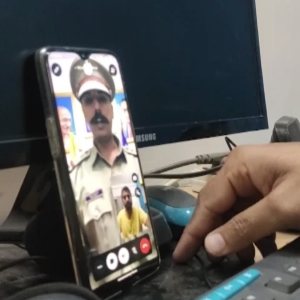
The caller further threatened that if he involved his family members, they would be implicated as well. The caller, posing as a Superintendent of Police, kept him on a video call for five days, questioning him about his bank accounts and other savings.
The man in a police uniform then asked him to deposit ?25 lakh as security to have his name cleared from the list. The man broke his fixed deposit and deposited the money. When the fraudsters demanded more money, he realised that he had been defrauded.
A senior citizen in Pune recently lost ?74 lakh after fraudsters convinced him that he was implicated in criminal activity. The scammers used video calls and impersonated law enforcement officials to make the threat appear real.
These are not the only cases. Across India, the rise of "digital arrests" demonstrates how the scam works. The fear is created not by technology alone but by fraudsters' ability to impersonate authority.
A person who would never hand even a few bucks to a stranger ends up transferring life savings to a voice on the phone. The same principle drives sextortion rackets, investment scams, and image-based abuse. With artificial intelligence and cheap editing tools, criminals can now create evidence that never existed. The victim is trapped not by reality but by the fear of what others might believe or think about them.
The woman whose case reached the Madras High Court allegedly found her photographs digitally altered, uploaded online, and then used to extort money. Such crimes attack something deeper than finances. They target dignity and exploit the social stigma that victims often carry long after the crime has ended.
This is precisely why the Court's ruling matters. A prank is a prank only when everyone laughs, not at the cost of others. Someone's humiliation cannot be termed humour. Digital cruelty is not harmless entertainment. The Court observed that "Online sexual humiliation, morphing, creation of fake profiles, threat of further circulation, and demand of money for deletion of such content constitute, if true, a serious intrusion into bodily privacy, decisional dignity, reputation, and the constitutional protection of life under Article 21 of the Constitution of India."
The Court asked the police to take prompt action, as evidence in such cases can disappear quickly. Unfortunately, both law enforcement authorities and lawmakers have been moving at a snail's pace. We are still dependent on a law promulgated more than two decades ago, when the IT industry was just starting in India. Cybercriminals are way ahead of the technologies that are used to catch them.
Data compiled by the Indian Cyber Crime Coordination Centre paints a disturbing picture. More than 28 lakh cybercrime complaints were reported in 2025—significantly higher than the previous year—with reported financial losses crossing ?22,000 crore in 2024. In fact, the numbers are expected to touch ?1.2 lakh crore. Investment frauds, digital arrest scams, phishing attacks, and online impersonation schemes accounted for a substantial share of these losses. And the trend does not seem to be slowing down.
The government has repeatedly warned citizens about digital arrest fraud, acknowledging the growing number of complaints being received through the National Cyber Crime Reporting Portal. Recent incidents suggest the scale may be even larger than official figures indicate.
In Uttar Pradesh alone, authorities recently reported freezing over ?530 crore linked to cyber fraud investigations during a special enforcement drive.
In Bhopal, citizens lost nearly ?15 crore to cyber fraud in just the first seven months of 2026, and police believe the actual losses are much higher because many cases remain unreported.
The under-reporting is significant, as many victims of image-based abuse, sextortion, and digital harassment never approach law enforcement, fearing stigma, public embarrassment, or blame. Many simply want the nightmare to end quietly. As a result, official statistics likely capture only a fraction of the damage.
The challenge is particularly acute for senior citizens, who have started interacting with technology without understanding the risks. My mother has developed a fondness for YouTube. Like millions of older Indians, she has embraced technology enthusiastically. Yet even a routine message from her bank can trigger anxiety. She often calls to verify whether the message is genuine.
Every week brings reports of fraudsters impersonating banks, police officers, courier companies, and government agencies. Criminals routinely possess enough personal information to sound convincing. In such an environment, caution begins to look less like paranoia and more like common sense.
For sure, our digital revolution has been a remarkable success story. Millions who never used computers now access banking, government services, education, and entertainment through smartphones. Digital payments have become routine, and public services can now be accessed at the click of a button.
But digital inclusion has also created digital exposure. We have taught citizens how to use technology, but have not spent enough time educating them on how technology can be used against them. The gap is becoming expensive, day by day.
Cybersecurity discussions often focus on software, encryption, and firewalls. Those tools certainly matter, but when cybercriminals use fear of arrest, shame, social judgment, and stigma, they are certainly not enough.
The defining cybersecurity challenge of our time is therefore not technological. It is behavioural. We need digital literacy programmes that teach people, starting at the school level, how scams work psychologically. Employers must also conduct regular awareness programmes. Besides, our legal paraphernalia needs a complete overhaul for faster resolution of complaints involving impersonation and image-based abuse. Law enforcement agencies need greater capacity to preserve digital evidence before it disappears.
The Madras High Court's judgment serves as an important reminder: human dignity is non-negotiable, privacy is not optional, and reputation is not expendable.
.jpg)
.png) Cedric Prakash
Cedric Prakash

 ICPA
ICPA
 ICPA
ICPA
 ICPA
ICPA
 ICPA
ICPA
 ICPA
ICPA
 ICPA
ICPA
.jpg)
 A. J. Philip
.jpg)
.png) Jacob Peenikaparambil
Jacob Peenikaparambil
.jpg)
.png) John Dayal
John Dayal