

 A. J. Philip
.jpg)
Yogendra Yadav and I were members of the Assessment and Monitoring Authority (AMA) of the Planning Commission. The AMA was expected to monitor all minority welfare programmes of the Union government. Whether we were able to do the work is a different matter. The AMA was constituted as per the recommendation of the Sachar Committee report.
Though I was an admirer of Yadav when he appeared on television analysing election results, it was the first time I heard him in closed-door meetings. He was able to provide the best inputs during the discussions.
Of course, I could not appreciate him for his political activities, including contesting elections. I thought he was more cut out for academic and intellectual activities than for shouting slogans and seeking votes from people ready to be swayed by caste and community influences. Yadav was one of the many who knocked on the doors of the Supreme Court when the Election Commission of India announced a Special Intensive Revision (SIR) of electoral rolls in Bihar.
On May 27, when the Supreme Court announced its final verdict on SIR, Yadav did not go to the court to hear the verdict firsthand because he knew what the verdict would be. I have written extensively about SIR, and I, too, knew how the challenges to the Election Commission would eventually end.
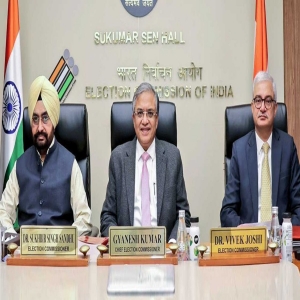
Like countless people in the country, I knew that the Union Government had something up its sleeve when it appointed Gyanesh Kumar as the Chief Election Commissioner and Dr Sukhbir Singh Sandhu and Dr Vivek Joshi as the Election Commissioners. To do so, the government changed the law on their selection. Earlier, a three-member committee headed by the Prime Minister, the Leader of the Opposition, and the Chief Justice of India was to choose them.
The government conveniently dropped the CJI, and in his place, the Home Minister was chosen. Who has not heard of Sancho Panza, the famous sidekick and loyal squire to Don Quixote in Miguel de Cervantes' classic novel? They are two sides of the same coin. The CEC was known to Home Minister Amit Shah, as he had worked in the Ministry of Cooperation that Shah headed.
It became clear in which direction the government was moving when an extraordinary law was created to protect the threesome. They can never be questioned for what they did as members of the ECI. What's more, they were given protection from arrest even if they were accused of a heinous crime. Nobody in India, including the President and the Prime Minister, enjoys such immunity.
In the past, one governing principle was that the King could do no wrong. The phrase meant that the monarch was considered above legal blame and could not be held personally responsible for mistakes or injustices. In constitutional systems, ministers or advisers were held accountable. The new law reminded me of the Mahabharata character, Karna, who was born with a natural protective shield called the Kavacha and divine earrings called the Kundala. They made him invincible.
Lord Indra had to tap Karna's generosity to get these shields before he was forced into the war, where on the 17th day, he fell to the arms of Arjuna. Unlike Karna, the three remain protected. When they announced the decision to revise the electoral rolls with 2003 as the base year, instead of the one used for conducting the elections that brought Narendra Modi back to power, I knew who they wanted to target.
What a tragedy that they chose Bihar for launching SIR. For starters, the concept of a Republic was pioneered in the Indian subcontinent in ancient Vaishali, now in Bihar. The Licchavi clan established a unique system of collegial governance called the ga?asa?gha, where decision-making relied on public assemblies, debates, and consensus rather than a monarch. This early experiment established the foundational idea that citizens could have a voice and choice in how they were governed. SIR had a contrarian purpose.
The ECI knew the moment the 2021 Assembly elections were held in Bihar and a government formed that the next election would be due in 2026. It could have started the work for SIR from that day onwards. Instead, they waited until the 11th hour to do everything in haste. They wanted to avoid scrutiny, especially judicial.
When SIR was unrolled, it was obvious that it would hit the poor, migrant labourers, people frequently displaced by floods, and illiterates who might not even know whether or not they voted in 2003. Even the Aadhaar card was not accepted as proof of nationality. That is why a large number of public-spirited individuals like Yadav, political parties, human rights organisations, and minority bodies challenged SIR in the apex court.
There is a saying: justice delayed is justice denied. This means that if justice is given too late, it loses value. Delayed court decisions can prolong suffering, deny relief, and make fairness meaningless for affected people. All they prayed for was that SIR be deferred to let people submit proof to be enrolled. The situation demanded immediate action. Instead of addressing the core issue, the court looked at procedural difficulties to address them.
As elections advanced and SIR was being completed, it was as clear as daylight that nothing substantial would happen. When Chief Justice Ranjan Gogoi and Chief Justice DY Chandrachud led the Supreme Court, they faced criticism from civil liberties groups and petitioners for the delayed listing, avoidance, or dismissal of several high-profile and sensitive constitutional petitions.
For instance, petitions challenging the abrogation of Jammu and Kashmir's special status were initially placed before a bench led by CJI Gogoi in 2019, but they were not taken up for regular hearing until CJI Chandrachud's tenure in 2023. Similarly, challenges to the Citizenship Amendment Act and the Electoral Bonds scheme were rarely listed for substantial hearings during their initial years, drawing criticism from activists over the court's perceived inaction.
Under CJI Chandrachud, the Supreme Court rejected public interest litigations demanding inquiries into the administrative decisions made by former CJI Gogoi, ruling that such demands against retired judges are inadmissible. Gogoi was made a member of the Rajya Sabha only to draw its perks, for he seldom attended the sessions or took part in debates. Chandrachud found it necessary to invite Modi to his house to attend a puja.
Despite all the petitions against SIR and complaints that millions of people were removed from the electoral rolls, elections were held in Bihar. It is a moot question how the result would have been if the electoral rolls used in the previous election had been revised. The fact is that in the name of SIR, millions of voters, a majority of whom belonged to a particular community, were disenfranchised.
Thereafter, elections were held in Assam, West Bengal, Kerala, and Puducherry. What happened in West Bengal was unbelievable. One of my friends, who was the editor of the most respected newspaper in Kolkata, was also disenfranchised. New governments are in place now.
Nobody, even in their wildest dreams, would have imagined that the Supreme Court would declare SIR unconstitutional and the elections held in the wake of SIR untenable. Imagine the Centre imposing President's rule in the five states and Union Territories which went to the polls recently. That is why I did not expect much from the verdict.
In fact, the verdict was, in many ways, a fait accompli. The court, therefore, confined itself largely to procedural questions and reaffirmed the Election Commission's constitutional authority under Article 324 to revise and maintain authentic electoral rolls. Indeed, periodic revision of voters' lists has been part of India's democratic practice ever since elections based on universal adult suffrage began. On that principle, there could hardly have been any serious challenge to the Commission's powers.
In fact, it was tantamount to stating the obvious, like saying that the President is the Supreme Commander of the armed forces or that we have a bicameral system at the Centre. Yet, the verdict leaves behind troubling questions that cannot be brushed aside merely because the process has received judicial approval.
The court did not sufficiently examine the extraordinary haste with which the SIR was undertaken. Democracy is not merely about cleaning up electoral rolls; it is equally about ensuring that no eligible voter is excluded. A fair revision process requires adequate notice, transparency, and sufficient time for those wrongly omitted to prove their eligibility and restore their names. By focusing narrowly on the Commission's powers rather than on the human consequences of the exercise, the court overlooked the scale of disenfranchisement caused by the hurried implementation of the SIR.
All the same, the judgment does contain one important safeguard. It clearly states that the authority to determine citizenship rests with the government, particularly the Union Home Ministry, and not with the Election Commission. This is significant because the Commission had removed millions of names from electoral rolls on the suspicion that the individuals concerned were non-citizens.
The verdict thus leaves the door open for affected persons to approach the competent authorities and establish their nationality. However, for those already excluded from the democratic process, this offers limited comfort. How many of them have the resources to approach a court of law and get a fair hearing, let alone a favourable verdict? The triumphalism visible in the Election Commission's response cannot conceal the reality that the SIR was imposed with undue haste and with consequences that will haunt Indian democracy for years.
The CEC argued that the turnout of voters was larger this time. This was because a fear psychosis was created that if anyone did not vote, they might be disenfranchised next time. So many came back to Assam, West Bengal, and Bihar from places as far as Kerala only to vote and prove to the world that they are Indian citizens. Until now, anyone who was born in India was an Indian citizen. Now, many documents are needed to prove your citizenship, especially if you belong to a particular community.
A decorated Army officer who took part in the Kargil war was found to be "stateless." What's worse, some government officials went to Pratichi, which means "Westend," in Santiniketan to verify whether Nobel laureate Prof. Amartya Sen had all the credentials to vote in India. No matter that the government of Atal Bihari Vajpayee gave him an amount to match his Nobel prize money to do educational research primarily in West Bengal.
If the SIR exercise is extended nationwide, nearly 100 million people could be affected. A democracy cannot claim moral strength if millions are forced to first prove that they belong before they are allowed to vote. There is a saying that only the wearer knows where the shoe pinches. Millions of people who have been disenfranchised alone know how SIR has destabilised their lives.
If the SIR exercise is eventually extended across the country, its consequences could fundamentally alter the character of Indian democracy. Electoral rolls are not mere administrative documents; they are the foundation of citizenship in practice.
Any process that creates fear, uncertainty and exclusion among ordinary citizens weakens faith in democratic institutions. The Supreme Court may have upheld the Election Commission's authority, but legality alone cannot substitute for fairness, compassion and constitutional morality. A nation as diverse as India must ensure that no citizen is compelled to repeatedly prove that they are a citizen. Democracy survives not by exclusion, but by trust and inclusion. Gana-Sangha, not Jan Sankhya, should matter!
.jpg)
.png) Cedric Prakash
Cedric Prakash
 ICPA
ICPA
 ICPA
ICPA
 ICPA
ICPA
 ICPA
ICPA
 ICPA
ICPA
 ICPA
ICPA
.jpg) A. J. Philip
A. J. Philip
.jpg)
.png) Jacob Peenikaparambil
Jacob Peenikaparambil
.jpg)
.png) John Dayal
John Dayal