

.png) John Dayal
John Dayal
.jpg)
It is not surprising that India has been lukewarm to Pope Leo XIV's Encyclical on Artificial Intelligence. The Pope has warned that Artificial Intelligence threatens to normalise an "anti-human vision" and has called upon people and governments to counter the concentration of immense digital power in the hands of a few private actors.
Describing it as an event of "Biblical proportions," the Chicago-born Pontiff has cautioned human beings will be reduced to coins in a machine, a warning given many times in twentieth-century history by philosophers, writers and the occasional religious leader railing against crony capitalists and military industrial machines created to maximise profits, even if the result is human misery.
The response by the Indian government, industry and business leaders is understandable - they know the Pope is talking about people like them and their shenanigans as they have pushed digital technologies at breakneck speed, with government providing them land, water, power, tax concessions hoping that this technology will help them recover lost ground in military balance against their enemy nations, while making money available for political battles at home.
This takes on urgency because India is technologically a few generations or more behind both the United States and China, where Artificial Intelligence and the "chips" that make it possible at speeds not even imagined in science fiction are being produced at mind-boggling speed. So much so that the fate and security of states such as Taiwan now depend on their silicon chip sector not being taken away to more secure locations in the US.
The Indian church, both Catholic and Protestant, is not savvy with technology and medical science, and usually takes a long time to comprehend and transmit downstream guidelines and warnings issued by the Vatican.
Its own ability to monitor government programmes, including accompanying legislation and industrial programmes, has not proved effective in the past. Perhaps only in matters of genome engineering has the church been alarmed. However, it has not been able to provide the pushback that civil society needed at the time to check the government's commitment to genetically modified crops such as cotton.
About two years ago, Archbishop Vincenzo Paglia, President of the Pontifical Academy for Life, and Grand Chancellor of the John Paul II Pontifical Theological Institute for Marriage and Family Sciences, came to India, met government signatories, spoke to the Catholic Bishops Conference at Bangalore, and gave an address to us in New Delhi, telling us how the Vatican saw the need for great caution in the explosive manner in which Artificial Intelligence had overwhelmed the world this decade, sending global powers China, the US and Europe into a competitive frenzy not seen since the nuclear race of the second world war and the 1960s race to put a man on the Moon.
A New Industrial Revolution, a Familiar Danger
Pope Leo signed his encyclical on May 15 this year. Vatican experts said this was deliberately chosen to mark the 135th anniversary of his predecessor, Leo XIII's "Rerum Novarum," the landmark document that addressed the dehumanisation brought about by the Industrial Revolution.
As Leo XIII spoke for workers ground down by industrial capitalism, Leo XIV speaks for human beings at risk of being diminished — or discarded — by the machine intelligence now being built around them, Vatican watchers say.
The heart of the document is a simple, unyielding assertion that human dignity is non-negotiable; it does not depend on a person's abilities, wealth, or position in life, nor on right or wrong choices made, but simply on existing.
The Pope identifies a greater danger than job loss or manipulation — that human beings may begin to see themselves and others as products of "algorithmic assessment" rather than as persons of inherent worth.
"AI is not a morally neutral tool; it matters not only how it is used, but how it is designed," he says, warning that control of AI must not remain in the hands of a few.
Perhaps the most important call is to "disarm AI" by removing it from military and economic interests.
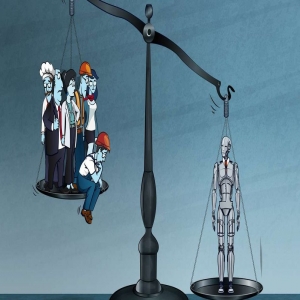
On jobs, he is direct: the pursuit of greater profits cannot justify choices that systematically sacrifice employment, because the human person is an end, not a means, and the economic order must remain subordinate to human dignity and the common good. Without decisive action, he warns, greater poverty and inequality loom, leaving many individuals marginalised and stranded, surrounded by the machines that have replaced them.
India's AI policy is not really a story about innovation, but about power, weak safeguards, and the normalisation of surveillance, last seen in the Pegasus spyware that infiltrated the mobile phones of most senior journalists and writers in India some years ago, and something similar into the laptops of people like Jesuit Fr Stan Swamy and others arrested in the Bhima Koregaon case.
India has built a digital system that favours industry growth — and that, too, by a handful of tycoons — and state control over citizen protection.
Prime Minister Narendra Modi and Home Minister Amit Shah want to present India ripe for the age of artificial intelligence — efficiency, inclusion, innovation, and digital transformation. But beneath that vocabulary lies a more uncomfortable reality.
Therefore, the country's AI and digital policy architecture is not designed primarily to protect citizens from harm, but to give industry room to grow, and civil society very little room to object.
India's foundational AI strategy came from NITI Aayog in 2018, a document that was ambitious in tone but limited in imagination, as senior scientists and intellectuals noted at the time. They were hooted down.
Niti Aayog is the successor to the Planning Commission, which flourished during the Nehru-Indira era and helped birth heavy industry, infrastructure, and educational institutions. It had no foresight and very little real talent as its main purpose was to erase the vestiges of the Nehruvian ethos.
By the time it evolved a view on digital technology, of which AI is the logical child, the world had already seen the dangers of data abuse, algorithmic bias, and misuse of facial recognition.
The newer MeitY AI governance guidelines of 2025 sound more sophisticated, but they do not change the deeper orientation. They remain voluntary, do not create an independent regulator with real powers, and are inevitably structurally tilted toward industry and the executive.
If there is one sector where AI can genuinely do great good, it is healthcare, where AI can support diagnostics, screening, triage, and early detection. But medicine is also where the costs of failure are most severe, and if an AI tool misses a cancer, misreads a scan, or fails to flag a dangerous condition, no one knows who to hold responsible.
Health data itself is another major vulnerability as India's digital health infrastructure is expanding rapidly, including through the Ayushman Bharat Digital Mission and the ABHA system. This is sensitive data because it reveals not just present illness but genetic predisposition, reproductive choices, psychiatric history, and much more and once it is linked to AI systems, the potential for misuse expands dramatically.
Private health platforms, telemedicine providers, insurers, and wellness apps are collecting such information at a rapid pace. The user is asked to accept the terms, and access to the service is bundled with the surrendering of data.
India's Digital Personal Data Protection Act was sold as a privacy law that would bring citizens closer to the protections associated with global standards, but in practice, it fell short where it mattered most. And as with even the Supreme Court, or the Election Commission, the Data Protection Board also does not function as a fully independent watchdog but is structurally close to the government it is meant to regulate.
The deeper worry is that India's digital architecture is increasingly cumulative. Aadhar authentication logs, health records, financial data, location traces, and communication metadata may each seem limited on their own. Combined through AI, they become a powerful instrument of surveillance.
The Pegasus revelations woke us up, showing that India was developing surveillance capabilities but lacked a robust public framework to govern them. Commercial spyware from Israel, network interception tools, facial recognition systems, and monitoring platforms from the US can all be deployed in the name of law and order while remaining largely opaque to public scrutiny.
Senior Civil society activists say facial recognition is especially alarming as it is error-prone, especially in the case of women and darker-skinned people. Reporters know the chilling effect of surveillance is often more powerful than surveillance itself. We are now censoring ourselves more than perhaps the local intelligence bureau did during the 1975 State of Emergency.
Political messaging, similarly, has been weaponised - with voter profiling, deepfakes, synthetic audio, and hyper-targeted messages deployed in regional languages with remarkable speed. The most important fact about AI is that it is not just technical. It is political. Every system reflects a decision about who benefits, who is monitored, who bears risk, and who can object.
[Writer's Note: AI tools, especially Grok and Claude, have been used in researching details published in newspapers over the past few years on the Indian response to Artificial Intelligence. AI, however, is no good for expressing real thoughts]
.jpg)
.jpg)
.png) Jacob Peenikaparambil
Jacob Peenikaparambil
 John Dayal
.jpeg)
.png) Joseph Maliakan
Joseph Maliakan

.png) Dr Arnald Mahesh SDB
Dr Arnald Mahesh SDB

.jpg) Jose Vattakuzhy
Jose Vattakuzhy
.png)

.jpg) Isaac Gomes
Isaac Gomes
.png)
.png) Robert Clements
Robert Clements