

.png) Jacob Peenikaparambil
Jacob Peenikaparambil
.jpg)
The word democracy originates from the Greek word d?mokratia, which combines d?mos (meaning "the people" or "the populace") and kratos (meaning "power" or "rule"). Together, they literally mean "rule by the people" or "power of the people."
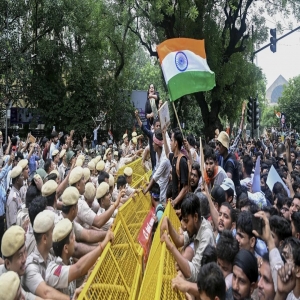
The youth of India demonstrated on July 20 that, in a democratic country like India, power resides with the people and not with the government. Despite barricades, lathi charges, and tear gas, thousands of people marched towards Parliament, declaring to the Modi government that power belongs to the people, not to the RSS-BJP combine, and that the government is accountable to the citizens of India.
According to social media accounts, an estimated 50,000 people, most of them youth, participated in the Sansad March, although the majority of the Godi media reported the crowd to be around 20,000. The protesters primarily comprised young people, students, and competitive examination aspirants. The extensive mobilisation was organised by the Cockroach Janta Party (CJP), a rapidly growing youth-led movement that initially began as a satirical online campaign.
Democracy does not merely mean winning elections by hook or by crook, as Modi and Shah seem to understand it. The essence of democracy lies in the accountability of elected representatives to the people and in the people's right to question the government and protest peacefully against its failures and misguided policies. This is precisely what the young people of India, under the leadership of the CJP, have been doing since June 20, 2026, at Jantar Mantar, New Delhi.
The demands of the protesting youth are entirely legitimate in a democracy:
1. Sweeping reforms in India's public education and examination systems following the massive NEET examination paper leak scandal.
2. The immediate resignation of Union Education Minister Dharmendra Pradhan over the alleged examination irregularities and the NEET paper leak.
3. Financial compensation of ?1 crore for the families of NEET candidates who died by suicide as a result of the paper leak crisis. At least 12 NEET aspirants reportedly died by suicide during the 37 days between the cancellation of the NEET-UG examination on May 12, 2026 and the re-examination held on June 21.
The fast undertaken by educational reformer and environmentalist Sonam Wangchuck at Jantar Mantar in solidarity with the CJP protesters greatly boosted the morale of the young demonstrators. During his fast, several opposition leaders visited Jantar Mantar and expressed their support for the protesters. At the same time, the Modi government remained a deaf and dumb spectator. The Prime Minister left on a foreign tour, as he has often done whenever the country has faced a major crisis.
As the government appeared arrogant and insensitive to the demands of the young people, the protesters decided to march to Parliament on July 20, the opening day of the Monsoon Session. Instead of engaging in dialogue with the protesters, the Modi-Shah government chose to suppress the march through force, including violence, as it had done during earlier movements such as the anti-CAA protests and the farmers' protest.
Numerous videos circulated on social media showed what appeared to be the brutality of the Delhi Police. These visuals generated widespread public debate regarding the level of force used during the protest. Video footage showed security personnel using batons to disperse the crowd. Some reports and social media videos also alleged the use of non-standard crowd-control equipment. Other videos showed men in plain clothes wielding batons against protesters. Protesters were also seen questioning police personnel about the equipment being used during the demonstration.
There were also allegations that the police attempted to portray the protesters as violent. For example, videos circulating on social media showed damaged vehicles stationed at the protest site. Another video showed a truck loaded with stones. Allegations were made that these were intended to create the impression that the protesters had resorted to violence so that they could be branded as anti-national, Pakistan supporters, members of the "tukde tukde gang," and similar labels that the BJP has frequently used against protest movements since coming to power in 2014.
According to the Delhi Police, nearly 180 people were injured, including 118 security personnel and 60 protesters, while several student leaders were detained during the clashes. The police reportedly took many protesters into custody, although no official information regarding their exact number has been made available.
The Delhi Police have registered multiple FIRs against the organisers and participants of the "Sansad Chalo" (Parliament March) held on July 20. The FIRs invoke provisions of the Bharatiya Nyaya Sanhita (BNS) and the Prevention of Damage to Public Property (PDPP) Act, including charges of rioting, unlawful assembly, assault on public servants, and damage to public property.
Several political leaders, including senior Congress leaders, strongly criticised the use of batons and tear gas against the students. Human rights advocates and civil society observers also condemned what they described as the excessive use of force. The Leader of the Opposition termed the police action "undemocratic," while Priyanka Gandhi described it as "criminal." On July 21, Rahul Gandhi demanded that Prime Minister Narendra Modi apologise to the students for the police brutality and resign along with Home Minister Amit Shah.
Organisations and activists organised solidarity demonstrations in several other states as well. The Catholic Bishops' Conference of India (CBCI) strongly condemned the police crackdown on the young protesters. The bishops' conference described the use of tear gas and batons against the youth as "a heartbreaking assault on the very soul of our democracy." The CBCI also affirmed that the students had taken to the streets with "legitimate demands for urgent accountability and reforms in our education system."
According to critics and opposition parties, India has witnessed the gradual erosion—and, in some respects, even the murder—of democracy ever since the BJP, under the leadership of Narendra Modi, came to power at the Centre in 2014. They argue that the government has employed several methods to throttle democratic institutions.
The capture of democratic institutions is the foremost among them. Critics contend that independent institutions such as the judiciary, the Election Commission, and investigative agencies have increasingly lost their autonomy. For example, nearly six crore (60 million) voter names have reportedly been deleted from the electoral rolls by the Election Commission of India (ECI) during the first year of the Special Intensive Revision (SIR) exercise. In West Bengal alone, around 60 lakh voters were officially moved to the "Under Adjudication" list, rendering them unable to vote in the recently concluded Assembly elections.
Subjugation of the media is another method allegedly employed by the BJP government. There has been increasing pressure on independent journalists and the growing dominance of a government-aligned media narrative. Government influence over the mainstream media has become so pervasive that it is popularly referred to as the Godi media. Cases have been filed against media organisations and journalists critical of the government. Among the media organisations targeted are The Wire and NewsClick.
In June 2026, the Delhi High Court quashed the FIR and the Enforcement Directorate's money laundering case against the news portal NewsClick and its founder-editor, Prabir Purkayastha. Justice Neena Bansal Krishna described the process adopted by the investigating agencies as "a gross abuse of the process of law."
Civil society organisations play a crucial role in strengthening democracy by creating awareness about human rights and constitutional rights. They also help people access and assert these rights whenever they are violated. Many such organisations are actively engaged in protecting the environment and defending the rights of Adivasis over Jal, Jungle, and Jameen. The BJP government has frequently targeted these organisations by tightening regulations, particularly through the Foreign Contribution Regulation Act (FCRA), thereby affecting the functioning of numerous non-governmental organisations (NGOs).
In the absence of a strong opposition, democracy can gradually slide into autocracy or authoritarianism. Critics argue that the BJP has employed several strategies to weaken opposition parties across the country. These include engineering mass defections of MLAs and MPs, often resulting in the collapse of elected state governments; the alleged misuse of central agencies such as the Enforcement Directorate (ED), the Central Bureau of Investigation (CBI), and the Income Tax Department against opposition leaders; securing a disproportionate share of political funding; and, most importantly, mobilising Hindu votes through communal polarisation by aggressively using religion for political purposes.
When democratic institutions are captured, the Election Commission functions like an extension of the ruling party, the media is reduced to subservience, civil society organisations are suppressed, and opposition parties are systematically weakened, the only option left before the people is to take to the streets and protest through non-violent Gandhian methods. This is what happened on July 20 in Delhi in the form of the Sansad March—a people's attempt to save democracy from being murdered.
.jpg)
.jpg) Jacob Peenikaparambil
Jacob Peenikaparambil

.png) John Dayal
John Dayal
.jpeg)
.png) Joseph Maliakan
Joseph Maliakan

.png) Dr Arnald Mahesh SDB
Dr Arnald Mahesh SDB

.jpg) Jose Vattakuzhy
Jose Vattakuzhy
.png)

.jpg) Isaac Gomes
Isaac Gomes
.png)
.png) Robert Clements
Robert Clements