
 John Dayal
.jpg)
In a Republic whose Constitution guarantees equal citizenship and freedom of conscience, parties organised around religious identity continue to shape electoral competition but have little future of their own, as their fortunes rise and fall with demographic concentration, organisational strength and the arithmetic of alliances.
The Narendra Modi government's threatened demographic survey is designed to make such groupings obsolete or irrelevant in its kamikaze thrust to make India a Hindu nation, and the delimitation exercise that will inevitably follow the 2027 census will make the picture even more uneven across the political landscape.
Though it doesn't want to be described internationally as such, the Bharatiya Janata Party (BJP) is the only religious-oriented formation with a truly national footprint, dominant in the Hindi heartland, Gujarat, and parts of the Northeast and East, including Assam and West Bengal after the 2026 Assembly victory.
The Shiromani Akali Dal (SAD) is confined to Punjab, the Indian Union Muslim League (IUML) is decisive in Malabar and increasingly seeking relevance in southern Kerala, the All India Majlis-e-Ittehadul Muslimeen (AIMIM) holds Hyderabad and maintains bridgeheads in Bihar's Seemanchal region and select Maharashtra urban pockets, while the All India United Democratic Front (AIUDF) has receded in Assam.
Christian communities, concentrated in the Northeast, Kerala and Goa, lack a comparable national or strong regional confessional party; their votes are largely channelled through the Congress, regional outfits or, in some cases, the BJP, which is why the periodic anxious demand for a pan-India Christian political party finds few, if any, takers in the country.
Election Commission statistical reports and party contribution filings confirm the resource and organisational disparity: the BJP's membership and funding far exceed those of all others combined. Dynastic patterns appear in the SAD (Badals), the AIMIM (Owaisis) and the AIUDF (Ajmal), while the IUML and the BJP rely more on cadre structures, though family influence exists in both.
These "religious" parties must, by law, operate within the constitutional framework and contest elections freely; their rise and decline illustrate how religious identity can mobilise voters in a diverse society, yet also how demographic concentration, alliance arithmetic, and governance records determine outcomes.
In a polity still formally secular, their continued presence also calls into question the constitutional promise and fulfilment of equal citizenship, triggering the electoral incentives of identity politics.
As every school-going child knows, even if the Sangh cadres do not, India's Constitution establishes a secular republic that guarantees freedom of religion (Articles 25–28) and equal protection under the law (Articles 14–15), while Articles 29–30 protect minorities' educational and cultural rights.
And as minorities, especially Muslims and Christians, know, groups organised around religious identity have long existed and continue to shape electoral outcomes.
Though the Election Commission of India registers parties under the Representation of the People Act, 1951, without formal religious classification, several major and regional formations are widely understood as Hindu-, Sikh-, or Muslim-oriented, and their histories, vote shares, and territorial bases reveal identity politics' limits within a multi-party system.
Among majoritarian Hindu-oriented parties, the BJP is the dominant force; its direct predecessor, the Bharatiya Jana Sangh, was founded on October 21, 1951, in Delhi by Syama Prasad Mookerjee, with organisational support from the Rashtriya Swayamsevak Sangh (RSS), which was itself established in 1925.
The Jana Sangh merged into the Janata Party in 1977 and, after the Janata government collapsed in 1979 and Indira Gandhi trounced the party summarily in the January 1980 election, re-emerged as the BJP in 1980 under Atal Bihari Vajpayee, with its ideology firmly centred on cultural nationalism known as Hindutva.
Its organisational strength, linked to the RSS, exceeds that of any rival, as shown in the 2014 Lok Sabha election, led by Narendra Modi of Gujarat 2002 notoriety, when it won 282 seats with 31.34 per cent of the vote; in 2019 reaching 303 seats (37.36 per cent); and in 2024 securing 240 seats (36.56 per cent), remaining the single largest party and leading the National Democratic Alliance (NDA).
As of November 2026, it holds 240 Lok Sabha seats, and the NDA it leads governs in about 21 states and Union Territories, including Uttar Pradesh (Yogi Adityanath), Maharashtra (Devendra Fadnavis), Gujarat, Madhya Pradesh, Rajasthan, Assam (Himanta Biswa Sarma), West Bengal (Suvendu Adhikari, after the 2026 victory), Bihar (Samrat Choudhary), Odisha and others.
Shiv Sena, founded in 1966 in Mumbai by the brilliant cartoonist "Tiger" Bal Thackeray, combined Marathi regionalism with Hindu assertion, but after the 2022 split, the Eknath Shinde faction remains in the Maharashtra government within the NDA, while the Uddhav Thackeray faction (Shiv Sena-UBT) sits in opposition, both currently retaining much influence in the Mumbai–Thane corridor and parts of western Maharashtra, but with no national footprint.
Similarly, Sikh-oriented parties show how influence in a narrow region can still translate into relevance in New Delhi, with the SAD, among India's oldest regional parties and founded on December 14, 1920, as the political arm of the Shiromani Gurdwara Parbandhak Committee (SGPC), having long represented Sikh religious and political interests in Punjab.
In the last half a century, its leadership has been dominated by the Badal family, with Parkash Singh Badal (president 1995–2008) and his son Sukhbir Singh Badal (president since 2008, apart from the interval after his resignation in November 2024, and re-elected in April 2025), ensuring dynastic concentration despite occasional internal revolts and splits.
Electorally, SAD's decline is marked: though it formed governments with the BJP in 1997, 2007 and 2012 (56 seats and 34.73 per cent in 2012), in 2017 it fell to 15 seats and in 2022 it won only three seats, with 18.38 per cent of the vote, its worst Assembly performance.
In the 2024 Lok Sabha election, its vote share dropped further to roughly 13.4 per cent, with the party retaining only Bathinda (Harsimrat Kaur Badal); it now remains a distant fourth behind the Aam Aadmi Party (AAP), the Congress and a rising BJP, with its core areas confined to rural Malwa and Majha districts with strong SGPC influence.
Muslim-oriented parties are limited to regional or even district-level concentrations of population, as is their base.
The Indian Union Muslim League was founded on March 10, 1948, in Madras, deliberately distancing itself from the separatist stance of the pre-Partition All India Muslim League and choosing constitutional coalition politics, which has made it the most electorally successful Muslim-oriented party in the country.
In Kerala, it is the key junior partner in the Congress-led United Democratic Front (UDF), and in the 2026 Assembly election it won 22 of the 27 seats it contested, a strike rate above 81 per cent, with a statewide vote share of about 11 per cent, its best-ever tally, sweeping Malappuram and expanding into northern and even southern districts.
Led by national president KM Kader Mohideen and senior Kerala leaders including PK Kunhalikutty, the party retained three Lok Sabha seats in 2024. It showed further growth in the 2025 local-body polls, including seats in southern Kerala, though its presence remains marginal outside Kerala.
The All India Majlis-e-Ittehadul Muslimeen, called a national spoilsport for the Congress and socialist parties fighting the BJP in North India, traces its origins to the Majlis-e-Ittehadul Muslimeen founded in Hyderabad on November 12, 1927, revived in its present form in 1958 and has been led by the Owaisi family ever since, with the charismatic British-trained barrister Asaduddin Owaisi as the current president and Hyderabad MP.
Its traditional base is the Old City of Hyderabad, but it has expanded to five seats in each of the 2020 and 2025 Bihar Assembly elections, one seat in the 2024 Maharashtra Assembly election, one Lok Sabha seat in 2024 and strong local-body results, including 114 seats across 12 Maharashtra municipal corporations in the January 2026 polls and 33 in Chhatrapati Sambhajinagar alone.
In November 2026, it allied with Chandrashekhar Azad's Azad Samaj Party (Kanshiram) to form the Samajik Parivartan Morcha in Uttar Pradesh ahead of the 2027 Assembly polls, naming Azad as the chief ministerial face.
Its vote share remains small nationally, at 0.22 per cent in 2024, but is concentrated and occasionally decisive in Muslim-majority pockets of Telangana, Bihar, Maharashtra and parts of Uttar Pradesh.
The All India United Democratic Front, founded in 2005 by perfume entrepreneur Badruddin Ajmal after the Supreme Court struck down the Illegal Migrants (Determination by Tribunals) Act, focuses on Bengali-origin Muslim voters in Assam.
It peaked at 18 seats in 2011 and won 16 in 2021, but in the 2026 Assam Assembly election it collapsed to two seats, with its vote share falling from 9.3 per cent to about 5.5 per cent.
Ajmal remains the dominant figure, and the party, which has no current Members of Parliament and is widely viewed as family-centric, retains residual influence only in specific Lower Assam constituencies.
Smaller Muslim parties include the Social Democratic Party of India (SDPI), founded in 2009 and widely seen as the political front of the banned Popular Front of India, which has registered negligible results, with no seats and 0.25 per cent in the 2026 Kerala Assembly election, and the Welfare Party of India, the political wing of Jamaat-e-Islami Hind, launched in 2011, which remains electorally marginal.
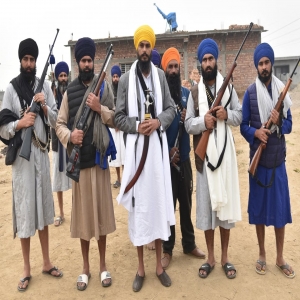
Waris Punjab De, centred on Amritpal Singh, who won Khadoor Sahib as an Independent in 2024 while in custody and later formalised a party, represents a radical Sikh strand but has limited organisational depth.
.jpg)
 A. J. Philip
.jpg)
 Jacob Peenikaparambil

 Dr Suresh Mathew
John Dayal
.jpg)
.jpg)
.png)
 Robert Clements
.jpg)
 P. A. Chacko
.jpeg) A. J. Philip