

.jpg)
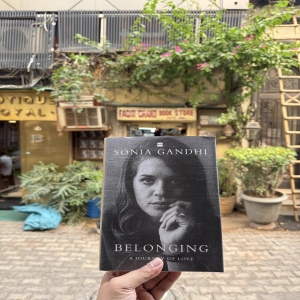
Following the release of Sonia Gandhi's autobiography, "Belonging: A Journey of Love," on November 10, 2026, it became an instant bestseller. At the official launch on November 16, Anant Padmanabhan, CEO of HarperCollins Publishers, said that within a week of its release, more than 2,00,000 copies had been sold, making it the fastest-selling and most important memoir in independent India.
I bought a copy of the book at Hyderabad Airport on November 11 and have since read the full book of more than 500 pages, right from the Prologue to the Epilogue. I was eager to understand how an Italian-born woman, culturally and socially so different, could be adopted into the most powerful and much-celebrated political family of India, overcoming personal tragedies, and how her children—Rahul and Priyanka, born to a foreign-origin mother—could come out unscathed and unaffected by the trauma of witnessing the violent killings of their grandmother and father, being confined to their home and led abnormal lives, and grow up to represent today the very essence of India.
The book is extremely moving at times. It is a candid, gripping account of a remarkable political personality of our time, with so much falsehood and myth woven around her by her uninformed critics and political rivals. Surprisingly, she begins and ends her story with quotes from the Rig Veda and the Atharva Veda. She is more of a Nehruvian secularist, uncompromised by divisive communal politics.
To begin with, her story is one of intense love, a 'magical' romance with Rajiv Gandhi. They met at the Varsity, a Greek restaurant in Cambridge, in 1965 and fell in love. She was nineteen, and he was twenty-one; they courted for nearly three years. Sonia was taking an English course at the Jarrett School of English, and Rajiv was studying engineering at Imperial College. He told his mother, Indira Gandhi, about his love for Sonia, and she approved of his marrying her.
Rajiv decided to go to Italy in November 1966 to meet her father. When he met Rajiv, her father told her mother, "You look into the boy's eyes, and you know the man right away." But he was not willing to give his consent to their marriage, as she was still a 'minor' under Italian law, the marriageable age being twenty-one. He gave them one year, that is, until December 1967, to decide about their marriage, hoping that their love might not last until then. It was a long separation, particularly for Sonia. They were genuinely in love. They exchanged letters almost every day, which sustained their bond.
She landed in New Delhi on January 13, 1968, and her father gave her a return flight ticket so she could return to Italy if things went wrong. However, she was destined to adopt India as her home and marry the son of India's Prime Minister on February 25. They led a happy, blissful life, with Rajiv serving as a pilot in Indian Airlines and Sonia being adopted into the Gandhi-Nehru family. People at the PM's House called her Bahurani.
It is not known to the public that Sonia Gandhi gave birth to her first male child on January 18, 1969, who died a day later. Rahul was born on June 19, 1970. She writes: "My mother-in-law would rush in from her work straight into our room to see how he was doing. Her face would light up, and her worries instantly vanish when she was holding the baby in her arms." Sonia began to learn about her adopted country, its people, its history and culture. She found listening to her mother-in-law's anecdotes and reading about India's recent history interesting.
In September 1970, her mother-in-law took her, along with Rajiv, Sanjay and Rahul, to the Nehru family's ancestral homes—Swaraj Bhawan and Anand Bhawan—in Allahabad, which she had donated to the nation. This left a deep impact on Sonia. During that visit, Sonia learnt about the history of the freedom movement and related events from her mother-in-law. In 1920, at Swaraj Bhawan, with Mahatma Gandhi in residence, the Non-Cooperation Movement was founded. Motilal Nehru had drafted the Nehru Report, demanding the immediate grant of Dominion Status to India. Both the houses were full of memories for her mother-in-law: where she had grown up, where she got married, but, more importantly, where the stalwarts of the freedom struggle had gathered to take important decisions. Her mother-in-law showed them the basement room where Congress workers clandestinely printed pamphlets, posters, and articles against the British.
Sonia recalls: "I picked up a copy of Jawaharlal Nehru's Discovery of India, and my eyes fell on a passage I've never forgotten, describing his travels in 1936-37 through every province and deep into India's villages: 'It was not her wide spaces that eluded me or even her diversity, but some depths of soul which I could not fathom ... She was like some ancient palimpsest on which layer upon layer of thought and reverie had been inscribed ... All of these existed in our conscious or subconscious selves, though we may not have been aware of them, and they had gone to build up the complex, mysterious personality of India.'" She found this very inspiring, and on her return to Delhi, she read all his books and more of his writings. This helped her understand the depth of India and its people.
They were taken to the courtyard in Swaraj Bhawan where, as part of the Swadeshi Movement, the family had lit a bonfire of all their foreign clothing, including some of Indira's favourite frocks. All the expensive clothes owned by the Nehru men and women were thrown into the bonfire. They were led by her mother-in-law to the spot where all the women, including her grandmother, her mother, her aunts and she herself, had taken part in the struggle against colonial exploitation during the Salt Satyagraha Movement in 1930. Listening to these real-life accounts and seeing the very sites where they had taken place instilled in her a deep sense of pride in the family she had married into and a sense of belonging to India.
She was elated when her mother-in-law accepted her as a family member and asked her to accompany Rajiv and Sanjay to carry the containers containing some portions of the ashes of her grandfather, her mother and her father, which were still preserved, and immerse the ashes at the Triveni Sangam—the confluence of three rivers: the Yamuna, the Ganga and the mystical Saraswati. Sonia records: "And I wondered at the destiny that had brought me there from a far-away land, from a different people, and from different circumstances to participate in this sacred intimate ritual."
What a quirk of fate! While the foreign Bahurani, Sonia Gandhi, was getting adopted into the Nehru-Gandhi family and the larger cause of nation-building, Maneka, the native Choti Bahu, Sanjay Gandhi's wife, was getting edged out of the family owing to her personal ambition and hobnobbing with political rivals. After Sanjay's untimely death in a plane crash in June 1980, Maneka's mother was encouraging those in the Congress Party who had been personally loyal to Sanjay to demand a political position for his widow, projecting her as 'the only possible inheritor of the Sanjay cult figure.' Indira Gandhi felt that, at twenty-three, Maneka was too young and immature for a leadership role. She was not even eligible to contest the by-election from Amethi, as the law required a minimum age of twenty-five. She celebrated Varun's first birthday in March 1981 at the house of Vasundhara Raje—the future Rajasthan CM and daughter of the Rajmata of Gwalior, a staunch RSS supporter and a political opponent of Indira Gandhi—without the latter's knowledge. She sold her magazine, Surya, to a close RSS associate.
Maneka left the Prime Minister's House because she could not continue disloyal political activities against the family. She did not even allow Varun to meet his grandmother. She deprived him of the privilege of being part of the Gandhi-Nehru family and the aura that it carried. Today, mother and son have almost become political non-entities in the BJP, which they chose to join.
In hindsight, we may say that Rajiv and Sonia were destined to play a bigger role in national politics. Sonia was staunchly opposed to Rajiv joining politics. Indira Gandhi saw him as an emotional support. He eventually joined politics. Sonia was happy to lead a normal family life. And after Indira Gandhi's brutal assassination by her own Sikh security guards on October 31, 1984, Rajiv Gandhi was called by President Giani Zail Singh to be sworn in as the Prime Minister late in the evening on the same day. Sonia "burst out crying, pleading, begging him with folded hands" not to accept the Office: "No, no, you can't think of it. You have to stop them, you must refuse, you must say no—for the children's sake, for yourself, you can't do this to us. They will kill you; they will kill you too!" He said: "They will kill me anyway." He was sworn in as the Prime Minister.
What would have happened to the Gandhi-Nehru family if Sanjay had not met with an untimely death, and if only Maneka had shown some patience and bided her time? History would have been different; Rajiv and Sonia would probably have led a normal family life, away from the public gaze. Throughout her life, Sonia Gandhi was deeply worried about her husband's and children's safety and security. Rahul and Priyanka were 'virtually imprisoned' at home for all five years that Rajiv Gandhi was the Prime Minister. They had their schooling at home.
The national general elections were conducted in May-June 1991. Sonia Gandhi, along with Rajiv Gandhi, campaigned across the length and breadth of the country. Wherever she went, the people greeted her with love and affection and accepted her as one among them. The campaign ended in Amethi on May 18, and Sonia Gandhi returned home.
On May 20, Rajiv left to campaign in Orissa and Tamil Nadu. Before leaving, he spoke to Rahul in the US, turned to Sonia and said, "Why don't you come with me?" She was tempted for a moment, then replied: "I'm still very tired, Rajiv. I will see you when you get back." Imagine what her fate would have been if she had joined him! On May 21, he reached Sriperumbudur. A woman holding a garland approached him. As he bent to receive it, she detonated the explosives strapped to her body, killing him and fourteen others.
That day, the Congress Working Committee met and decided to ask Sonia Gandhi to take over as the next Congress President. She declined the offer and remained mostly in seclusion for more than six years. She used to lose herself in her thoughts: "The days seemed never to end, the nights were longer still. If I fell asleep, heavily sedated, it was to wake up from a nightmare drenched in perspiration, my heart in my throat, frightened and lost." Her sister Nadia and mother told her that "they killed your mother-in-law and your husband" and asked her to come to Italy. She said no and told them: "This is my country; this is the country of my children."
Gradually, she emerged from seclusion, worrying about the fate of the Congress Party: "The India of my belonging had come to me through my husband and my mother-in-law. The very forces they had fought against for decades to protect India's pluralistic ethos were now bent upon a path that would do untold damage. How could I sit comfortably at home and let their work and their sacrifices go in vain? I felt tormented; I'd wake up in the middle of the night wondering what I should do, asking myself which way I should go ... I was caught in a war with myself."
Sonia Gandhi was not religious. However, as if on a divine calling, she felt the urge to turn to the Bhagavad Gita. Professor Vachaspati Upadhyaya of Lal Bahadur Shastri Sanskrit Vidyapeeth—an erudite scholar known to the family—agreed to visit her at home in his spare time to explain the Gita's deeper philosophical meaning. Starting in January 1997, he would recite a verse or two in Sanskrit, she would read out the Hindi translation, and he would explain the meaning.
Rahul and Priyanka were against her entering politics. Ironically, she had vehemently opposed Rajiv's entry into politics, and now her children were arguing fiercely against her joining politics. They didn't want to lose her, too, they said emphatically. She writes: "I was on my own now with my churning thoughts ... Krishna has expounded the message of the Gita: perform your dharma without regard for the fruit of your action. Arjuna, the Pandava prince, declares that his illusion is now dispelled; he is restored to himself, firm and free from all doubts, and ready to play his part in the battle. Something awoke in me."
That is how she became a primary member of the Congress Party in 1997 and Congress President in 1998, remaining in that position for the next two decades as the most powerful and influential political leader of the grand old party that won India's independence.
Sonia Gandhi's destiny is intertwined with India's.
.jpg)
.png)
 Robert Clements
.jpg)
 P. A. Chacko
.jpeg)
 A. J. Philip
.jpg)
 Jacob Peenikaparambil
.jpeg)
 John Dayal
.jpg)
 Jose Vattakuzhy