

 A. J. Philip
.jpeg)
My wife has never forgiven me for a missed opportunity. We had met Sonia Gandhi on the sidelines of a function at Rashtrapati Bhavan. Security was relatively relaxed, and I had my smartphone safely tucked away in my pocket. It would have taken me barely a few seconds to take a photograph of my wife with Sonia Gandhi. But I did not.
As a journalist, I had always considered it somewhat demeaning to ask prominent people for photographs. I believed that one should meet them, converse with them and move on, rather than seek photographic evidence of the meeting.
My wife has never accepted this lofty journalistic principle. To her, it was an unforgivable lapse. I am sure Sonia Gandhi would have readily obliged had I requested her to pose for a photograph. Alas, we lost a golden opportunity. I have since undergone a change of heart. Whenever we are likely to meet someone important, I tell my wife in advance to be ready to spring for a photograph. Experience has taught me that some opportunities are too precious to be sacrificed at the altar of journalistic dignity!
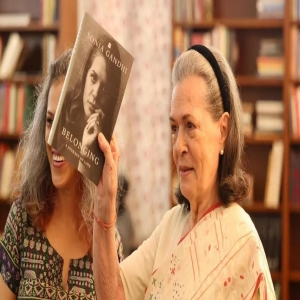
My renewed interest in Sonia Gandhi was partly responsible for my buying her recently published book, Belonging: A Journey of Love (HarperCollins, 530 pages, ?1,299). There are few public figures in India who have been subjected to as much ridicule, condemnation and downright abuse as this woman of Italian origin.
I remember my confusion when I first heard that Sonia was the fiancée of Rajiv Gandhi. I thought Sonia was perhaps a new name she had adopted to make herself more acceptable to Indians. It was only after reading the book that I realised that Sonia was indeed her maiden name. Her full name was Sonia Maino.
The book is interesting for several reasons. It demolishes a number of myths that have been assiduously cultivated by her political detractors. One of the more persistent allegations was that Sonia had worked as a cabaret dancer in London when she met Rajiv Gandhi, who was then studying engineering. The book makes it clear that she never had to take up employment in London to finance her language studies. She met Rajiv at a restaurant serving Italian food, and what followed was a courtship that eventually changed the course of both their lives.
Sonia gives considerable space to the romance, the anxieties and the practical difficulties that accompanied their relationship. Rajiv was not the privileged young man that political opponents sometimes made him out to be. He was willing to work with his hands and did not mind getting them dirty while changing a wheel or repairing a car engine.
This was a habit he and his younger brother Sanjay had acquired from their father, Feroze Gandhi. There was nothing particularly glamorous about the young Rajiv who was courting an Italian girl. He was an ordinary young man in love, prepared to undertake ordinary tasks to make ends meet.
I found the book extremely readable. Sonia has a language that keeps the reader engaged. More importantly, she does not write with an air of superiority. There is no attempt to present herself as someone who was destined to occupy the centre of Indian public life. She comes across as a woman who was drawn into extraordinary circumstances by love, family obligations and, eventually, an almost overwhelming sense of duty.
One must remember that Sonia had already paid a tribute to her husband through a pictorial biography soon after his assassination. Rajiv was an enthusiastic amateur photographer who liked to keep his SLR camera within easy reach. Photography was not merely a hobby for Rajiv; it was a way of preserving moments of family life.
The choice of photographs for the new book is particularly thoughtful. The picture on the front cover was taken by Rajiv Gandhi in Turin in 1966. The photograph on the back cover was taken by her grandson Raihan Vadra and his fiancée Aviva Baig in 2026. Sixty years separate the two pictures. The text inside the covers offers an account of six decades of her life.
I once heard a senior government official from Tamil Nadu, who is herself a connoisseur of saris, remark that few women wear the Indian garment as elegantly as Sonia Gandhi. Since hearing that observation, I have paid particular attention to her sartorial choices. She has indeed developed an understated elegance that has become part of her public persona.
But the sari was once a source of considerable apprehension for her. When she first came to Delhi, she dreaded the thought of wearing one. Her father had given her a return ticket, to be used if she found life in India unbearable. He could hardly have imagined that his daughter would not only refuse to return to Orbassano but would also marry into one of India's most prominent political families.
There was, however, a question of propriety. It would have been rather scandalous for the young Italian woman to move straight into the Prime Minister's residence at 1, Safdarjung Road. Instead, she was accommodated at the house of the poet Harivansh Rai Bachchan, whose son Amitabh would subsequently become one of India's biggest film stars.
It was at her wedding that Sonia wore a sari for the first time. She had to use several safety pins to keep the unfamiliar garment in place. The irony is that, years later, she would accompany Indira Gandhi on foreign tours and double as the Prime Minister's sari draper, helping her with the garment.
Her culinary transformation was equally remarkable. Sonia had an almost total dislike for Indian food when she arrived in the country. She found it excessively spicy, and the smell of some Indian preparations was an assault on her senses. Over the years, however, she developed a taste for the familiar Indian combination of rice, roti and dal.
The book's value lies in the ringside view it provides of events that unfolded in India over six decades. Sonia was not merely a member of the Nehru-Gandhi family. She was an eyewitness to its joys, tragedies, anxieties and political battles.
One episode that particularly interested me concerns the allegations made during the Gujarat elections in 2002. Narendra Modi campaigned aggressively against Sonia Gandhi and James Michael Lyngdoh, the then Chief Election Commissioner. Modi alleged that the two met every Sunday at the Catholic Cathedral Church in Delhi and conspired to delay elections in Gujarat.
The allegation was particularly outrageous because Lyngdoh was a confirmed atheist. Sonia, too, came from a family that was hardly religious. Her father had a pronounced dislike for the Church. On one occasion, after succumbing to his wife's insistence that the family attend Sunday Mass, he stood up shortly after the service began and walked out. His wife and children had no option but to follow him!
This does not mean that Sonia herself is an atheist. On the contrary, she appears to have developed a deep respect for different religious traditions. After Rajiv was assassinated, she took a copy of the Bhagavad Gita from his collection and sought the help of a scholar to understand its essential teachings.
Krishna's exhortation on Karma gave her considerable spiritual strength. There is something deeply Indian about this willingness to seek solace in a religious text that is not one's own. It illustrates the difference between respecting religion and exploiting it for political purposes. The allegations against her were an attempt to turn religion into a political weapon.
Another allegation, attributed to Modi, concerned the enormous expenditure supposedly incurred by the Government of India on Sonia's medical treatment, with figures running into thousands of crores being bandied about. She describes how she travelled to Europe twice for medical treatment. She could have sought treatment at a hospital such as Sir Ganga Ram in Delhi, but the prospect of relentless media attention made that difficult.
The book also contains a deeply moving account of a family tragedy that I had never heard about. Rahul Gandhi had an elder brother who died soon after birth. The family faced the difficult question of what to do with the body. Cremation was not an option, and the religious practice of immersing the body in a river was considered.
Sonia, however, remembered having seen a dead body floating in the Yamuna, only to be dragged ashore by dogs. She firmly rejected the idea of immersing the infant's body. It was eventually buried in a plot of land owned by the family. Whenever she visited the place, she would leave a flower in memory of the child.
This is an intimate account of maternal grief, one that most families would prefer to keep private. Yet, when some of her detractors got wind of the incident, it became an occasion for the most vicious kind of political attack. A newspaper item appeared under the headline: "Indira Gandhi failed in her attempt to become the grandmother of a bastard child."
When an opportunity arose for her to become Prime Minister after the Congress-led United Progressive Alliance won the 2004 general election, the attacks reached another level. Sushma Swaraj threatened to shave her head and sleep on a mat if Sonia assumed the office.
I know of only one other politician who declined a comparable opportunity. C. Krishnan Nair, who took part in the Salt Satyagraha along with Gandhi, preferred that his younger colleague become Delhi's Chief Minister rather than occupy the position himself. There is, of course, no exact parallel between the two situations.
Sonia chose Manmohan Singh to be Prime Minister. It was a decision that surprised many people, but Singh turned out to be one of India's most accomplished Prime Ministers. Their relationship was later subjected to considerable speculation, particularly after an aide to the former Prime Minister published a controversial account alleging that government files were routinely sent to Sonia Gandhi without an iota of truth.
One is reminded of an incident from the life of Jawaharlal Nehru. HK Dua, who later became one of India's distinguished editors and was one of my bosses, had among his early journalistic assignments the coverage of the immersion of Nehru's ashes at the Sangam in Allahabad, now Prayagraj.
He may not have known that some of Nehru's ashes had been retained at his ancestral house in Allahabad. It was Rajiv Gandhi, accompanied by Sonia and others, who eventually took those ashes to the confluence of the Ganga, the Yamuna and the mythical Saraswati. There is a certain continuity in the family's relationship with the rivers and traditions of India.
Sonia's political opponents did not confine their attacks to the national stage. When she contested against Sushma Swaraj in Bellary, Karnataka, the latter tried to turn the election into a contest between an Indian daughter and a foreign daughter-in-law. The electorate, however, knew better. Sonia won decisively.
There were also those who predicted that Sonia would leave India if the Congress lost the 1977 general election. She did not. Nor did she leave when the family suffered successive political reverses and personal tragedies. She remained in India, raised her children here and eventually entered public life. After reading her account, I find it difficult to think of many politicians who have demonstrated a stronger commitment to the country in which they have chosen to make their home.
One of the most significant observations in the book concerns the future of democracy. Sonia believes that authoritarian regimes cannot endure indefinitely because people will eventually rise against them. The attempt to impose a single-party, single-food and single-language system is bound to fail in a country as diverse as India. The observation is particularly relevant at a time when political uniformity is sometimes projected as a substitute for national unity.
Her concern about climate change is another revealing aspect of the book. She concludes by invoking the Prithvi Sukta of the Atharva Veda: "What of thee I dig out, let that quickly grow over. Let me not hit thy vitals."
It is a beautiful prayer, expressing humanity's obligation to the earth. What we take from nature must be replenished, and we must not wound the very source of our existence. The words have an application far beyond environmental protection. They could well serve as an admonition to those who are determined to strike at the vitals of Indian democracy.
.jpg)
 P. A. Chacko
A. J. Philip
.jpg)
 Jacob Peenikaparambil
.jpeg)
 John Dayal
.jpg)
 Jose Vattakuzhy
.png)
.png)
 Robert Clements

 Cedric Prakash