

 John Dayal
.jpeg)
Motilal Nehru was among the tallest figures in Uttar Pradesh's political landscape before Independence, and Jawaharlal Nehru and Indira Gandhi stood on those shoulders to write their own names in the firmament of India's most important political province. So did Lal Bahadur Shastri and a host of other luminaries of the freedom struggle and six decades of Independence.
But Narayan Dutt Tiwari was the last Congress chief minister of Uttar Pradesh before Uttarakhand was carved out of it to form a tiny Himalayan state, and his third and last term ended in 1989.
Since then, the Chief Ministers of Uttar Pradesh after 1989 have been Mulayam Singh Yadav of the Janata Dal and Samajwadi Party, who last held office in 2007, Kalyan Singh of the Bharatiya Janata Party till 1999, Mayawati of the Bahujan Samaj Party, who last served until 2012, Ram Prakash Gupta, the first of the Bharatiya Janata Party, who exited office in 2000, Rajnath Singh of the BJP till 2002, Akhilesh Yadav of the Samajwadi Party, who served until 2017, and the incumbent Ajay Singh Bisht, "Yogi Adityanath," of the BJP.
And Uttar Pradesh is where the Congress must prove it is still a national party, as the state sends 80 members to the Lok Sabha, nearly 15 per cent of the 543 seats in the lower house of Parliament, a figure and a political weight that will grow if ever there is a delimitation, or gerrymandering, as Prime Minister Narendra Modi promises.
Patently, a party that cannot credibly contest all of them must rely on its allies to do its arithmetic to remain a nationally ambitious political configuration.
The Congress has lived with the ignominy of that condition for more than three decades, and the assembly elections due early next year, along with the panchayat polls the Allahabad High Court has ordered within three months, will show whether it can leave it.
The numbers are more sobering than the party's recent confidence suggests, and the ground issues it might build on are ones where it has so far been a spectator rather than a leader.
In 2022, the BJP won 255 of 403 assembly seats on 41.29 per cent, the SP 111 on 32.06, and the BSP one on 12.88; the Congress contested 399, won two and polled 2.33 per cent, its lowest share in the state.
In 2024, the SP won 37 Lok Sabha seats on 33.59 per cent, the Congress six of 17 on 9.46, and the BJP fell to 33, with the RLD taking two and two smaller parties one each. The INDIA bloc's 43 seats rested on about 43.5 per cent against the NDA's 43.7, by one analyst's estimate, a narrow win rather than a landslide.
The Congress's rise from 2.33 to 9.46 per cent came on 17 seats under an ally's umbrella, showing what an alliance can do for it and little of what it can do alone.
Dalits make up about 22 per cent of the population: half are Jatavs; Muslims about 19 and Yadavs 11 to 13, the last two being the SP's base and its ceiling; OBCs exceed 40 per cent across some 48 castes. In 2024, the SP gave 27 tickets, or 44 per cent, to non-Yadav OBCs, and the alliance's share rose from about 10 to 25 per cent among Jatavs, 27 to 56 among other Dalits and 82 to 92 among Muslims.
The BJP works these fractures through caste-based allies, while the Congress, whose Brahmin-Dalit-Muslim coalition Kanshi Ram, Mandal and Mandir broke, must decide which pieces it can reassemble.
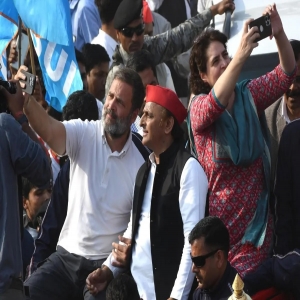
Mr Rahul Gandhi's team says it knows the answer, though perhaps not that it can deliver it.
On October 2, the party replaced Mr Ajay Rai with Ms Aradhana Mishra 'Mona,' a three-time Brahmin MLA from Rampur Khas in the east, with Mr Imran Masood, the Muslim MP from Saharanpur, as working president and Mr Devendra Nishad among the senior vice-presidents.
The party had earlier made Mr Rajendra Pal Gautam, a Jatav, its state in-charge, and the new troika, a Brahmin president, a Muslim working president and a Dalit AICC in-charge, is a deliberate attempt to rebuild the Congress's traditional social coalition of upper castes, Muslims, Dalits and non-Yadav OBCs.
The timing, months before an election and after open quarrels over appointments, temple visits and the terms of the alliance, invites the question of whether the party values continuity.
The seat-sharing talks make the question urgent, because the Congress has submitted a list covering 175 to 200 seats against a Samajwadi Party that insists winnability, not political bargaining, must determine the allocation.
There are many issues the party could take up. Though the National Crime Records Bureau minimises the count of communal violence, mostly saying there is no such thing in Uttar Pradesh, this is a sleight of hand, as the Bureau divides rioting into 15 categories and classification depends on how the police choose to register a case, totally avoiding cases such as the targeted violence at Sambhal on November 24, 2024, during a court-ordered survey of the Shahi Jama Masjid, in which four people were reported killed.
The Bureau's report for 2023 puts the state's overall crime rate at 335.3 per lakh population against a national rate of 448.3, but the same report shows Uttar Pradesh with the largest number of crimes against women, about 66,000 or 14.8 per cent of the national total, and the largest number of crimes against Scheduled Castes, 15,130 out of 57,789 or about 26 per cent.
Police "encounters," which the BJP government presents as zero tolerance, caused 13 deaths in 2022 and 48 in 2025, the highest for any year since 2017, and the Director General of Police's figures record 16,284 operations between March 2017 and December 2025 with 10,990 persons injured and 266 killed.
Land is the second ground issue, and here the Congress has a natural claim that it has hardly used, since it was the party that passed the 2013 land acquisition law. Farmers from about twenty districts rallied at Greater Noida in November 2024 over compensation and developed plots, and a BJP legislator was publicly critical in May this year of a freeze on compensation while land prices soared.
Education and employment are the third. The June 2025 order to pair or merge schools with fewer than 50 pupils covered more than 10,000 schools. The Leader of the Opposition, Mr Mata Prasad Pandey, alleged that 29,000 had been merged and 10,000 closed, while Mr Akhilesh Yadav later put the closures at 22,000. The Basic Education Minister insisted that none had been shut.
The police constable examination for 60,244 posts was cancelled in February 2024 after a paper leak, and a record 15.76 lakh candidates applied for 4,543 sub-inspector posts, about 350 for each vacancy.
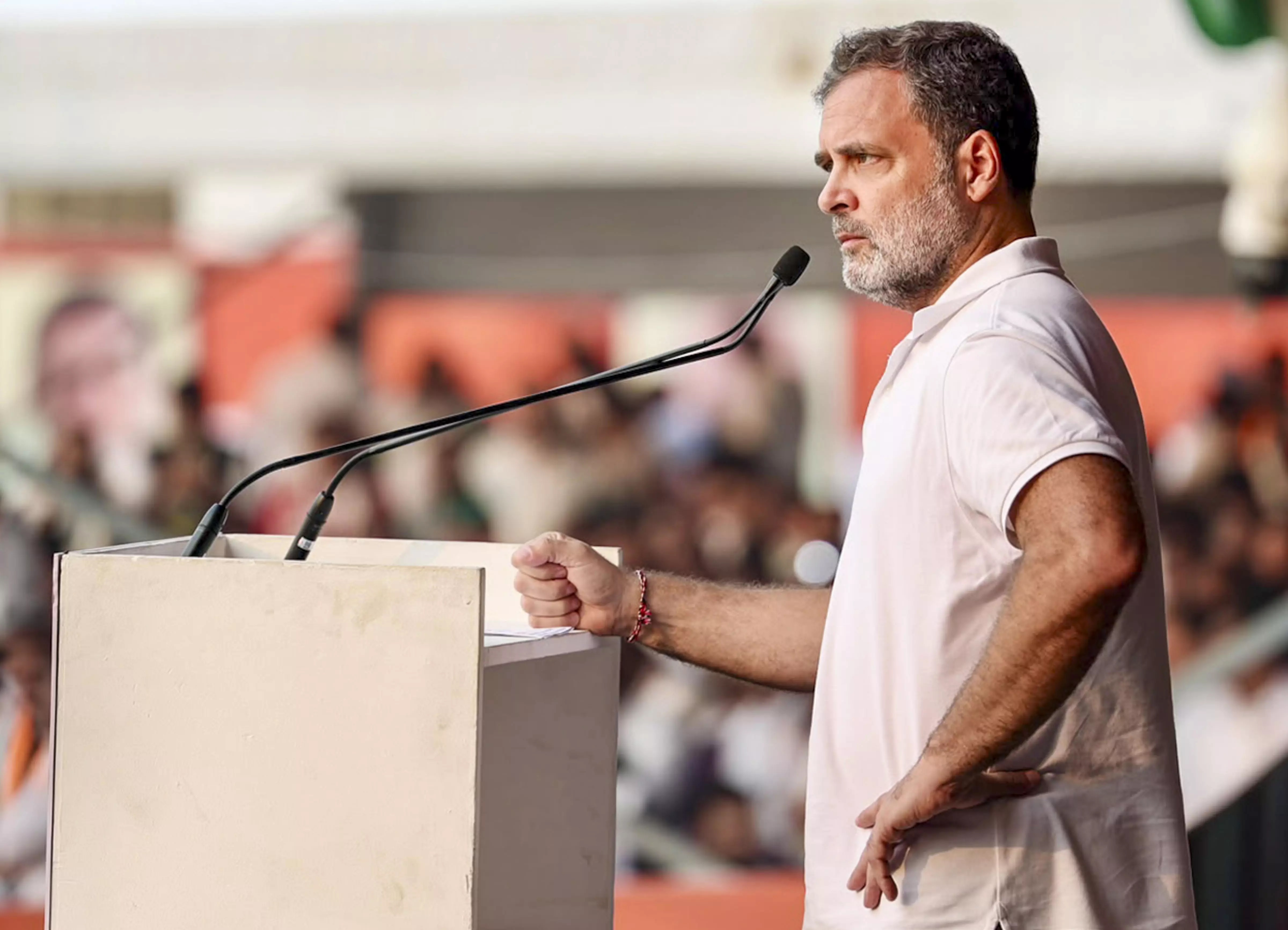
Mr Rahul Gandhi has made this the centrepiece of his youth outreach: his 'Chhatron Ki Goonj' programme in Prayagraj in August 2026, for which nearly two lakh students registered, was explicitly framed around paper leaks, recruitment delays and contractual employment, and the Congress's OBC department was mobilised to bring students to the venue.
The constitutional centre of the contest lies in the electoral roll. The Special Intensive Revision reduced the state's electorate from 15.44 crore to a draft of 12.55 crore, removing 2.89 crore names (18.7 per cent), and the final roll in April stood at 13.40 crore after 84 lakh were restored, leaving 2.04 crore (13.2 per cent) deleted.
More than two crore citizens have been removed from a register on which every other right depends; the Congress and the SP allege that slum dwellers and the poor were hit hardest, and the party that documents those cases village by village will be doing more than electioneering.
The regional picture is correspondingly varied.
In the west, the RLD has left the alliance for the NDA, and the Muslim-Dalit belt around Saharanpur, where Mr Masood won in 2024 with 45 against the BJP's 39 per cent, is the Congress's natural ground.
In the east, the Congress polled 4.6 lakh votes against Mr Narendra Modi's 6.12 lakh at Varanasi, and the Bhojpuri belt turns on the Nishads, Rajbhars and Kurmis, whom the BJP has courted through its allies. A single template from Lucknow will not serve all of this, which is why the party needs a regional leader in each belt with real authority over tickets.
The foundation is the village, and there the Congress record is distressing.
In the 2023 municipal elections, the BJP won all 17 mayoralties, and the Congress won none, with a little under 70 of 1,420 corporator seats; in the last panchayat round, it won about 125 district panchayat wards against 768 for the BJP, 759 for the SP, and 944 for independents.
The state government postponed the present round in May, citing OBC reservation and delimitation, and the High Court's October 14 order directed that the election be completed within three months, with the State Election Commission saying it was ready.
Can Mr Rahul Gandhi turn the tide, then, alone or in alliance?
Alone, he cannot, and the more candid voices in his party do not pretend otherwise.
With ten years in office, a 7-2 result in the November 2024 by-elections, and a 6-5 edge in the recent legislative council polls, the BJP had the advantage.
As Frontline magazine argued, while the Congress believes it has gained momentum, it "will have to recognise the Samajwadi Party's stronger organisational base and accommodate its demands if the INDIA bloc hopes to wrest Uttar Pradesh from the BJP-RSS combine."
A Congress that treats 2027 as a contest it can win outright would be deceiving itself, while one that treats it as a contest it can afford to lose would be deceiving its workers.
What it can build is a partnership in which it holds seats where its booth work is real, speaks for Dalits on the atrocity figures, for farmers on compensation and cattle, for the young on schools and examinations, and for every citizen on the roll, and leaves 2029 with thirty or more parliamentary seats across the west, Awadh and the east.
That would make it again a national party that lives in the state, even if it does not rule in Lucknow.
.jpg)
 P. A. Chacko
.jpeg)
 A. J. Philip
.jpg)
 Jacob Peenikaparambil
John Dayal
.jpg)
 Jose Vattakuzhy
.png)
.png)
 Robert Clements
 Cedric Prakash
.jpg)
 Mathew John