

 P. A. Chacko
.jpg)
Today, the Christians and the Christian institutions in India are at the receiving end of the beating stick of the Sangh Parivar.
The truth is that Christian missionaries are known for daring to dream and weave the lives of people who need care and a healing touch. In the public healthcare landscape, Christian medical institutions have historically reached regions completely devoid of state or private medical infrastructure. World-renowned institutions such as the Christian Medical College (CMC) in Vellore (founded by Dr Ida S. Scudder) and CMC Ludhiana (founded by Dr Edith Brown) revolutionised medical training, research, and accessible patient care.
Long before government-led eradication programs, Christian mission hospitals established pioneering sanatoriums and asylums to care for patients suffering from leprosy, tuberculosis, and mental illnesses, alongside opening specialised care facilities for orphans and people with disabilities. Today, a vast network of village-level and rural dispensaries and health care centres exists, where dedicated staff attend to every patient without asking about their caste or community.
Graham Stuart Staines, an Australian Christian missionary, spent over three decades working with the poor, marginalised, and leprosy patients in the remote tribal regions of Odisha. Finally, he paid for his humanitarian work by being burned alive with his two young sons, Philip (aged 10) and Timothy (aged 6), while sleeping inside their station wagon in Odisha. Stein's crime was touching the untouchable with Christian compassion. Hindu fanatic Dara Singh led his murderous team in the horrendous act.
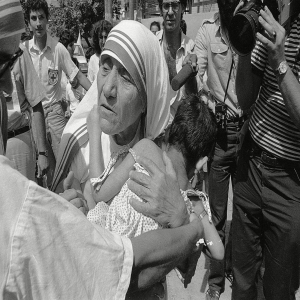
Saint Mother Teresa's crime was pulling out a dying human figure from a rat-infested waste heap and asking for a little space at the Kalighat temple in Kolkata to nurse the person for a while. She did not stop to find out which religious community the dying person belonged to. However, presuming that person to be a Hindu, she rushed to the temple. Her crimes multiplied by opening nursing homes and care centres for the sick, elderly, abandoned and orphans without finding their religious or caste identity. For her crimes, she was honoured with the nation's highest civilian award, the Bharat Ratna, in 1980. Of course, the Sangh Parivar saw it as a crime by the Indian state to award her the Bharat Ratna.
PO Bodding of the Norwegian Mission lived among the tribals of Jharkhand, researched indigenous herbal medicine practices, and recorded his findings for future generations. While he made monumental contributions to documenting and preserving the Santhali language and the culture of the Santhal tribal community, he found no time to convert the Santhals to Christianity. His seminal works were A Santhali Grammar for Beginners, a 5-volume Santhali dictionary, and Studies in Santhal Medicine and Connected Folklore.
Jesuit Fr. J. Bressers' seminal work, "The Botany of the Ranchi District" (1951), meticulously documented the local flora, fauna, and indigenous use of plants native to the Chotanagpur plateau in central India.
The Chota Nagpur Tenancy (CNT) Act of 1908 was designed and drafted by Jesuit priest Fr John Baptist Hoffman. He is often called the "Father of the CNT Act." His extensive documentation and advocacy provided the core blueprint that the British administration enacted on November 11, 1908, to legally protect indigenous tribal lands from illegal alienation.
Another Belgian Jesuit priest, Fr Camille Bulke (1909-1982), Padma Bhushan awardee (1974), became one of the most prominent Western scholars of Hindi, Sanskrit and classical Indian literature. His magnum opus was Ramkatha: Utpatti aur Vikas (The Rama Story, Origin and Development). His other famous works are: English-Hindi Dictionary and Critical Research Essays.
The Christian organisations believed they were contributing to the broader Indian Renaissance by helping local reformers tackle deep-seated societal injustices. They actively worked alongside social reformers to challenge the rigid caste hierarchy, untouchability, and oppressive feudal practices targeting Dalits and Adivasis.
They lent support to prominent Hindu reformers like Raja Ram Mohan Roy, the Father of Modern India, who spearheaded the campaign that led to the official abolition of Sati and fought fiercely against polygamy, child marriage, and the caste system, and advocated strongly for women's property rights; Swami Vivekananda, a chief disciple of Ramakrishna Paramahamsa who founded the Ramakrishna Mission in 1897 and challenged rigid ritualism, and preached social service; Dayanand Saraswati, founder of the Arya Samaj in 1875, who rejected idolatry, polytheism, and hereditary caste divisions; Jyotirao Phule and Savitribai Phule of Maharashtra who pioneered the fight against caste oppression and patriarchy; Dr BR Ambedkar who charted a distinct political and spiritual path by embracing Buddhism and his lifelong crusade to uplift the Dalits, and such other prominent reformers. Christian community leaders appreciated these Hindu leaders' humanistic values and supported their movements.
In language, literature, and journalism, Indian Christians contributed immensely to preserving, structuring, and modernising various Indian languages: Christian missionaries authored the earliest comprehensive grammars and dictionaries for Tamil, Malayalam, Telugu, Hindi, and tribal dialects. Figures like Rev. F. Kielhorn, Bishop Robert Caldwell (Comparative Grammar of the Dravidian Languages), and GU Pope helped unearth and translate classical South Indian literature for global audiences.They facilitated the mass publication of textbooks, newspapers, and vernacular literature, boosting regional literacy. Christian missionaries are singularly responsible for introducing modern movable-type printing technology to India.
The first printing press in India - and the entire region of Asia - was established in Goa in 1556 by Jesuit missionaries. Originally destined for Ethiopia on a Portuguese ship, the press was offloaded in Goa when travel plans fell through and set up at St. Paul's College. Missionaries expanded print technology to regional Indian languages. Later, Danish missionary Bartholomaeus Ziegenbalg established the famous Tranquebar Press in 1712–1713 in Tamil Nadu, which cast the first Tamil font types. All such activities paved the way for the broader spread of publishing and journalism across British India.
Though a religious minority, Indian Christians actively participated in the struggle for Swaraj (self-rule) and the formation of the republic. Indian Christians marched alongside fellow citizens in major Gandhian mass movements, facing imprisonment, police brutality, and economic boycotts.
Indian Christians contributed profoundly to the Indian independence movement through grassroots activism, intellectual discourse, legal defence, and institutional nation-building. Thevarthundiyil Titus (1905–1980) of Kerala was a close associate of Mahatma Gandhi and served at the Sabarmati Ashram. He was a Christian participant among the 78 chosen marchers in Gandhi's legendary Dandi March (Salt Satyagraha) of 1930. In various princely states and regions, Christian leaders spearheaded local anti-colonial and pro-democracy movements.
They played a massive role in demanding responsible government in Travancore (Kerala). Leaders like TM Varghese, AJ John, Pillai, and women leaders like Akkamma Cherian (often called the "Joan of Arc of Travancore") and Annie Mascarene, a freedom fighter, prominent politician and lawyer, mobilised thousands against the Diwan's autocratic rule.
George Joseph (1887–1938), a Malayalee Christian lawyer and nationalist leader, edited the 'Independent' newspaper (founded by Motilal Nehru). He was imprisoned for his role in the Non-Cooperation Movement and famously led the Vaikom Satyagraha for Dalit temple-entry rights after the arrest of other local leaders. Many Christian educators and institutions quietly or openly shielded, funded, and fostered the nationalist movement.
Sushil Kumar Rudra (1861–1925) was the first Indian Principal of St. Stephen's College, Delhi. His home was a secret sanctuary for Mahatma Gandhi, CF Andrews, and other core nationalist leaders to plan strategies during tense phases of the freedom struggle. Rajkumari Amrit Kaur (1887–1964), born into the royal family of Kapurthala and a devout Christian, she gave up a life of privilege to join the freedom movement. She spent years working closely with Gandhi, participated in the Dandi March and Quit India Movement, and later became independent India's first Health Minister.
By integrating faith, democratic ideals, and patriotism, Indian Christians helped shape a pluralistic vision for an independent, democratic India. Prominent Christians served in the Indian National Congress, as active trade unionists, and as delegates in the Constituent Assembly. Leaders like Harendra Kumar Mookerjee (Vice-President of the Constituent Assembly), Joachim Alva, and JC Kumarappa (a close associate of Mahatma Gandhi) contributed deeply to economic policy and constitutional drafting. Amrit Kaur was one of the 15 women in the 299-member Constituent Assembly that drafted the Constitution of India.
Christian bodies, through platforms like the All-India Conference of Indian Christians, fiercely advocated for a united, secular, and democratic India, opposing the partition of the country on communal lines.
Christianity's crime in India was agenda-based: To serve the nation faithfully, help toward the democratic development of the country by providing infrastructure facilities through an elaborate educational network, humanitarian health care, participation in the freedom movement, research into indigenous culture and systems of traditional healing methods, promotion of printing and communication facilities, supporting reform movements of social reformers, and the like.
And surprisingly, even after two millennia in India, their population is a negligible 2.3%. The 1951 census showed their population at 2.35%, and the 2011 enumeration showed it at 2.3%. One wonders, with their vast network of education, health care, contribution to nation-building, and uplift of the poor and marginalised, etc., how their number has not increased, but rather gone down the ladder.
And yet, they are at the receiving end of the Sangh Parivar's abuse, vandalism, and persecution. Christian sanctuaries and prayer halls are desecrated and destroyed; the cross, the most venerable symbol of their belief, is stoned and pulled down; their pastors and staff are imprisoned on false charges. If there is no retaliation or bloodshed, it is because Christianity preaches and practices peace, patience and fellowship. Because we are law-abiding and because we believe in an impartial judiciary, the rule of law, and legal process, we do not even resort to our constitutional right to self-defence.
We also wonder how many of our enlightened alumni, or whose children and grandchildren are students in our elite institutions, see things from the right perspective or speak up against the harsh realities we are made to undergo!
 P. A. Chacko
.jpeg)
 A. J. Philip
.jpg)
 Jacob Peenikaparambil
.jpeg)
 John Dayal
.jpg)
 Jose Vattakuzhy
.png)
.png)
 Robert Clements

 Cedric Prakash