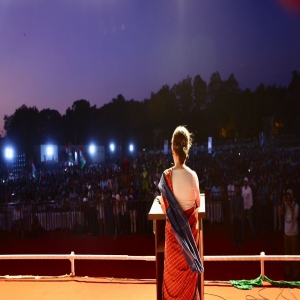


 Jacob Peenikaparambil
.jpg)
I was motivated to write this article by reading Sonia Gandhi's memoir, Belonging: A Journey of Love. As Sonia Gandhi recounts, she came to India because she loved a man, Rajiv Gandhi. However, her journey did not end with her marriage; it extended to the Gandhi family and, ultimately, to India. Although she chose to embrace India as her own country, she had to overcome numerous obstacles and challenges. Her memoir vividly depicts the struggles she faced, and continues to face, in her quest to belong to a country she accepted as her own nearly six decades ago.
It was almost a Herculean task for a woman born and raised in an entirely different socio-religious-cultural and political context to become part of an Indian family, especially the family of Indira Gandhi, one of the country's most powerful women and then Prime Minister of India. The language, domestic workers, food, and the unfamiliar combination of Indian dishes with dishes of indeterminate provenance were all strange to her. Recalling the early years of her marriage, when Rajiv Gandhi had to leave for pilot training, she writes: "Now that he was leaving, I felt apprehensive and fragile ... At the same time, I was determined to be brave and get on with my efforts to adjust to my new life."
In her memoir, Sonia Gandhi describes her efforts to learn Hindi and, later, the Bhagavad Gita. Despite her sincere efforts to adapt to India's socio-cultural milieu, she was repeatedly branded a videshi bahu (foreign daughter-in-law) by the BJP and RSS. In the 1999 general elections, Sonia Gandhi contested parliamentary constituencies in Amethi and Bellary, Karnataka. The BJP fielded Sushma Swaraj against her in Bellary, framing the contest as one between a desi beti (Indian daughter) and a videshi bahu.
In May 1999, three prominent members of the Congress Working Committee (CWC), including Sharad Pawar, wrote a letter to Sonia Gandhi questioning her eligibility to hold high office in India because of her foreign birth. Recalling the incident, she writes: "I felt tears welling up and walked out of the meeting. I hadn't entered politics to grab position and power. It was some of these colleagues who had urged me to join politics and now they were turning on me." She adds, "It wasn't the issue of holding office that hurt me; it was my loyalty to India was being questioned."
Sonia Gandhi also recounts another heart-wrenching experience involving leaders of her own party. At a high-level Congress conference held in Shimla in July 2003, the party decided to form an alliance with secular parties. Towards the end of the conference, however, she grew uneasy as party members discussed who should lead the Congress in the forthcoming elections. She felt deeply hurt and wrote: "I felt wounded at the thought that they still saw me as an outsider: they, my colleagues of years." As Congress president, she believed it was her responsibility to lead the election campaign, and she asserted her right to do so.
During election campaigns, Sonia Gandhi became a principal target of the BJP. Her opponents alleged that she would bring Rome Raj to India. Other allegations portrayed her as a cabaret dancer, a "Monica Lewinsky," and even a spy. These accusations did not discourage her. She remained determined to challenge the divisive and fanatical religious forces represented by the RSS and BJP, which, in her view, propagated hatred and division against minorities and promoted the interests of the wealthy at the expense of the poor and disadvantaged sections of society.
Sonia Gandhi faced further humiliation after the Congress-led United Progressive Alliance (UPA) won the 2004 general elections. While congratulations and best wishes poured in for Sonia Gandhi and her party, the BJP was in an uproar. Some of its women leaders threatened to shave their heads, a symbolic act of mourning, if the videshi bahu became Prime Minister.
As UPA leader, Sonia Gandhi approached the then President of India, APJ Abdul Kalam, with a list of the alliance partners and the number of seats they had won. The President asked her to submit letters signed by each ally to complete the formalities. However, the BJP spread rumours through the media that the President had refused to appoint her Prime Minister because of her foreign birth.
Despite immense pressure from Congress party workers and alliance partners, Sonia Gandhi declined to accept the post of Prime Minister. Instead, she recommended Dr Manmohan Singh, a scholar, technocrat, and, above all, a person of compassion and unquestionable integrity. In her address to the Congress and its allies, she made it clear that power had never motivated her. She declared: "My aim has always been to defend the secular foundation of our nation and the poor of our country—the creed sacred to Indiraji and Rajivji."
The BJP could never appreciate Sonia Gandhi's decision to decline the post of Prime Minister. Instead, it kept spreading the allegation that she was the government's "backseat driver." In this context, Sonia Gandhi refers to a book published a decade later by a former aide of Dr Manmohan Singh, which reaffirmed the malicious allegation that she summoned files from the Prime Minister's Office, interfered in administrative matters, and influenced key appointments. Responding to this accusation, Sonia writes: "Though I have been the subject of worse accusations over the years, the fabrication that distressed me most was that I was looking into official files—something improper for anyone outside the government."
Although Sonia Gandhi does not mention the book's title or author, many readers would recognise the reference as The Accidental Prime Minister, by Sanjaya Baru, who served as Dr Manmohan Singh's media adviser.
Another major challenge Sonia Gandhi has faced since 2014 is the RSS-BJP's vision for India. She describes the ideological differences between Prime Minister Narendra Modi and herself: "We come from different ideological worlds; his ideas of this country are vastly different from mine." According to her, Modi's ideology reflects a form of fundamentalism in which his faith and culture take precedence over those of others. In the India envisioned by this ideology, hierarchy, order, and control are central.
In contrast, Sonia Gandhi's vision of India rejects hegemony and upholds inclusiveness, secularism, and social justice. The BJP's stated objective of creating a "Congress-free India" has, in practice, raised concerns about the possibility of an India without an effective opposition, paving the way for a majoritarian and authoritarian state.
Sonia Gandhi expresses deep concern over the erosion of India's ideal of unity in diversity—a heritage built over millennia and strengthened by the Indian Constitution. She writes:
"In sum, ideological forces behind Prime Minister Modi are undermining a system that for close to eighty years has held intact a diverse population, a tapestry of different languages, beliefs, and customs in a delicate web of unity. It is this fabric, essential to our unity and freedom, that is now threatened by the authoritarian force bent upon changing the very nature of our country."
A sense of belonging among the members of a community, organisation, or nation is one of its greatest strengths. Fostering this sense of belonging requires efforts not only from individuals but also from other members of the community, especially its leadership. Just as Sonia Gandhi made sincere efforts to adapt to India's way of life and cultural practices, individuals must be willing to adjust to and embrace the culture and ethos of the country of which they are citizens. They must also be prepared to make sacrifices for the nation.
At the same time, the majority community and the country's leadership have an equally important responsibility to create an inclusive environment through laws and policies that guarantee equal treatment, equal rights, and equal opportunities for all citizens, irrespective of religion, language, caste, race, or other differences.
The socio-political environment created by the RSS and BJP, particularly during the past twelve years, has not been conducive to fostering a sense of belonging among all sections of Indian society, especially religious minorities such as Muslims and Christians. The increasing emphasis on exclusion, discrimination, and religious polarisation threatens the inclusive and pluralistic foundations of our nation.
May Sonia Gandhi's memoir inspire all Indians to deepen their sense of belonging to the country and reaffirm their commitment to its constitutional values. At the same time, may it challenge the RSS-BJP to abandon policies and practices that promote exclusion, discrimination, and hatred against minorities. True belonging cannot be built by imposing one culture, religion, or ideology on others. It can flourish only when every citizen feels respected, accepted, and valued as an equal member of the Indian nation.
.jpg)
 Cedric Prakash
.jpg)
 A. J. Philip
Jacob Peenikaparambil

 Dr Suresh Mathew
.jpg)
 John Dayal
.jpg)
.jpg)
.png)
 Robert Clements
.jpg)
 P. A. Chacko