

 A. J. Philip
.jpg)
Arrogance has always been the greatest enemy of those who wield power. It blinds rulers to the consequences of their actions, convinces them that they are infallible, and leads them to dismiss criticism as the handiwork of enemies. History is replete with examples of mighty leaders brought down not by external adversaries but by their own hubris.
Napoleon Bonaparte's disastrous invasion of Russia was born out of overconfidence. So was Hitler's invasion codenamed Operation Barbarossa. Closer to home, the Emergency imposed by Indira Gandhi in 1975 demonstrated how the belief that one could silence dissent indefinitely ultimately resulted in a humiliating electoral defeat.
Power, when tempered by humility, strengthens democracy. When mixed with arrogance, it becomes its gravest threat.
That lesson appears to have been forgotten by many occupying high office today. Accountability, once regarded as the cornerstone of parliamentary democracy, has steadily become a casualty of political expediency. The reluctance to accept responsibility, even for glaring administrative failures, has created the impression that ministers enjoy immunity so long as they remain politically indispensable.
Nothing illustrates this decline more starkly than the handling of the National Eligibility-cum-Entrance Test (NEET). Question-paper leaks, irregularities, and administrative lapses threw the future of tens of thousands of students into uncertainty. Those who had spent years preparing for one of India's most competitive examinations suddenly found their dreams clouded by suspicion.
The controversy struck at the very credibility of the country's educational system. The psychological trauma was immense. Tragically, nearly two dozen students, unable to bear the anxiety and uncertainty surrounding the examination, allegedly took their own lives. No examination should ever exact such a terrible human cost.
In any mature democracy, such a colossal failure would have demanded political accountability. Union Education Minister Dharmendra Pradhan should have resigned, not necessarily because he personally leaked a question paper, but because the system under his watch had failed.
India once had a richer tradition of political accountability. In 1956, Railway Minister Lal Bahadur Shastri resigned after the Ariyalur railway accident that claimed over a hundred lives. Prime Minister Jawaharlal Nehru initially declined to accept his resignation, but Shastri insisted that moral responsibility rested with him. That act of integrity enhanced rather than diminished his stature, and he later became Prime Minister.
Similar examples abound. External Affairs Minister Natwar Singh resigned in 2005 after his name surfaced in the Volcker Committee report on the Iraq oil-for-food programme, even before any guilt had been established. Minister of State Shashi Tharoor resigned in 2010 amid controversy surrounding the Kochi IPL franchise.
Maharashtra Chief Minister Ashok Chavan was asked to step down following allegations relating to the Adarsh Housing Society scandal, though legal proceedings continued for years thereafter. It is a different matter that he is with the BJP today.
Resignation was once understood not as an admission of guilt but as an affirmation of constitutional morality. Today, however, the standard appears entirely different. Political utility has replaced political accountability. NEET was not the only controversy during his tenure. The Central Board of Secondary Education (CBSE) also faced serious criticism over examination management and administrative lapses. Instead of restoring confidence through transparent reforms and accountability, official responses often appeared defensive.
His attempts to restructure the University Grants Commission through wide-ranging reforms also generated widespread opposition. Significantly, criticism did not come merely from Opposition parties. Student bodies and organisations affiliated with the Sangh Parivar expressed reservations in Uttar Pradesh and elsewhere. When even ideological allies voice strong objections, it is difficult to dismiss every criticism as politically motivated.
Yet Pradhan continues to enjoy the complete confidence of Prime Minister Narendra Modi. There are understandable political reasons for this. He is widely credited with playing a major role in expanding the BJP's organisational base in Odisha, a state that had long resisted the party's advance. His political skills are valued within the party, making him one of its trusted strategists.
Before assuming charge of the Education Ministry, he served as Petroleum Minister, another prestigious portfolio. His tenure there, however, was not free from controversy. Questions were raised over the functioning of the ministry and the deployment of senior officials. It was alleged that a Secretary-level officer from Keralam was effectively sidelined without meaningful responsibilities. Simultaneously, substantial corporate social responsibility funds from public sector undertakings under the ministry reportedly flowed to organisations associated with the Sangh Parivar.
One report claimed that the Oil and Natural Gas Corporation (ONGC) alone provided about ?668 crore to around twenty such organisations, including Seva Bharati, over the last ten years.
The larger question, however, is whether political indispensability should become a shield against accountability. Would the government have collapsed had one minister been asked to step aside pending a thorough inquiry? On the contrary, such a decision might have strengthened the belief that constitutional government values responsibility over political convenience.
The erosion of accountability has not been confined to the executive. The Supreme Court has repeatedly described itself as the vigilant guardian of the Constitution and the fundamental rights of citizens. Such a description inevitably carries an equally weighty obligation.
When credible allegations emerge that students exercising their democratic right to protest were subjected to brutal police action, the nation's highest court cannot afford to appear indifferent. Reports that Chief Justice Surya Kant remarked that the court had "no time" to watch videos depicting police excesses against students have therefore caused understandable concern. For his information, tens of thousands in India ànd abroad have watched those very videos.
Courts need not decide cases on the basis of social media videos alone. Allegations require verification, evidence, and due process. Yet words spoken from the highest judicial forum possess immense symbolic significance. When those words appear dismissive of complaints involving the liberty and dignity of young citizens, public confidence inevitably suffers.
The concern extends beyond a single judicial remark. It goes to the heart of the relationship between the citizen and the State. In every constitutional democracy, the courts are expected to stand between governmental power and individual liberty. They are not expected to accept every allegation at face value, but they are expected to ensure that allegations of abuse by the State receive a fair, prompt, and impartial hearing. Justice is not merely about the final verdict; it is equally about the willingness of courts to listen.
The events surrounding the "Chalo Sansad" protest have exposed a troubling truth about the state of Indian democracy. When citizens, particularly young citizens, seek answers, the State increasingly responds with force rather than dialogue. Thousands of students gathered in Delhi to protest against the continuing uncertainty surrounding the integrity of competitive examinations. They were not armed insurgents. They were students anxious about their future, angry over repeated allegations of question-paper leaks, and demanding accountability from those entrusted with safeguarding public examinations.
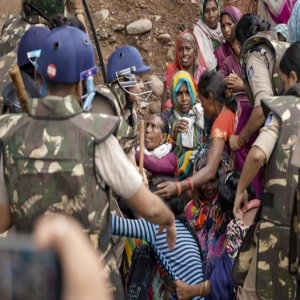
What followed has shaken public conscience. The police resorted to lathi-charge, tear gas, pellet guns, and mass detentions. Students were dragged on the roads. Women protesters were handled roughly. The allegations are serious enough to merit immediate judicial scrutiny. Yet the institutional response has been marked more by defensiveness than by concern.
Most disturbing were the videos showing young men with masked faces, carrying lathis, moving alongside the police and attacking students. They were not in uniform. They did not appear to be ordinary bystanders. Their conduct was ruthless. Many viewers felt they resembled political cadre operating in tandem with the police.
If private individuals participated in crowd control, the government owes the nation an explanation. In a constitutional democracy, the monopoly over the legitimate use of force cannot be outsourced, informally delegated, or disguised behind anonymity. The symbolism of the protest is sharpened by an earlier controversy involving Chief Justice of India Surya Kant.
While hearing another matter concerning unemployed youth, he reportedly used the word "cockroaches" in a context that many young people considered deeply insensitive, notwithstanding later clarifications. Words spoken from positions of constitutional authority carry enormous weight.
The police response also reflects a deeper institutional inheritance. In his important book Defenders of the Establishment, former Director General of Police KS Dhillon observes that the Indian police, through the millennia, have largely regarded their primary duty as protecting the interests of their masters — the ruling power — rather than serving the people.
Whether under ancient kingdoms, imperial courts, colonial administrators, or elected governments, the instinct has often remained the same: defend authority first, citizens later. Dhillon's observation is uncomfortable precisely because it continues to resonate. Independent India still relies substantially on the colonial policing framework embodied in the Police Act of 1861.
That law was enacted by the British after the Revolt of 1857 to control a subject population, not to protect democratic rights. The irony is glaring. Many Indian police forces continue to function under a colonial mindset, little realising that Britain itself has long moved on. British policing today is governed by modern laws, professional standards, independent oversight, and the principle of policing by public consent. India, however, continues to preserve a structure designed for imperial control.
Because the violence occurred in Delhi, sections of the media that often avoid uncomfortable stories were compelled to report it. The images could not be ignored. Far from weakening the agitation, the crackdown appears to have strengthened it. Public sympathy shifted towards the students. The government itself seemed to recognise that force alone would not resolve the crisis.
Prime Minister Narendra Modi was forced to send emissaries to Sonam Wangchuk, who was continuing his fast at Medanta Hospital, with assurances that the matter would be discussed in the Cabinet. That assurance invites an obvious question: what else is the Cabinet for, if not to discuss issues affecting lakhs of students and the credibility of national examinations? Parliament has been disrupted over the controversy.
The contrast with an earlier era is striking. When Anna Hazare launched his anti-corruption movement demanding a strong Lokpal, the UPA government constituted a formal joint drafting committee. Senior ministers such as Pranab Mukherjee and P Chidambaram sat across the table from representatives nominated by Hazare, including Shanti Bhushan ànd Prashant Bhushan. The government recognised that public dissent deserved institutional engagement.
Today, the approach appears diminished. Student representatives were not invited to the Prime Minister's Office, the Home Minister's Office, or even the Central Secretariat for structured talks. Instead, they were asked to meet a senior minister at his residence, as though they were attending a private social function rather than discussing a national crisis.
When that was found unacceptable, another informal venue — a businessman's house — was reportedly suggested. Such arrangements only deepen the perception that corporate power enjoys easier access to the State than ordinary citizens do.
The same pattern is visible beyond Delhi. While national attention focused on the capital, the Madhya Pradesh Police reportedly dealt harshly with the Ken-Betwa agitation. Tribal protesters were forcibly moved into buses and sent back to their villages. There was little attempt to hear their grievances.
These communities have repeatedly paid the highest price for development. Their forests become mines, their villages disappear under reservoirs, and their livelihoods are disrupted. They are promised prosperity, but tangible benefits rarely reach them.
A government confident of its legitimacy does not fear dialogue. It does not answer questions with lathis, tear gas, and pellet guns. It does not treat students as enemies and tribal protesters as obstacles. Assault is not administration. Force may disperse a crowd for a day, but it cannot extinguish anger, restore trust, or solve the underlying problem.
Prime Minister Modi must come down from the pedestal of political infallibility. He must take the students into confidence, engage them through formal and transparent dialogue, and address their legitimate concerns with sincerity. If the government continues to substitute coercion for conversation, chaos will gradually replace order. And when order collapses, no amount of force will be able to restore the trust that has been lost.
.jpg)
.jpg)
.png) Jacob Peenikaparambil
Jacob Peenikaparambil

.png) John Dayal
John Dayal
.jpeg)
.png) Joseph Maliakan
Joseph Maliakan

.png) Dr Arnald Mahesh SDB
Dr Arnald Mahesh SDB

.jpg) Jose Vattakuzhy
Jose Vattakuzhy
.png)

.jpg) Isaac Gomes
Isaac Gomes
.png)
.png) Robert Clements
Robert Clements