

.png) Cedric Prakash
Cedric Prakash
.jpg)
'Old is gold' is a proverb that has stood the test of time! It connotes and denotes all that is precious: enduring value, wisdom, and even the superior quality of material things that have transcended the years. Older elements carry a nostalgic charm, whether it is cherished traditions, vintage objects, or classical music. They have unmatched authenticity that newer things cannot replicate.
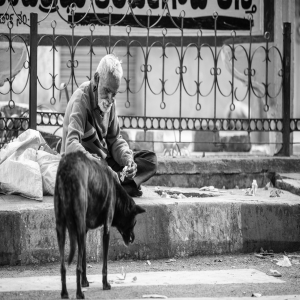
Today, 'old is gold' is just a cliché. Our world is permeated with the 'throw- away' culture; the new model of a gadget becomes obsolete in no time. Disposables: be it plates or glasses, are so very convenient! Heaps of garbage everywhere are indicators of how easily we 'discard' things and even food today! And when it comes to human beings, old people are so easily dispensable, unwanted, inconvenient and even rejected!
Pope Francis established in 2021 the "World Day of Grandparents and the Elderly" in the Catholic Church. He was keen on addressing the isolation of older people; he also wanted to highlight that they are a vital link between generations, holding wisdom and roots, and to encourage young people to connect with them. Every year on the fourth Sunday in July (the Sunday closest to the Feast of Saints Anne and Joachim), the Church celebrates this very special day.
Little is known about these two Saints; but the very fact that they were the parents of Mary and the grandparents of Jesus is sufficient to hail them as role models: wonderful and exemplary, caring and sensitive senior citizens, worthy of emulation today Significantly, this year for the very first time the 'World Day' will be celebrated on Sunday July 26, the proper feastday of Sts Anne and Joachim.
For this Sixth World Day, Pope Leo XIV has given us all a wonderful message on the theme, "I will never forget you" (Is 49:15). His message is motivating and inspiring. He cautions one about the perils of old age, yet in the words of the prophet Isaiah, he assures all with words of hope, "Even today, we can read these words as referring to each of us, and everyone can hear that 'I will never forget you' spoken directly to them. These are words that fill us with comfort and hope."
He lays bare the reality which many elderly people have to face today: "the lives of many elderly people, in particular, seem to be covered by a veil that blurs the features of their faces and shrouds them in oblivion. This is what happens in homes where loneliness reigns and also in those care facilities where each person's uniqueness risks being reduced to a bed number or an illness."
'Times are changing indeed!' Another cliché that is repeated from one generation to another. Today, it is true that families have become smaller; careerism and consumerism have overwhelmed the average person. The rapid strides in technology have made us less human and more individualistic! The value time that families enjoyed in the past: caring and sharing, praying and playing, bonding and nurturing – seems to have become a rarity today.
Those times of the traditional big 'joint family,' where the very presence of elders was deemed sacred, have all but disappeared! "We have no time" – scream all; there is much less time for grandparents and the elderly. Often, they are just tolerated, if not regarded as an absolute nuisance!
It is so easy for fairly well-to-do children and grandchildren who enjoy a comfortable life abroad to dump their seniors in a 'Home for the Aged' back home. They attempt to absolve themselves from all responsibility and guilt, saying "the Sisters there look after them very well; we call every week and of course, we pay for their monthly expenses!" What grandparents and the elderly want and need the most is the presence of their very own: their flesh and blood- just to be there!
Pope Leo challenges the young directly, "May this day, therefore, be an inspiration for everyone, especially the young, to revive the beautiful custom of visiting their grandparents, the elderly members of the family and even those who have no one to visit them." He goes on to add from his encyclical Magnifica Humanitas, "In an era that favours speed and fragmentation, the human person still yearns to receive care and recognition from attentive minds, kind words and hands capable of tenderness. The digital culture multiplies connections and offers new opportunities for interaction; yet, the human heart retains an irrevocable need for genuine closeness" The only way then to help the elderly overcome their loneliness is to be physically close to them, to listen to them, to care for them!
In India, the number of elderly people keeps increasing. India's senior citizen population is projected to surge to around 230 million by 2036, making up about 15% of the total population. The elderly in India often find themselves in vulnerable positions due to a lack of proper and adequate support systems, both institutional and familial. They are confronted with many challenges, which include issues like:
Health: stigmatised mental health conditions (Dementia, Alzheimer's, etc), rising disabilities, inadequate geriatric infrastructure, Urban-rural divide in access to medical services.
Economic: insufficient social security provisions, rise in living and medical expenses, limited financial resources.
Social: weakening family support systems, social isolation, neglect, lack of companionship
Digital divide: technology adoption barriers, lack of training and accessible devices.
Infrastructure: inadequate literacy, emergency response system; many overlook the elderly as a vulnerable group. Public spaces and transport in India are largely not elderly-friendly since ramps, handrails and accessible washrooms are in most places non-existent.
Those who still do not fall under the category of 'seniors' are today called to revisit and celebrate the warmth and love, the sacrifices and generosity, the selflessness and the sensitivity: that 'revolution of tenderness,' which one may have experienced from one's own grandparents and the other elderly in families and communities. Today, one needs to accept and appreciate that the elderly too have their rights, which include the right to independence, participation, care, self-fulfilment, and dignity.
The younger ones need to work towards the realisation of these at all times! Grandparents and the elderly, particularly in India today, must be cared for! There should be no debate about this! It is non-negotiable! On the other hand, seniors should also learn how to grow old gracefully and be ready to adjust and adapt to changing times and situations.
Pope Leo is very clear: "the Church understands the suffering of her elderly members; she knows full well that they are all too often viewed through the lens of stereotypes and considered a burden; she is aware that a profit-driven economy weakens family ties; she knows that many elderly people are left behind by children who are forced to migrate or, in some cases, to fight in wars. For each of these reasons, she joyfully proclaims the Lord's promise: 'But I will never forget you!'"
The challenges are many. Only when we realise that God never forgets and have the sensitivity to reach out to others, particularly the seniors, will we truly be able to celebrate a memorable 'World Day of Grandparents and the Elderly.' Let us never forget that 'old is gold!'
.jpg)
.jpg)
.png) Jacob Peenikaparambil
Jacob Peenikaparambil

.png) John Dayal
John Dayal
.jpeg)
.png) Joseph Maliakan
Joseph Maliakan

.png) Dr Arnald Mahesh SDB
Dr Arnald Mahesh SDB

.jpg) Jose Vattakuzhy
Jose Vattakuzhy
.png)

.jpg) Isaac Gomes
Isaac Gomes
.png)
.png) Robert Clements
Robert Clements