

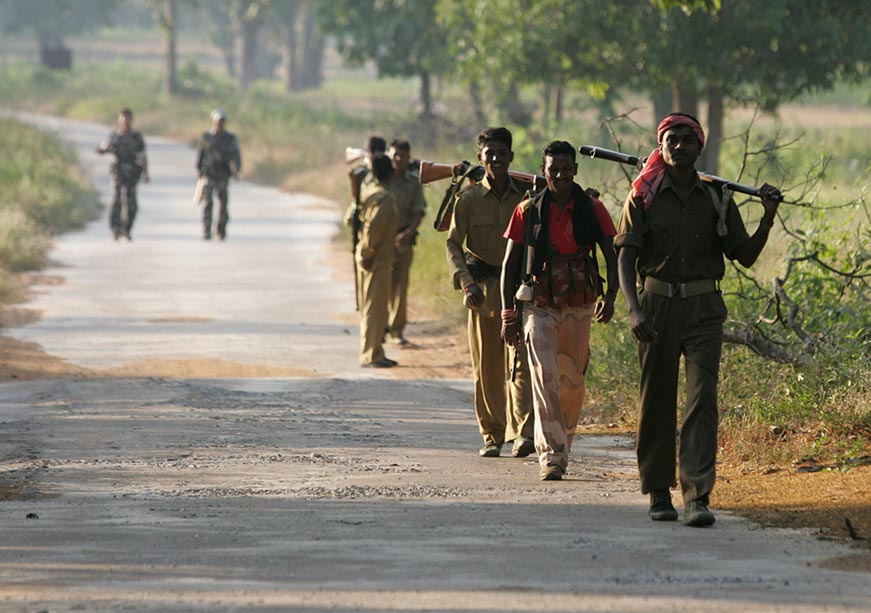
The politics of labelling certain groups or ideologies to demarcate them is emerging day by day from responsible individuals to particular groups. The most recent example is the ex
The question that deserves serious consideration, however, is not merely whom the Prime Minister intended to describe; rather, it is at what point does legitimate criticism of the people or State become Naxalism? This distinction is vital because a democracy cannot afford to confuse violent rebellion against the constitutional order with peaceful disagreement with the government of the day.
What is Naxalism?
Historically, the term "Naxal" derives from Naxalbari, a village in Darjeeling district of West Bengal, where an armed peasant uprising took place in 1967. The movement subsequently evolved into a broader Maoist revolutionary movement, with a radical ideology advocating revolutionary transformation through armed struggle. Eventually, several Naxalite organisations adopted the objective of overthrowing the existing governance through violent revolution.
Therefore, Naxalism in its political and security context cannot simply mean "thinking differently." Its historical character includes revolutionary violence, armed insurgency, rejection of the existing state structure and, in its Maoist manifestation, the pursuit of a revolutionary alternative to the constitutional system.
A person who picks up a weapon to overthrow the constitutional power cannot be equated with a citizen or groups who pick up a pen to question the functioning of the government.
Who is a Naxalite?
A Naxalite, in the conventional political and security sense, is someone associated with the Maoist movement, particularly its revolutionary ideology, armed organisations, and violent methods.
The government is entirely justified in combating armed groups that attack civilians, security personnel and democratic institutions. The State has both the right and the responsibility to protect citizens from political violence and insurgent groups.
But the definition becomes considerably more complicated when the word "Naxal" is extended from an organisation or violent movement to a category of thought. Ideas must be examined differently from weapons.
A gun can constitute a direct physical threat. An idea, however controversial, must ordinarily be confronted through argument, evidence, law and democratic debate and procedure.
"Dimagi Naxal"
Prime Minister did not refer to anyone when he made the statement of "dimagi naxals"; he said that armed naxalism had been defeated, but the same mindset still exists. Of course, the connotation is clear to the public in the present socio-political scenario. Therefore, many came forward to criticise the prime minister's remark.
The phrase "dimagi naxal" becomes especially problematic when it is applied broadly to intellectuals, academics, writers, journalists, students or activists merely because their conclusions differ from those of the government.
An intellectual's responsibility is not necessarily to support the government nor is it necessarily to oppose the government. The intellectual's responsibility is to question, investigate, analyse, and speak according to evidence and conscience, thereby guiding the government.
Sometimes intellectuals will be wrong, and sometimes governments will be wrong. There can be a time and place when both sides are partially right or even wrong. The answer to an intellectual argument should therefore ordinarily be another argument to reach a desirable final conclusion. Calling an argument "Naxal" does not refute it.
Is critical thinking Naxalism?
Certainly not; critical thinking is one of the foundations of a democratic society. A citizen who asks, "Why?" "Who benefits?" "Is this Fair?" or "Could the government have done this differently?" is not necessarily opposing the nation. Indeed, a genuine democracy requires citizens capable of questioning authority and promoting the same.
If questioning authority itself becomes evidence of ideological extremism, democracy risks becoming a system in which citizens are encouraged to blindly obey rather than participate. The real challenge, therefore, is to distinguish critical thought from destructive ideology.
A person may strongly criticise a government and remain deeply committed to the Constitution and the nation. The State should support them and be enlightened by them, rather than exclude them.
Is the desire for social change Naxalism?
Social change is not inherently revolutionary. Indian democracy itself is a history of social transformation. Movements against untouchability, caste discrimination, bonded labour, gender inequality, child marriage and other forms of injustice required citizens to challenge established practices, and we have such initiatives before us.
Many social reforms that are now regarded as essential to Indian democracy were once controversial. Therefore, the desire to change an unjust social structure cannot automatically be described as Naxalism.
The crucial question should be how this change is pursued. Change through elections, legislation, public movements, peaceful protest, judicial intervention, education and constitutional advocacy belongs to democratic politics.
Change through assassination, armed rebellion, mob violence, coercion and the violent overthrow of the constitutional State belongs to an entirely different category and a matter to be dealt with seriousness.
Is the dream of a corruption-free society Naxalism?
If demanding a corruption-free India is Naxalism, then an uncomfortable question arises: what should an honest citizen do when confronted with corruption?
Today, it is quite common for corruption to rule from the very bottom level to the top of the administrative hierarchy. The demand for transparency, accountability, independent investigation and clean administration is not anti-national. It is a demand for better governance.
A democracy should be strong enough to tolerate the citizen who says, "The government is not doing enough to prevent corruption."
That statement may be inconvenient to a government, but inconvenience is not insurgency. It is the right of a person to live in a corruption-free state, as guaranteed by the Constitution.
Is demanding fair governance Naxalism?
Governance is ultimately exercised in the name of the people. Citizens therefore have a legitimate interest in asking whether public institutions are functioning fairly, efficiently and transparently. A citizen may or ought to question administrative decisions, allocation of public resources, government appointments, implementation of welfare schemes, police accountability, bureaucratic transparency, public funds, institutional independence, etc.
None of these questions automatically constitutes Naxalism. In fact, accountability is one of the mechanisms through which democratic institutions preserve legitimacy. A government that welcomes scrutiny becomes stronger. A government that treats every question as hostility may gradually weaken the very democratic culture that sustains it.
Is demanding an independent and fair judiciary Naxalism?
The judiciary is one of the pillars of constitutional democracy. Citizens may legitimately debate judicial appointments, judicial delays, access to justice, judicial accountability, equality before law, etc.
To demand justice that is impartial, accessible, and independent is a right, not a rejection of the Constitution. It is to demand that the State live up to its constitutional promises. The common man is unhappy with the functioning of the present-day judiciary, as in many cases justice is both delayed and denied.
A person who says, "The judiciary must be independent" is making a constitutional argument. One who advocates violence against judges or seeks to dismantle the constitutional order through armed rebellion is doing something fundamentally different.
Is demanding fair elections Naxalism?
Perhaps nowhere is the distinction between democratic dissent and anti-State activity more important than in elections. Elections are the mechanism through which citizens periodically confer political legitimacy.
Therefore, questions about electoral transparency, equal political opportunity, institutional neutrality, electoral procedures, counting processes, horse trading, the independence of electoral institutions, etc should be regarded as legitimate subjects of democratic discussion.
Questioning an electoral process does not necessarily mean rejecting democracy. On the contrary, the ability to question elections peacefully may be evidence that democratic participation is alive and active.
The appropriate response to an allegation concerning an election should be evidence, investigation, institutional review, and a transparent explanation, not merely branding the questioner.
Is protest Naxalism?
Peaceful protest has historically been one of the principal instruments through which citizens communicate with governments. The nation's independence is the result of peaceful agitation.
A democracy cannot be reduced to voting once every few years. Citizens also participate through public meetings, petitions, peaceful demonstrations, journalism, academic discussion and other constitutional means.
At the same time, peaceful protest has boundaries. Violence, destruction of public property, intimidation and attacks on citizens or security personnel cannot be justified merely by invoking dissent. One's protest should not be a hindrance to the other's rights.
Political Labelling
The political labelling as 'dimagi naxals' to the one who questions the government and its policies is very dangerous.
Once a person is labelled "anti-national," "Naxal," "communal," "fascist," "corrupt," or some other politically charged term, the discussion can shift from the person's argument to the person's identity. This is dangerous for democratic discourse.
The question should always remain: what exactly has the person said or done? If someone advocates violence, the law should act. If someone supports an armed insurgency, the State should investigate and prosecute in accordance with the law. If someone conspires against the constitutional order, the appropriate legal mechanisms should apply.
But if someone merely criticises a policy, questions corruption, demands electoral transparency, argues for judicial independence or proposes social reform, those views should first be engaged through democratic debate.
The most useful way to understand the controversy is not to ask whether someone is "pro-government" or "anti-government." The better question is: Does the person accept the constitutional framework and pursue political change through lawful and peaceful democratic means?
A citizen may be radically critical and still be constitutionally committed. A citizen may disagree profoundly with the government and still love the country.
Can one love the nation and criticise the government? The answer is absolutely yes. Governments change, political parties change, ministers change, policies change, but the nation and its constitutional institutions endure. Therefore, criticism of a government should not automatically be interpreted as hostility towards the country.
In a mature democracy, patriotism should not mean silence before power. It should mean a commitment to the country's welfare, constitutional values, and the common good, even when that requires asking uncomfortable questions.
Who decides what Naxalism is?
This is the major question: who decides what constitutes a "Naxal mind?" This is perhaps the most serious issue raised by the phrase "dimagi Naxal" today.
If the term has a precise meaning which is support for Maoist violence, armed insurgency, rejection of the Constitution and advocacy of violent overthrow, then it should be clearly defined and applied with evidence.
If, however, the term becomes sufficiently broad to include journalists who question the government, students who protest, academics who criticise policies, activists who demand reform or citizens who question elections, then the term risks becoming a political label rather than a meaningful security category.
The State possesses enormous institutional power. The citizen primarily possesses the power of voice, vote, conscience, and collective action. The greater the power of the State, the greater should be its responsibility to distinguish between threat and disagreement.
A democracy must be able to tolerate uncomfortable minds and lead them to confidence through radical changes wherever required, rather than confuse a questioning mind with an insurgent mind.
India has every right to fight Naxalism when Naxalism means armed violence, terrorism, coercion and violent attempts to overthrow the constitutional order. India's democratic strength will ultimately be measured not by how effectively it silences its critics, but by how confidently it can listen to them without fearing them.
.jpg)
.png) Cedric Prakash
Cedric Prakash
 ICPA
ICPA
 ICPA
ICPA
 ICPA
ICPA
 ICPA
ICPA
 ICPA
ICPA
 ICPA
ICPA
.jpg)
 A. J. Philip
.jpg)
.png) Jacob Peenikaparambil
Jacob Peenikaparambil
.jpg)
.png) John Dayal
John Dayal