

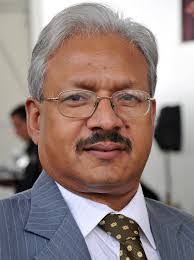
 A. J. Philip
.jpg)
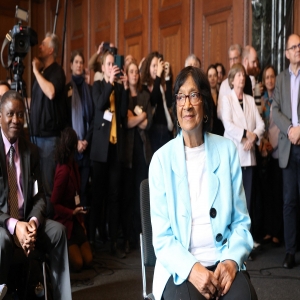
It was a friend in Houston, Texas, who first alerted me to the news that the Nobel Peace Prize for 2026 had gone to Navi Pillay, a South African jurist of Indian origin. He also sent me her photograph. Her face looked familiar. I told him I might have met her when I visited South Africa in 2006 as a journalist with The Tribune.
I had accompanied Prime Minister Manmohan Singh on his visit to South Africa to mark the centenary of Satyagraha, the method of non-violent resistance that Mahatma Gandhi first developed there. The Prime Minister also wanted South Africa's support for the India-US civil nuclear agreement. South Africa, a significant producer of uranium, was an important country to engage in the effort to end India's international nuclear isolation.
The visit brought me into contact with several prominent South Africans of Indian origin. There were receptions and official functions at which people connected with the ruling establishment were present. I also accompanied Manmohan Singh when he met Nelson Mandela. It is entirely possible that I encountered Pillay at one of those gatherings. I cannot claim certainty, but the photograph brought back memories of that visit.
Pillay, now 85, has spent her life confronting injustice. The Nobel Committee recognised her efforts to promote peace and international law, including her work in strengthening accountability for war crimes, crimes against humanity and genocide.
Yet, as I read the news, I was struck by something else. Prime Minister Narendra Modi, who is rarely reluctant to celebrate the achievements of people of Indian origin abroad, had not publicly congratulated her, at least in the immediate aftermath of the announcement. Why should a recognition of such international significance be treated differently?
Before addressing that question, let me return to my memories of South Africa, a country whose history has a special place in the story of modern India.
During Manmohan Singh's visit, he inaugurated a Gandhi museum inside a prison in Pretoria, where Gandhi had been imprisoned. The exhibits offered a glimpse into the life of a man who would eventually become one of the most influential figures of the twentieth century.
Among the objects associated with him were a pair of leather sandals he had made for his friend and prison superintendent, General Jan Smuts, a writing table, books and other personal possessions. The sandals are part of the well-known story of Gandhi's relationship with Smuts, who later acknowledged the moral force of the man he had once imprisoned.
One exhibit particularly fascinated me: a thick Bible that Gandhi had used. I managed to hold it for a few seconds and turn to his favourite passage, the Sermon on the Mount, in Chapters 5–7 of the Gospel according to Matthew, before the security personnel noticed what I was doing.
What struck me was the amount of writing and underlining in the book. It suggested that Gandhi did not merely read the Bible; he studied it. The Sermon on the Mount, with its insistence on humility, forgiveness, love for one's enemies and resistance to evil without hatred, profoundly influenced his moral thinking. He found in it a spiritual affinity with his own understanding of non-violence.
Gandhi went to South Africa as a young lawyer whose professional prospects were uncertain. He returned to India two decades later as a political leader equipped with a new method of resistance. But there is another side to Gandhi's South African experience that Indians must be prepared to confront.
A large public meeting had been planned at a stadium in Durban used for Test cricket to commemorate the centenary of Satyagraha. I remember the disappointment of those who had travelled with Manmohan Singh, including journalists like me. The stadium was almost empty. Apart from the Indian Prime Minister and his delegation, most of the people present appeared to be officials and security personnel. Ordinary South Africans were conspicuous by their absence.
We wondered why the organisers had chosen a stadium when a smaller hall would have been more appropriate. Perhaps they had expected a much larger turnout. But the absence of the public also raised a deeper question: how did ordinary South Africans, particularly Black South Africans, view Gandhi?
For Indians, Gandhi is the Father of the Nation and the apostle of non-violence. His South African years are celebrated as the formative period of his political life. Yet the Gandhi who arrived in South Africa in 1893 did not initially challenge the racial hierarchy in its entirety.
His early writings contain arguments that distinguished Indians from the Black African population and sought better treatment for Indians on the grounds of their education, social position and supposed proximity to European civilisation. In his early political campaigns, Gandhi often objected to Indians being classified alongside Africans whom the colonial authorities regarded as inferior.
His struggle was initially directed towards securing civil rights for Indians within a deeply racist system, rather than dismantling that system for everyone. Over time, his political and moral outlook evolved, and his commitment to non-violence became more universal. Nevertheless, the limitations and prejudices evident in his early South African years cannot simply be wished away.
How, then, could Black South Africans be expected to embrace Gandhi in precisely the same way as Indians did?
The question becomes even more pertinent when we consider Navi Pillay's life. Born into a poor Tamil family in Durban, she grew up under apartheid and experienced racial discrimination. Her parents' circumstances were modest, and her family background was far removed from the privileged world of the white establishment. She became a lawyer, defended anti-apartheid activists and eventually rose to positions of extraordinary international responsibility.
Pillay became the first woman of Indian origin to serve as a judge of South Africa's High Court. Her life is a reminder that the struggle for human dignity cannot be confined to the advancement of one community. It must embrace all those who are denied their rights, regardless of race, nationality or political affiliation.
The Nobel Prizes occupy a special place in the world's imagination. Although awards are given in several scientific and literary disciplines, the Peace Prize and the Prize in Literature often attract particular public attention because they engage with questions of power, morality, freedom and human experience.
South Africa has a distinguished record of Nobel recognition. Albert Luthuli received the Peace Prize in 1960 for his non-violent struggle against apartheid. Archbishop Desmond Tutu received it in 1984. Nelson Mandela and FW de Klerk shared the prize in 1993 for their work towards ending apartheid and laying the foundations of a democratic South Africa. Pillay is the fifth individual associated with South Africa to receive the Peace Prize.
India has a complicated relationship with the Nobel Peace Prize. Gandhi was nominated several times but never received it. The Nobel Committee's failure to honour him remains one of the most discussed omissions in the prize's history. In 1948, the year of his assassination, the committee did not award the Peace Prize, explaining that there was no suitable living candidate.
True, Kailash Satyarthi of India shared it in 2014 with Malala Yousafzai for their struggle against the suppression of children and young people and for the right of all children to education.
Gandhi's reputation was also contested in his lifetime. Chettur Sankaran Nair, the distinguished Malayali jurist who presided over the 1897 session of the Indian National Congress, wrote Gandhi and Anarchy, a fierce criticism of Gandhi's political methods and the consequences of his non-cooperation movement.
Political labels, however, are not permanent verdicts on history. Nelson Mandela, now universally admired as a symbol of freedom and reconciliation, was once branded a terrorist by the United States government. The African National Congress's armed struggle against apartheid led to the organisation being treated as a terrorist movement by several Western governments. Mandela remained on the US terrorism watch list until 2008, long after he had become president of a democratic South Africa.
The title of Mandela's autobiography, Long Walk to Freedom, captures the distance between the world's earlier judgement of him and the recognition he eventually received. Former US President Bill Clinton wrote the foreword to the book. History has a way of exposing the inadequacy of political labels when they are used to silence those fighting injustice.
The Nobel Peace Prize is coveted by world leaders, including Donald Trump, Benjamin Netanyahu and Narendra Modi. Each would undoubtedly welcome the international prestige it confers. Imagine the celebrations in sections of the Indian media had Modi won it. That is precisely why the prize matters. Its moral authority can transcend the boundaries of ideology and nationality, even though individual awards are sometimes controversial.
Atal Bihari Vajpayee understood this. Although he and economist Amartya Sen occupied very different ideological positions, Vajpayee attended a function honouring Sen after the latter received the Nobel Prize in Economics in 1998. Vajpayee treated his achievement as a matter of national pride, not as an occasion to scrutinise his political beliefs.
Modi, too, has often been quick to celebrate the achievements of people of Indian origin. When Kamala Harris became Vice-President of the United States, he described her success as a matter of immense pride not only for her chittis, or aunts, but also for Indian-Americans. When Indian-American singer Falguni Shah won a Grammy Award, he congratulated her as well. Such gestures are perfectly appropriate. The Indian diaspora has made contributions to many countries, and its achievements deserve recognition.
Why, then, should Pillay's Nobel Prize be any different? The answer may lie in the positions she has taken on issues that have angered powerful leaders. In 2025, she chaired a UN commission of inquiry that concluded that Israel had committed genocide in Gaza, a finding Israel rejected.
If Modi had congratulated Pillay, neither Trump nor Netanyahu might have welcomed the gesture. But diplomacy cannot consist solely of avoiding displeasure in foreign capitals. A country that aspires to global leadership must sometimes demonstrate that its principles extend beyond the convenience of its friendships.
It is not necessary for Modi to agree with every position Pillay has taken. A congratulatory message would not amount to endorsing every conclusion of every report she has chaired. It would simply recognise a South African jurist of Indian descent whose life has been devoted to human rights and international justice.
Modi should also have recalled what he himself said about the contribution of people of Indian origin when he visited South Africa. The Indian community there has made enormous sacrifices, from the indentured labourers who endured exploitation to the activists who challenged apartheid. Its history is intertwined with the history of South Africa's freedom struggle.
The Indian government may underestimate the significance of its silence. South Africans are likely to notice when the leader of a country that takes pride in its diaspora fails to acknowledge one of their most distinguished citizens. For Black South Africans, Pillay's rise from a modest family to the highest levels of the legal profession is an affirmation of their own struggle for dignity and equality.
There is an irony here. India celebrates Gandhi's South African years as the beginning of a movement that transformed him into a global icon. Yet a woman whose life reflects the unfinished struggle against racial injustice has received a Nobel Prize without an immediate public congratulation from the Indian Prime Minister.
A Nobel Prize cannot solve the problems of poverty, racial inequality or political corruption. South Africa itself continues to grapple with the legacy of apartheid, and the ANC leadership has faced serious criticism over corruption and administrative failures. In A Promised Land, former US President Barack Obama reflected on how much of the goodwill earned through Mandela's heroic struggle had been squandered under ANC leadership, leaving many Black South Africans mired in poverty and despair.
Pillay's Nobel Prize should have been an occasion for India to celebrate a woman whose roots connect her to the Indian subcontinent and whose life's work has transcended national boundaries. It was an opportunity to acknowledge the aspirations of Black South Africans and the long road they have travelled from apartheid to constitutional democracy.
Modi missed that opportunity. Perhaps he calculated that silence was safer than offending friends in Washington or Jerusalem. If so, it was a small-minded calculation for a country that claims to speak for the Global South and to uphold the values of an ancient civilisation.
.jpg)
.png) Cedric Prakash
Cedric Prakash
 ICPA
ICPA
 ICPA
ICPA
 ICPA
ICPA
 ICPA
ICPA
 ICPA
ICPA
 ICPA
A. J. Philip
ICPA
A. J. Philip
.jpg)
.png) Jacob Peenikaparambil
Jacob Peenikaparambil
.jpg)
.png) John Dayal
John Dayal