

.png) Jacob Peenikaparambil
Jacob Peenikaparambil
.jpg)
The Special Intensive Revision (SIR) exercise, conducted by the Election Commission of India (ECI) under Chief Election Commissioner Gyanesh Kumar, has sparked widespread public controversy, nationwide protests, legal challenges in the Supreme Court, and legislative opposition, including the Kerala Legislative Assembly's adoption of a resolution seeking his removal.
After an investigative report in The Indian Express revealed that the other two Election Commissioners, Sukhbir Singh Sandhu and Vivek Joshi, filed at least 14 written objections over 10 months to decisions taken under Gyanesh Kumar, numerous articles and interviews appeared in the media. Former bureaucrat RK Singh, former Chief Election Commissioner Dr SY Quraishi, and former Election Commissioner Ashok Lavasa have highlighted the alleged flaws, illegalities, and unfairness in the conduct of the SIR exercise through their writings and interviews.
The alleged irregularities include circumventing the multi-member Commission; unauthorised changes to Form-6 that create hurdles for first-time voters; centralising the database in a way that overrides the authority of local Electoral Registration Officers (EROs); mass deletions of voters' names; and shifting the burden of proof onto citizens.
Critics say the SIR exercise is undermining free and fair elections, the very foundation of democracy. Following the publication of The Indian Express investigative report, opposition parties, civil society organisations, and the Cockroach Janata Party (CJP) have protested against the ECI. Their demands include the immediate resignation of Gyanesh Kumar, an end to the SIR exercise, the restoration of the names of nearly 13 crore people allegedly deleted through the process, the withdrawal of lifetime immunity granted to Election Commissioners, and the introduction of a fair mechanism for appointing Election Commissioners to replace the Chief Election Commissioner and Other Election Commissioners (Appointment, Conditions of Service and Term of Office) Act, 2023.
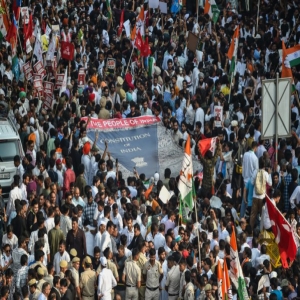
The Modi government's response to these protests has been mixed. While it adopted a heavy-handed approach against protesters at Jantar Mantar in Delhi on October 10, it took a softer approach towards the CJP's protest in Mumbai and did not respond as aggressively to the massive rally organised by opposition parties and civil society organisations towards the Supreme Court on October 12. This inconsistent response has created some confusion among the public regarding the lack of a united resistance. According to media reports, some Congress leaders have expressed doubts about the CJP's intentions because it did not join the rally on October 12. The Aam Aadmi Party (AAP) and the Dravida Munnetra Kazhagam (DMK) also stayed away from the Opposition rally.
At a press conference in New Delhi ahead of the INDIA bloc's March for Democracy to the Supreme Court, the Leader of the Opposition (LoP), Rahul Gandhi, was asked about the various demonstrations. He explicitly said these were not parallel protests but part of a single movement with a common mission.
In this context, the high-tea meeting Rahul Gandhi convened at his New Delhi residence on October 13, 2026, carries considerable significance. Gandhi is making efforts to bring different protesting groups together on a common platform to strengthen their collective impact. The meeting brought together leaders of 16 opposition parties belonging to the INDIA bloc, civil society representatives, and student activists to strategise a united movement against the SIR exercise and demand the resignation of Chief Election Commissioner Gyanesh Kumar. According to reports in The Hindu, Rahul Gandhi's office tried to contact the CJP leadership through an intermediary, but CJP representatives ultimately did not attend the meeting at his residence.
Nevertheless, Rahul Gandhi appears determined to bring the CJP onto a common platform with the other protesters. He has strongly condemned the arrest and five-day judicial custody of CJP leaders Sourav Das and Ashutosh Ranka in Delhi. In a post on X on October 14, 2026, the Leader of the Opposition in the Lok Sabha wrote:
"Jailing youth for it is an act of cowardice. Students. Youth. Journalists. The INDIA bloc. Different banners, one cause. All protests are one: citizens demanding their constitutional rights. Jantar Mantar belongs to the people of India. We will reclaim it."
Besides Gandhi, several INDIA bloc leaders have expressed solidarity with the CJP leaders Sourav Das and Abhishek Ranka. Dipankar Bhattacharya, general secretary of the Communist Party of India (Marxist–Leninist), said that "Jantar Mantar belongs to the people and the whole world knows it as Delhi's most common protest site." He described the custody of the CJP leaders as a "ridiculous punishment" and declared, "India shall not brook this arbitrary order. Reclaim Jantar Mantar."
The CJP has played a crucial role in mobilising young people to question the government and demand accountability, particularly on examination paper leaks. Its efforts contributed to mounting pressure on the Modi government that led to the removal of Dharmendra Pradhan as Union Education Minister. The CJP has also helped dispel the fear of the Modi-Shah government among young people. Therefore, bringing the CJP into the common struggle is essential for strengthening the movement.
The Modi government has a track record of brutally suppressing protests of various kinds. Although the government eventually withdrew the three controversial farm laws, it adopted harsh measures to suppress the farmers' agitation. In addition to using water cannons, tear gas, and police baton charges (lathi charges) to stop farmers' convoys marching towards Delhi, the police installed multilayered concrete barricades, barbed wire, and iron nails embedded in roads at major protest sites, including Singhu, Tikri, and Ghazipur.
The Modi government appears unsettled by revelations of malpractice in the Chief Election Commissioner's functioning and by protests demanding Gyanesh Kumar's resignation, the rollback of the SIR exercise, and the restoration of names deleted from electoral rolls through the process. Critics attribute the measures taken against protesters from the CJP, the AAP, and Left political parties on October 10 to the government's fear of growing public resistance.
The government does not appear willing to engage in dialogue with opposition parties and young protesters on the issues of Gyanesh Kumar's resignation and the SIR exercise. Statements by some BJP leaders defending the Chief Election Commissioner and the revision process indicate that the government is prepared to protect Gyanesh Kumar at any cost, even at the expense of democracy and the interests of the people of India.
The government's approach appears confrontational, seeking to suppress dissent and resistance rather than address the concerns raised. Consequently, an immediate resolution to the confrontation between the people and the government may be difficult to achieve. Opposition parties, civil society organisations, and young people must therefore prepare themselves for a prolonged struggle to safeguard democracy.
Rahul Gandhi indicated this in his press conference before the march towards the Supreme Court on October 12. He stated explicitly, "We are committed to fighting to the very end to restore the democratic process." He also clarified that the march was not a one-day political event but part of a long-term struggle.
The AAP, the DMK, the CJP, and all who cherish democracy and the Indian Constitution must join the united Opposition to strengthen the struggle to save Indian democracy. Differences in political affiliations, organisational identities, and protest methods should not hinder collective action when the fundamental principles of democracy are at stake.
United resistance is the need of the hour. Only a broad-based and sustained movement involving political parties, civil society organisations, students, young people, and all democratic forces can effectively challenge attempts to undermine democratic institutions. Without free and fair elections, democracy risks degenerating into an electoral autocracy.
.jpg)
.png) Cedric Prakash
Cedric Prakash
 ICPA
ICPA
 ICPA
ICPA
 ICPA
ICPA
 ICPA
ICPA
 ICPA
ICPA
 ICPA
ICPA
.jpg)
 A. J. Philip
Jacob Peenikaparambil
A. J. Philip
Jacob Peenikaparambil
.jpg)
.png) John Dayal
John Dayal