
.png) John Dayal
John Dayal
.jpg)
On September 18, 2025, Leader of the Opposition in the Lok Sabha Rahul Gandhi called a press conference in New Delhi and accused the Election Commission of India of facilitating what he called "vote chori," or vote theft.
Alleging that electoral rolls had been manipulated through the addition and deletion of voters, potentially influencing election outcomes in favour of the ruling Bharatiya Janata Party (BJP), Gandhi questioned the conduct of Chief Election Commissioner Gyanesh Kumar and accused the Modi government of undermining the independence of the institution constitutionally entrusted with safeguarding free and fair elections.
He charged that the machinery responsible for protecting Indian democracy was failing to discharge its responsibilities. Though the Election Commission rejected the allegations, the controversy grew as Gandhi repeatedly returned to the issue, arguing that electoral manipulation threatened the foundations of representative government.
At the Congress rally at Ramlila Maidan on December 14, 2025, he renewed his attack, warning that the Election Commission's conduct would seriously undermine public confidence in elections.
For months, the dispute stayed largely within the familiar boundaries of Indian political confrontation, with the opposition demanding accountability and the government dismissing its allegations, but nearly a year after Gandhi's September 2025 press conference, the controversy took on a new, more consequential dimension.
On September 23, 2026, The Indian Express published an investigation reporting that two of the three Election Commissioners, Sukhbir Singh Sandhu and Vivek Joshi, had formally objected at least 14 times in 10 months to decisions Chief Election Commissioner Gyanesh Kumar made without their knowledge.
The investigation brought the internal disagreements of a constitutional institution into the public domain, giving the opposition's allegations renewed political force. The political reaction was immediate as Rahul Gandhi accused the BJP, the RSS and the Election Commission of committing "an act of treason." At the same time, Jammu and Kashmir Chief Minister Omar Abdullah asked a question that resonated far beyond the immediate controversy: "If people's trust in the election is lost, then what is left in democracy?"
For the opposition, the two commissioners' objections were a serious warning about institutional transparency and accountability. Though the government and the Election Commission disputed the opposition's interpretation, the controversy had moved beyond party statements and press conferences into a much wider public debate.
A new generation of politically engaged young people, mobilised through social media and increasingly impatient with conventional political processes, found a rallying point in the controversy.
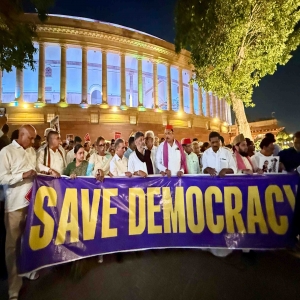
On October 2, the CJP called for a nationwide "Save Democracy" march with demonstrations in Delhi, Mumbai, Patna, Lucknow and Ahmedabad, and protesters demanding the resignation of Chief Election Commissioner Gyanesh Kumar and the restoration of the names of approximately 130 million voters reportedly removed from electoral rolls during the revision exercise.
The authorities' response quickly became another source of controversy, and Delhi saw extensive police deployments, barricades, movement restrictions, and preventive detentions as demonstrators tried to reach Jantar Mantar, a traditional site of political protest.
Reports described the closure of scores of metro stations, the cancellation of more than 200 trains across the country, and restrictions on internet connectivity around protest areas.
Journalists and activists alleged that they had been prevented from reaching demonstrations or detained while documenting police action, while videos circulating online appeared to show protesters being carried into police vehicles.
The confrontation became more disturbing when three female journalists and an activist alleged on October 4 that they had been molested by male police officers during the protests. One journalist alleged that a senior officer had touched her inappropriately when she questioned the detention of student leader Neha Bora near Kerala House, while another said that a policeman had rubbed against her as she filmed the detention of activists Yogendra Yadav and Prashant Bhushan.
The complaints prompted a protest by journalists and were eventually referred to the Crime Branch for investigation, with the police undertaking to examine CCTV footage as concerns mounted about the treatment of demonstrators and the accountability of the security forces.
On October 6, Rahul Gandhi and several opposition MPs staged a sit-in at Akashvani Bhawan in Delhi for more than eight hours, demanding the resignation of the Chief Election Commissioner as the opposition sought to challenge what it regarded as the official narrative surrounding the electoral controversy.
The Election Commission declined to meet the delegation, calling its request for a meeting outside the Commission's headquarters unusual and saying it had offered to receive a memorandum through an authorised representative.
The opposition rejected this explanation, arguing that an institution facing serious questions about its functioning had a responsibility to engage with elected representatives.
The sit-in ended when Delhi Police moved to clear the protesters, detaining Rahul Gandhi, Priyanka Gandhi and other opposition leaders. The detention of the Leader of the Opposition became a powerful political image, reinforcing the argument that the dispute had expanded from an electoral controversy into a confrontation over the right to dissent and the ability of opposition leaders to hold constitutional authorities accountable.
Yet it was Neha Bora, the 29-year-old president of the All India Students' Association and a PhD scholar at Jawaharlal Nehru University, who increasingly came to represent the energy and unpredictability of the youth movement.
After ending a 23-day hunger strike at Jantar Mantar, Bora became one of the most recognisable faces of the agitation, her participation linking the electoral controversy to a wider generation of students and young citizens who felt conventional political channels were insufficient to address their concerns.
On October 11, Bora called for a march from RK Ashram Marg Metro station towards Connaught Place, with the intention of reaching Jantar Mantar. As police attempted to control the gathering, she broke into a run towards Connaught Place, with protesters following her through the streets, eventually reaching Connaught Place before police caught up with the group shortly afterwards and detained her.
The authorities had already taken extensive measures to prevent a major demonstration planned for the weekend of October 10–11 and thousands of police and paramilitary personnel were deployed across the capital; protesters were detained before they could reach the designated site, and restrictions affected public transport and movement in several areas.
The government also announced that demonstrations would no longer be permitted at Jantar Mantar and identified alternative venues where protests would require prior permission, a move immediately opposed by Rahul Gandhi and the Opposition and youth groups who continue to test the police in guerrilla moves to stage token protests on the way to the old site of demonstrations.
The restrictions did not extinguish the movement. Instead, demonstrations and smaller gatherings appeared in different parts of Delhi, including areas around Gurdwara Bangla Sahib and the INA district.
Journalists, lawyers, students and activists were among those detained. The scale of the police operation attracted international attention. Thameen Al-Kheetan, spokesperson for the United Nations human rights office, expressed concern about reports of mass detentions and called on Indian authorities to respect the right to peaceful assembly, exercise restraint and release those arbitrarily detained.
The Indian government, however, rejected outside criticism of how it handles domestic affairs.
On October 12, Rahul Gandhi led what the opposition called the "March for Democracy" towards the Supreme Court, taking the confrontation from the streets to the judiciary, where eleven INDIA bloc leaders had filed a joint petition challenging the Special Intensive Revision of electoral rolls and seeking access to Election Commission records, alongside the establishment of an audit panel.
The march brought together two very different faces of the agitation, with Rahul Gandhi representing the established parliamentary opposition, and Neha Bora representing a younger movement that had emerged outside the conventional structures of party politics.
Chief Justice Surya Kant declined to meet the opposition MPs because the matter was already before the court, but assured them that the court would hear any petition at the earliest opportunity in accordance with the law; the BJP then accused Gandhi of trying to pressure the judiciary.
What began with Rahul Gandhi's allegations of "vote chori" has therefore developed into a far wider confrontation over the credibility of elections, the independence of constitutional institutions and the right of citizens to question the exercise of state power.
The movement's demands remain clear: the resignation of Chief Election Commissioner Gyanesh Kumar, the restoration of eligible voters' names, and a thorough examination of the Election Commission's procedures.
Yet the mass detentions, restrictions on demonstrations and allegations of police misconduct have made the protests about more than the electoral rolls.
They have become a test of whether democratic institutions can respond to criticism without treating dissent as a threat, and whether the right to peaceful assembly can be protected even during periods of intense political conflict.
They reflected the convergence of public distrust, institutional controversy and a generation increasingly unwilling to leave questions of democratic accountability to established political parties alone.
Whether the movement will achieve its demands remained uncertain, but it has already forced the country to confront the integrity of its elections and the responsibilities of those entrusted with protecting them.
The days that shook India are not over.
They had only just begun.
.jpg)
.png) Cedric Prakash
Cedric Prakash
 ICPA
ICPA
 ICPA
ICPA
 ICPA
ICPA
 ICPA
ICPA
 ICPA
ICPA
 ICPA
ICPA
.jpg)
 A. J. Philip
.jpg)
.png) Jacob Peenikaparambil
John Dayal
Jacob Peenikaparambil
John Dayal