

.png)
In Darjeeling's misty tea gardens, where generations of tea workers live in silence and struggle, two missionary traditions — the Jesuits and the Salesians — quietly brewed a different harvest: hope. At Singla Tea Estate, Jesuit Father (Dr) KL George remembers parents who once had to be coaxed into sending their children to school; today, descendants of those same families proudly escort them to class.
In nearby Sonada, Salesian Brother (Dr) PA Jose recalls youth rallies, community welfare schemes and women's workshops that turned isolated villages into centres of learning and leadership. And in Balasan Valley, Dr Sushna Subba describes Italian Salesian Father Luigi Jellici as a "walking Jesus," whose simple greetings and scholarship programs lifted entire communities across faiths.
Together, these two mission models transformed tea workers from marginalised labourers into empowered citizens, proving that faith and education can change people's destinies.
Their stories were shared at the International Tea Conference hosted by Salesian College Autonomous Sonada, March 27–28, on "Darjeeling Tea: Leaf, Life & Legacy — A Multidisciplinary Exploration of Place, People, and Possibility."
Jesuit Involvement in Darjeeling
The Jesuit presence in Darjeeling dates back to 1887, when Father Henri De Pelchin and companions established St. Joseph's School, North Point. Their early focus was education and pastoral care, later extending to tribal workers in the Terai plains. St. Peter's Parish at Gayaganga, founded in 1933, became the mother parish for the region, spawning at least 17 others.
In 1991, the Singla Tea Estate workers of Darjeeling were living through a period of acute hardship, marked by low wages, insecure employment, and limited access to education or healthcare. The estate, like many others in the hills, was struggling under the weight of market fluctuations and neglect, leaving its workforce vulnerable and marginalised. It was in this context that the Jesuits began their pastoral and social engagement with Singla's tea workers, initiating literacy programs, small-scale development projects, and advocacy for workers' rights.
Father George, Associate Professor of English at St. Joseph's College, recalls the lot of workers in the Singla Tea Plantation before the Jesuits and the Congregation of Jesus (CJ Sisters) began their mission in 1991. "It was a spiritually absent community," he says. "Alcoholism, gambling, and domestic violence were rampant. Parents had to be compelled to send their children to school. Today, the same parents insist on admissions and personally escort their children daily. That is the most significant change."
At Singla, CJ Sisters (formerly Loreto) opened a school in 1991, with Mr Prem Kumar Subba offering his house for classes. Sister Amalia pioneered adult literacy through evening schools. Over three decades, the mission reduced caste discrimination, promoted women's empowerment, introduced savings schemes, and encouraged skill development in tailoring, carpentry, mushroom cultivation, and bee farming. "We even distributed pigs and goats to the poor for income generation," Father George notes.
Salesian Outreach: From Seminary to Social Action
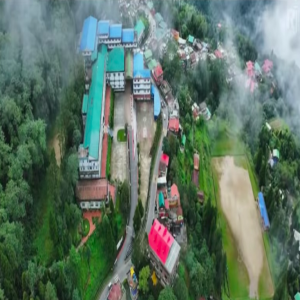
In parallel with the Jesuit mission, the Salesians of Don Bosco established Salesian College, Sonada, in 1938. Initially a residential college for Salesian seminarians, it transformed into a hub of community engagement with tea garden communities in 1963, when students, inspired by the pastoral zeal of Fr Luigi Jellici—the "wandering priest"—began working directly with youth from the estates.
At a time when tea garden families faced cycles of poverty and neglect, Fr Jellici encouraged the seminarians to step beyond the classroom and bring education, cultural activities, and social awareness programs into the gardens. This pioneering initiative not only offered literacy and hope to marginalised youth but also instilled in Salesian students a lasting sense of social responsibility. It marked the beginning of a legacy of engagement that continues today, with the College positioning itself as a hub for youth leadership and women's empowerment of Darjeeling's tea and coffee stakeholders.
"We moved from charity-based outreach to participatory and rights-based frameworks," explains Vice Principal of Salesian College, Sonada, Brother (Dr) PA Jose. "Our youth centres, vocational training, and Radio Salesian 90.8 FM - The Voice of the Hills have become platforms for empowerment."
The college operates 24 youth centres in tea garden areas. These host leadership training, sports, cultural competitions, and annual youth fest that once drew Everest hero Tenzing Norgay. Outreach includes repairing roads, supplying drinking water, providing basic medicines, and setting up village schools. Health initiatives ranged from dispensaries and vaccination camps to drug abuse awareness and paramedical training.
Brother Jose highlights women's empowerment programs: "We collaborate with Tea Promoters India and hold workshops on healthcare, mother and child welfare, domestic violence, parenting, and self-help groups. In 2025 alone, nearly 300 women participated across multiple villages. Empowering women meant empowering entire families."
Father Luigi Jellici: "Walking Jesus" of Balasan Valley
No account of the Salesian presence in the Darjeeling hills is complete without Father Luigi Jellici, whose ministry in the Balasan Valley and surroundings stretched over four decades. What began in 1963 with five Catholic families grew under his care into more than 406 families spread across 24 mass centres in 2009, when he was transferred to Mirik. For over 20 years, he had served as Organist and Choir Master at the Cathedral of the Most Holy Rosary in Calcutta, before throwing himself wholeheartedly into the demanding mission of the tea gardens from Sonada.
Dr Subba, quoting Archbishop Thomas D'Souza of Kolkata, calls him "a walking Jesus." She explains: "He refused vehicles, choosing instead to walk to every village. His simplicity and humility won trust across religions. Hindus and Buddhists often said he helped them become better Hindus and Buddhists."
Father Jellici's scholarship programs reached as many as 1,500 students from tea garden communities, many of whom today serve as teachers, healthcare workers, and leaders. His choirs brought dignity to the liturgy, while his catechism classes combined prayer with lessons in hygiene and social responsibility. "He believed in inculturation and dialogue," Dr Subba notes. "Non-Catholics embraced values of discipline, honesty, and service. His legacy is the rise of an educated middle class from the tea gardens."
Transformation Beyond Tea
The combined impact of the Jesuits and the Salesians is evident in the lives of beneficiaries. From Singla alone, five girls joined religious life, five youngsters became government school teachers, and others excelled in higher education and professional careers. One became a Buddhist monk, reflecting the mission's interfaith respect.
Brother Jose says: "Salesian College Sonada exemplifies integration of education with social commitment. Our motto, Flama Ardens et Lucens — Burning and Shining Flame — reflects our mission to light up communities."
Dr Subba concludes: "The tea gardens are no longer just sites of labour. They are sites of human dignity, cultural preservation, and social mobility. The Jesuit and Salesian missions show that faith and education together can transform marginalised communities."
Replicable Model
Both missions stress replicability. The Singla model, with its emphasis on education, skill development, and family values, is proposed for all tea gardens of Darjeeling and the Terai. The Salesian model, with youth centres, vocational training, and community radio, offers higher education institutions a blueprint for integrating academic excellence with social responsibility.
As Darjeeling tea continues to enchant the world, its workers now carry stories of resilience and renewal. The Jesuits and Salesians have brewed not just tea, but hope — steeped in faith, education, and service.
.jpeg)
 A. J. Philip
.jpg)
.png) Jacob Peenikaparambil
Jacob Peenikaparambil
.jpg)
.png) John Dayal
John Dayal
.jpg)
 Pachu Menon
.jpg)

.png)

.png)
.png) Robert Clements
Robert Clements
.jpg)